What Makes Alabasta Feel Like a Political Thriller?

Alabasta feels like a political thriller because the arc’s tension runs through institutions, rumors, and public mood—not just who hits harder. If you’re sea…

Alabasta feels like a political thriller because Crocodile’s real weapon is not his Devil Fruit. It is a country-wide crisis built on drought, fear, false evidence, and collapsing trust.

So, what makes Alabasta feel like a political thriller rather than a standard One Piece adventure? The Straw Hats can win fights, but defeating Crocodile alone cannot stop the royal army and rebel army from killing each other. To save the kingdom, the truth has to reach people before the crisis becomes irreversible.

That gives the arc a different kind of tension. Fights matter, but so do rumors, public image, deadlines, and who controls the facts. For a full event-by-event guide, see Alabasta Arc One Piece Explained: Story, Battles & Why It Matters.

Why Alabasta Turns One Piece Political

Alabasta is political because it shows a whole society under pressure. The drought affects daily life. People need water, answers, and someone to blame. King Cobra has authority, but authority means little when the public no longer trusts him.

Crocodile understands that weakness. He does not take over as an obvious invader. Instead, he lets the kingdom blame itself while Baroque Works pushes each side toward violence.

The arc makes one crucial distinction:

  • Winning a fight removes a threat in front of you.
  • Ending a political crisis means changing what frightened people believe and do.

Crocodile can lose a fight while the civil war continues. That is why the climax has so much pressure. Alabasta will not wait for Luffy to finish a duel.

The story is not a realistic political drama with no room for pirates, comedy, or superpowers. It uses those elements to make a political conflict easy to feel. A drought becomes personal when people cannot get water. A rumor becomes dangerous when it sends an army marching. A trusted hero becomes frightening when viewers know that trust was part of the trap.

The Political-Thriller Checklist

Political thrillers create suspense through systems as well as villains. Someone must work out who is shaping events, what ordinary people have been told, and whether the truth can arrive before violence does.
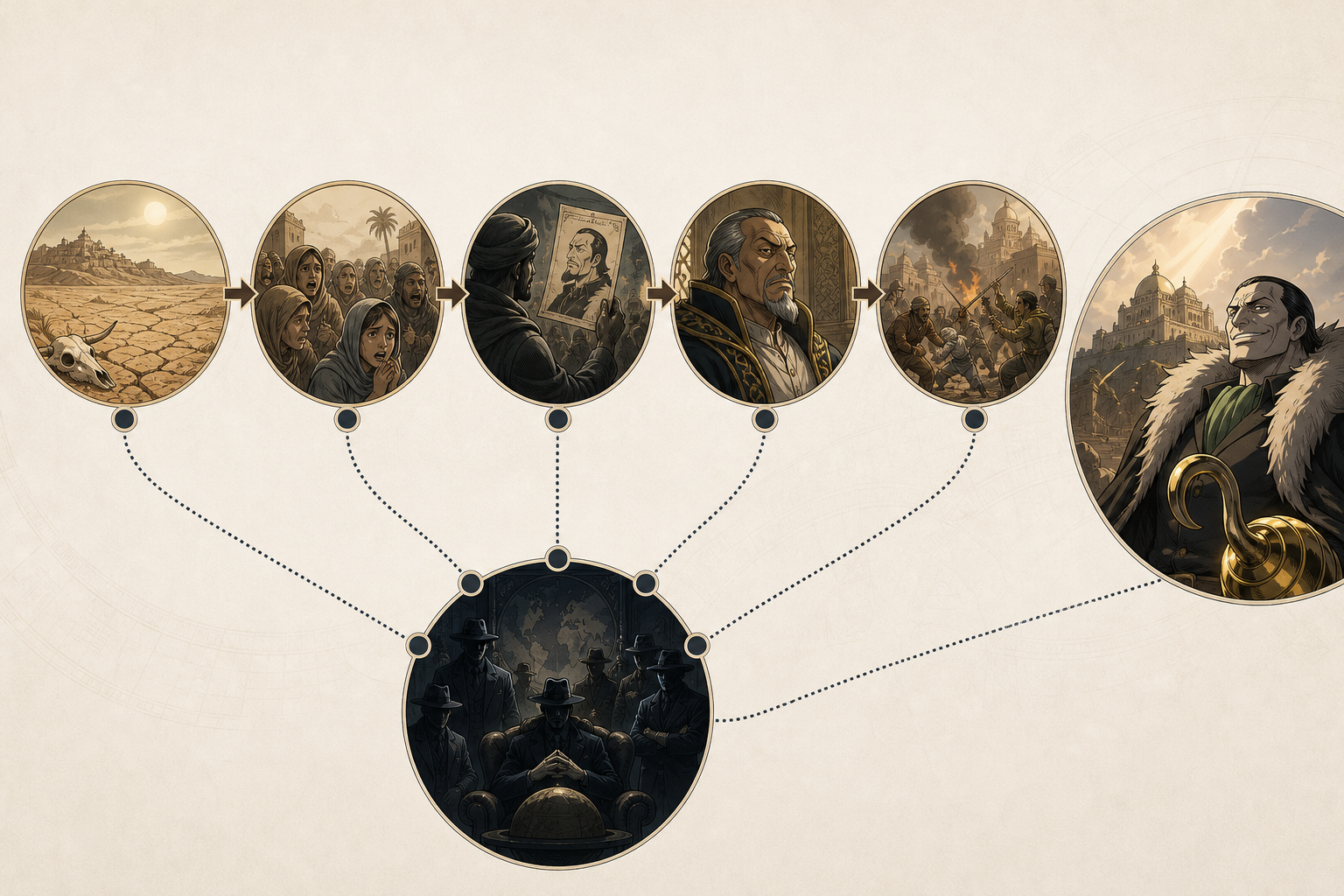
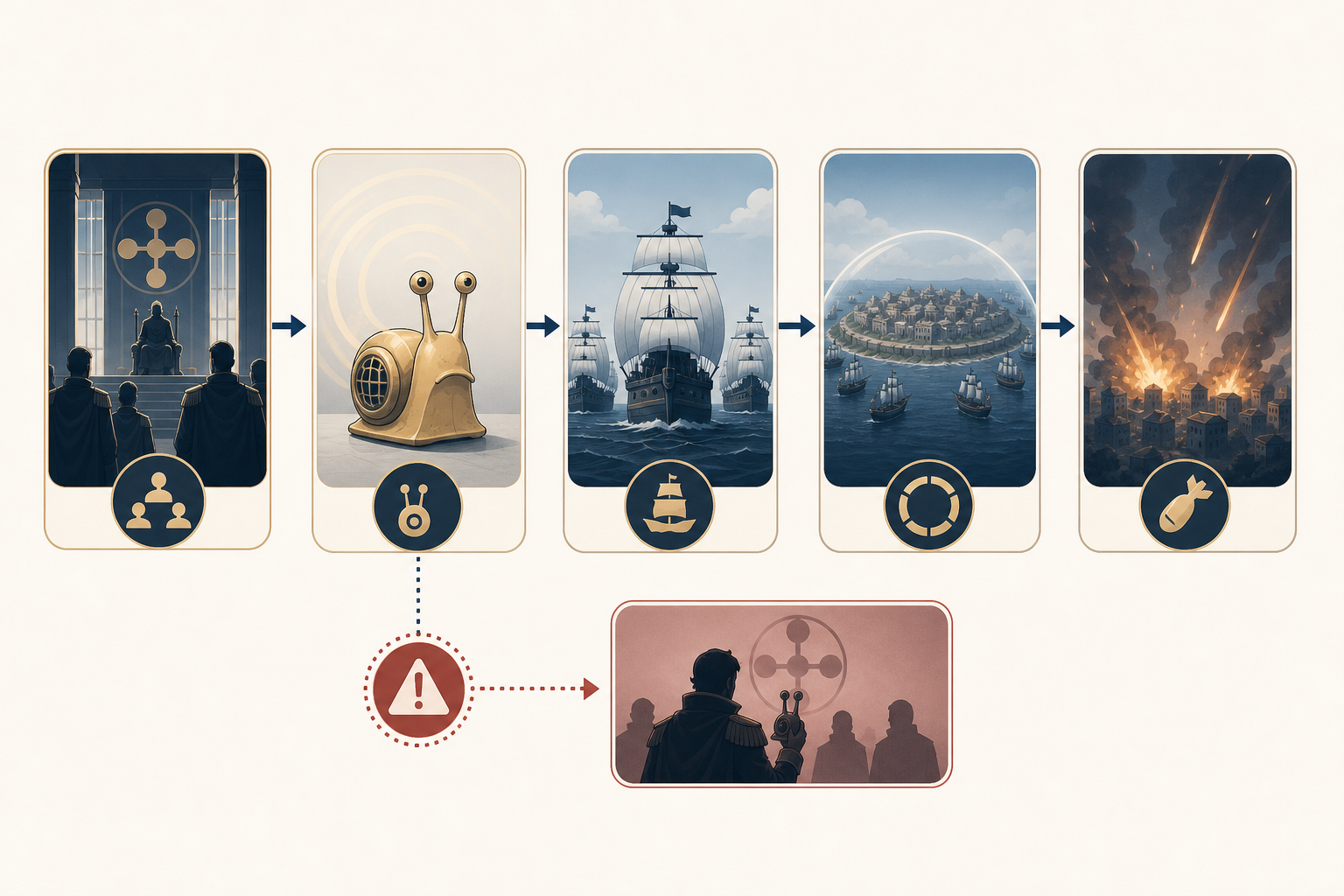
Diagram of how Crocodile turns drought and misinformation into civil conflict in Alabasta.
Crocodile’s plan works because each stage makes the next lie easier to believe.

Alabasta checks nearly every box:

Plot device How it works in Alabasta Why it matters
Scarcity The drought turns water into a source of fear and blame. People in crisis need answers quickly.
Propaganda Rumors and staged events make the royal family look guilty. Citizens act on a false story.
Public legitimacy Crocodile has a trusted public image. The person behind the crisis can appear to be its savior.
Covert operations Baroque Works uses code names and separate agents. It is hard to see the full plan at first.
Competing groups The crown, rebels, Marines, and civilians know different things. No single group can fix the crisis alone.
Ticking clock Civil war and the bomb plot create urgent deadlines. Even a late victory may cost lives.
Civilian stakes The people of Alabasta bear the cost of escalation. The conflict matters beyond the main cast.

This is the arc’s real engine. Viewers are not only asking, “Who will win?” They are asking, “Can the truth reach people before they act on a lie?”

That framework also works beyond Alabasta. When another One Piece story introduces a public crisis, look for the same ingredients: a real grievance, incomplete information, a figure with official cover, and someone who benefits from a rushed response.

Drought, Distrust, and Partial Information

The desert setting is more than atmosphere. The drought makes ordinary life harder, which makes the kingdom easier to destabilize.

When people are thirsty and scared, they do not need to be foolish to believe the worst about their leaders. They have real reasons to be angry. Their pain is genuine. Crocodile’s trick is to give that pain a false cause.

That makes the rebellion tragic. The rebels are not mindless crowds. They believe the government has failed them. Their conclusion is wrong, but it grows from suffering that cannot be ignored.

Why scarcity works so well

Scarcity creates urgency before the final battlefield. A resource crisis changes how every rumor lands. If life feels stable, a claim about government failure may invite skepticism. If people are already struggling, the same claim can feel like proof of what they see every day.

Crocodile does not need every citizen to be gullible. He only needs the lie to feel believable enough that anger can do the rest. The scheme succeeds because it attaches itself to a real problem.

Everyone sees only part of the truth

Most major groups in Alabasta have limited information:

  • The royal government is trying to hold the kingdom together.
  • The rebels believe peaceful options have failed.
  • Civilians react to the stories around them.
  • The Marines have their own duties and incomplete knowledge.
  • Baroque Works benefits whenever confusion grows.

A sincere character can make a terrible choice when they have been given bad information. On a rewatch, ask two questions: Who benefits if people panic? And who benefits if people wait? In Alabasta, both questions lead back to Crocodile’s plan.

Crocodile Manufactures Trust

Crocodile is dangerous because he understands reputation as well as power.

He is not an enemy hiding in a distant fortress from the start. His public identity gives him trust. That lets him work in the open while Baroque Works works in secret.

A hated villain has to overpower resistance. A respected villain can make resistance look unreasonable. Warnings about Crocodile sound less convincing when he already looks like a hero.

For a closer look at his role and Operation Utopia, read Crocodile One Piece Explained: Powers, Role & Season 2.

Power needs legitimacy

Crocodile does not merely seek power; he seeks legitimacy first. He builds a public identity that makes people ready to see him as a protector. Then he uses that trust as cover for a scheme that harms the country.

The audience knows his image is false, while many people in Alabasta have no reason to doubt it. This creates dramatic irony: viewers can see the danger before the people affected by it can.

His plan attacks two things at once. It weakens confidence in King Cobra and makes Crocodile look dependable by comparison. The problem is not only that the truth is hidden. A more convenient story has already taken its place.

Official status is not accountability

Crocodile’s Warlord status adds another layer. His title gives him public and institutional credibility, even though it does not prove that he serves the public interest.

Alabasta uses this to ask a simple question: what is the gap between power and the appearance of power? A title, uniform, or official role can shape public opinion long before people know the truth. That idea becomes more important as One Piece explores law and authority in later stories. For a wider look at that theme, see What Is Absolute Justice In One Piece? – In Depth!.

Baroque Works Turns Conflict Into a Network

Baroque Works is more than a lineup of opponents for the Straw Hats. It is a covert network designed to worsen a national crisis.

Its agents use code names and separate assignments. That keeps the full plan hidden. One person can carry out an order without knowing every detail, while Crocodile stays distant from the damage.

This is why raw strength is not enough. Defeating one agent does not reveal who controls the next move.

The Straw Hats enter Alabasta as outsiders. They have to learn the country’s conflict while moving through it. At first, separate incidents can seem random. Then the arc shows how carefully they fit together. That is a thriller structure: the heroes are solving a case while trying to survive it.

Infiltration makes the kingdom feel unsafe

A straightforward invasion would make the enemy easy to identify. Baroque Works makes danger harder to locate because its work is spread across the country. The network can influence events without looking like a single occupying force.

The organization also turns information into a weapon. Code names hide responsibility, and separate jobs make it hard for any one character to see the whole picture. The protagonists are always catching up to a plan already in motion.

Vivi Makes the Crisis Personal

Vivi gives Alabasta its emotional center. Her goal is not simply to defeat Crocodile. She wants to stop her country from destroying itself.

That puts her in a different role from a typical action hero. She has to persuade people, reach the right people at the right time, and prevent violence from becoming impossible to stop.

The rebels are suffering people, not disposable obstacles. The royal forces want to protect the kingdom, but they can still make the crisis worse. Vivi needs both sides to pause long enough to hear the truth.

Negotiation is not a side quest

In a simpler battle arc, defeating the boss could be the whole solution. Alabasta refuses that shortcut. Vivi’s attempts to communicate and de-escalate are not interruptions between action scenes. They are the actions needed to save the country.

Luffy’s determination matters, and the crew’s battles against Baroque Works matter. But Vivi’s desperate effort to stop people from treating each other as enemies is just as central. The story needs fighters, messengers, witnesses, and people willing to listen.

Truth moves slower than fear

Alabasta makes a hard point: having the truth does not mean people will accept it.

The source has to seem credible. The message has to arrive in time. People must also be willing to change their minds after choosing a side. Fear moves faster. Once violence starts, every loss becomes another reason to keep fighting.

That is why Vivi’s role is the arc’s genre engine. Every minute spent chasing Crocodile’s scheme is also a minute in which people may make choices they cannot easily undo.

Why Beating Crocodile Does Not End the Civil War

The arc’s best structural choice is its separation of tactical success from political success.
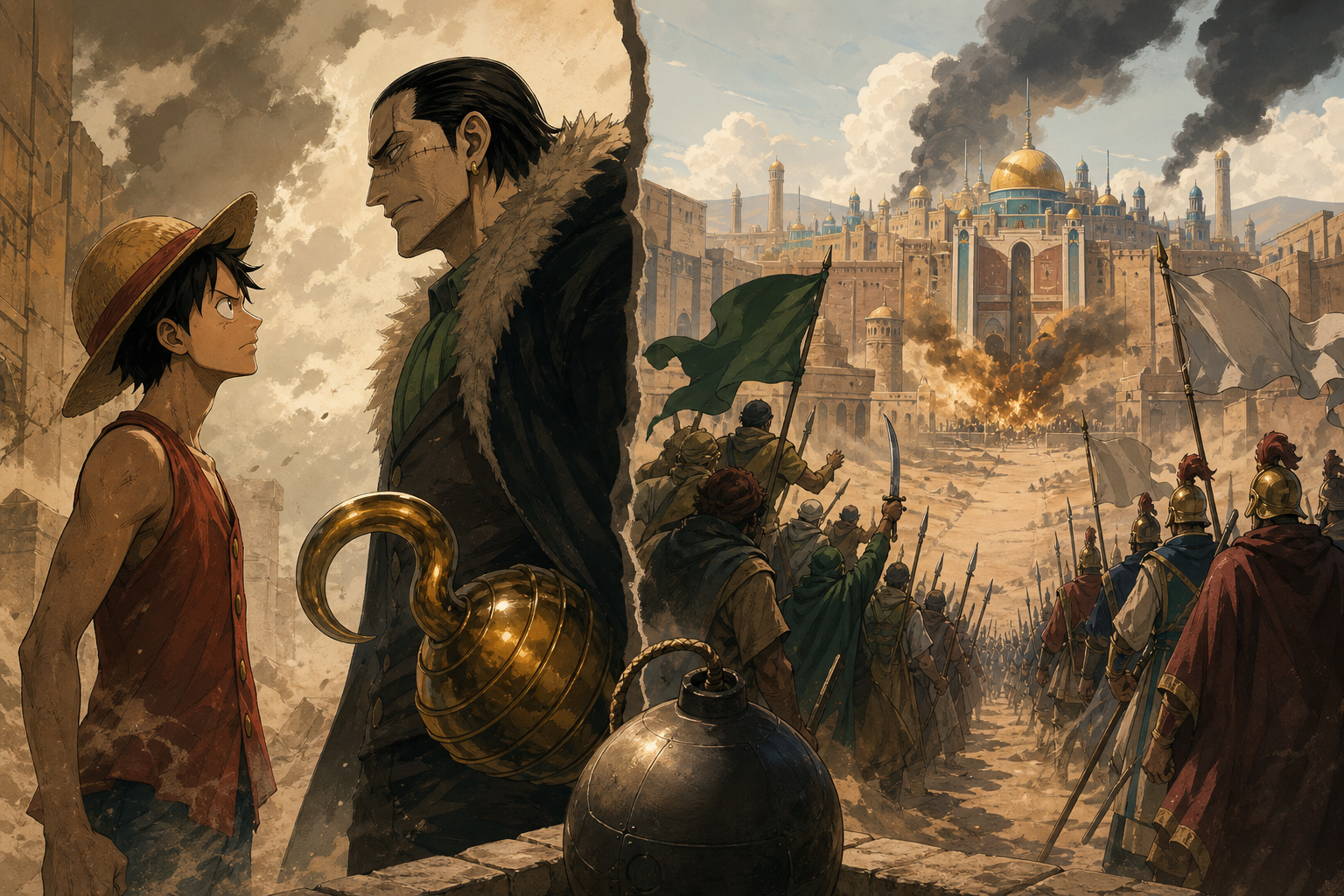
Luffy fights Crocodile while opposing forces and civilians face danger in Alubarna.
Alabasta’s finale runs on several urgent conflicts at once.

The Straw Hats can defeat Baroque Works officers. They can expose Crocodile’s role. Luffy can beat Crocodile. None of that automatically stops two armies already moving toward each other.

The conflict has momentum of its own. People have suffered losses. Leaders have made promises. Backing down can feel dangerous, shameful, or impossible.

The bomb plot makes this even clearer. It is not just one more obstacle before the ending. It is a mass-casualty threat that could make the crisis irreversible, no matter who wins the major fights.

Several deadlines run at once:

  • The rebel army is moving toward battle.
  • The royal forces are preparing to respond.
  • Baroque Works is pushing every side toward escalation.
  • The bomb threatens everyone in the city.

That is why the finale feels frantic. Some characters fight, some search, and some try to communicate. They are all trying to save Alabasta in different ways.

A real victory changes conditions

Removing the architect of a crisis is necessary, but it is not always enough. The people inside the crisis still have to learn what happened, survive the immediate danger, and stop treating each other as enemies.

This makes the resolution more mature than “the strongest person wins.” It does not lessen Luffy’s final fight. It shows why that fight matters only alongside everything else happening in the capital.

What Alabasta Says About One Piece Politics

Alabasta is one early reason people call One Piece political. The series does not only ask whether heroes can beat villains. It also asks how power affects ordinary people.

The politics are shown through consequences rather than long speeches. Alabasta shows how a government can lose trust, how an official title can shield a bad actor, and how civilians can be trapped between groups that do not know the whole truth.

It also teaches a useful habit for theory-minded fans. Separate these three things:

  1. What happened.
  2. What characters think happened.
  3. Who benefits from the gap between those versions.

That lens fits many later mysteries without requiring a major spoiler dump. When a character makes a frustrating choice, it is worth asking what they could reasonably know at that moment.

Was Alabasta inspired by real events?

It is best to be careful here. Without a direct statement from Eiichiro Oda, fan readings should not be treated as confirmed author intent.

Alabasta clearly uses ideas common in stories about political instability: a desert kingdom under stress, a basic resource in short supply, a ruler losing public trust, and a hidden figure who profits from conflict.

Fans have connected the arc to themes such as propaganda, anti-imperialism, and manufactured reasons for war. For example, this fan discussion of Arabasta, Skypiea, and anti-imperialism offers one interpretation. It is a fan source, not proof of Oda’s intent.

The clearest reading is in the text itself: Crocodile uses scarcity, fear, and misinformation to make a country turn against itself.

Later Arcs That Echo Alabasta’s Politics

Later One Piece arcs return to parts of Alabasta’s playbook, even when their settings and villains differ. This is a pattern-based comparison, not a claim that every later story repeats the same plot.

Manufactured crises

A recurring pattern is the engineered emergency. A public threat appears, anger is pushed toward a convenient target, and the person who gains most from the chaos stays hidden or acts helpful.

When a crisis seems unusually useful to someone powerful, Alabasta is a good reference point. It trains viewers to look past the loudest explanation and ask who shaped the conditions around it.

Official-looking power and information warfare

Alabasta also teaches viewers not to treat titles as proof of good intent. Later stories often explore people and groups that claim to represent law, safety, or order while causing harm.

The strongest echo is often the fight over public narratives: rumors, hidden history, selective evidence, and characters struggling to make the truth heard. If you enjoy sorting a popular claim from the story around it, One Piece Sabo kills Burgess – What really happened? takes a similar theory-focused approach.

The key question is not whether someone is official. It is what their status allows them to do, and who can challenge them.

Manga vs. Anime: Does Alabasta Feel Different?

The core political plot is the same in both versions, but the experience can differ.

In the manga

The manga can make the chain of cause and effect easier to track. Readers can move quickly from a rumor to its result, or from a Baroque Works move to the response it triggers. It is also easy to pause and reread a scene to check who knows what.

For readers who value momentum, that can sharpen the thriller feeling. The page-to-page pace makes the arc’s several problems feel tightly connected.

In the anime

The anime adds voice acting, music, and extended reaction shots. At its best, those elements make the kingdom-wide stakes feel immediate and emotional.

Some viewers may find the added runtime slows the urgency, especially during travel or repeated context scenes. If that happens, switching to the manga for part of the arc is a reasonable option. The manga can clarify the plot, while the anime adds performances and music to major moments.

Choose the manga if you want to follow the political machinery as directly as possible. Choose the anime if atmosphere, performances, and big emotional beats are your priority. Either version preserves the answer to what makes Alabasta feel like a political thriller: the outcome depends on more than who wins a fight.

Should You Skip Alabasta?

If you care about the larger One Piece story, it is better not to skip Alabasta.

The arc develops Vivi, introduces Robin in a major role, explores the Warlord system, and gives the series one of its first full nation-level crises. It also establishes patterns that matter later: public distrust, hidden networks, and the gap between official stories and reality.

A recap can give you the basic facts, but it cannot replace the build-up. The point is not only what Crocodile planned. It is watching distrust grow and seeing why a final fight cannot solve everything by itself.

If anime pacing is the problem, try one of these paths:

  • Read the manga for the most direct version of the plot.
  • Watch the anime, then use the manga when the pace feels slow.
  • Use a detailed recap as support, not as a replacement for key scenes.

There is also no single One Piece arc that every fan agrees is the most disliked. Opinions change by platform and format. Anime-only viewers may dislike slower pacing, while manga readers may feel differently. If an arc sounds divisive, sample a few chapters or episodes rather than relying on one ranking.

How to Rewatch Alabasta as a Political Thriller

Try these questions during a rewatch:

  • What do civilians believe right now?
  • What evidence led them there?
  • Who gains if the rebels and royal army fight?
  • What information does each group lack?
  • Is a character’s public image earned, made up, or both?
  • Which problems can a fight solve, and which require communication?
  • What must happen after the villain loses for the country to recover?

These questions make Alabasta’s construction easier to see. The arc is not only about uncovering Crocodile’s plan. It is about how that plan works because it uses fear, pain, and broken trust.

On a first watch, it is easy to focus on the final confrontation with Crocodile. On a revisit, the setup becomes more visible. Watch how often the story returns to what people think is happening, not only to what is actually happening. That distance between belief and reality is where the thriller tension lives.

Alabasta remains a key One Piece arc because it keeps the action, comedy, and emotion fans expect while adding a harder problem underneath: how do you save people when the truth alone may not be enough?

For another theory-focused look at secrets and wider conflicts in the One Piece world, continue with Baltigo One Piece – What really happened there?.
What Is the Buster Call Outside Ohara? Rules, Authority, and Limits

If you’re asking what is the buster call outside ohara, the short answer is this: it’s a repeatable World Government “wipe-the-map” protocol, not a one-time …

If you are asking what is the buster call outside ohara, it is not a separate event or a different weapon. A Buster Call is the World Government’s extreme Marine response: a large naval assault sent to destroy a location rather than handle a situation through a normal arrest or battle.

Ohara is the best-known case because of its human cost and connection to forbidden history. But Enies Lobby—and later developments that bring the idea back into focus—show that a Buster Call is a repeatable tool of state power. It can devastate an island. It cannot guarantee that every target dies, every secret disappears, or every Marine follows the plan.

For a general overview of how the attack is commonly described, see CBR’s guide to surviving a Buster Call. The details below focus on what the story’s major examples reveal about the system.

What Is a Buster Call in One Piece?

A Buster Call is an authorized Marine assault against an island-scale target. Its purpose is to overwhelm resistance, restrict escape, and remove what the World Government considers too dangerous to leave behind.

It is not a precise capture mission or a duel between elite fighters. It is a scorched-earth escalation used when the Government wants more than one enemy defeated. It wants a place—and often the people, records, and evidence connected to it—taken off the board.

That idea fits the harsh Marine policy explored in Absolute Justice in One Piece. In this world, “justice” can become the justification for extreme violence when officials decide that order matters more than individual lives.

What the operation is meant to do

A Buster Call generally aims to:

  • Overwhelm the target: Warships and senior Marine officers bring far more force than a standard pursuit.
  • Make escape difficult: A fleet can threaten coastal routes and turn evacuation into a deadly gamble.
  • Control the aftermath: Destroying buildings, records, and witnesses can help the World Government control the story afterward.

That final goal explains why Ohara matters so much. The attack was not only about defeating scholars. It was about preventing knowledge from surviving.

What it is not

A Buster Call does not automatically mean an Admiral is present. An Admiral may appear in a particular incident, but that is not the definition of the order.

It also does not mean Cipher Pol has completed its own mission. Cipher Pol often operates through infiltration, surveillance, or targeted force. A Buster Call is the blunt escalation that can follow when those methods are no longer enough—or when the Government decides precision no longer matters.

Most importantly, the order does not make the fleet all-knowing. It still depends on ships, commanders, communication, intelligence, and the ability to keep the right people trapped.

Who Can Trigger a Buster Call?

An ordinary Marine cannot simply call a Buster Call. The order requires high-level World Government or Marine authority, along with access to the special signal used to summon the fleet.

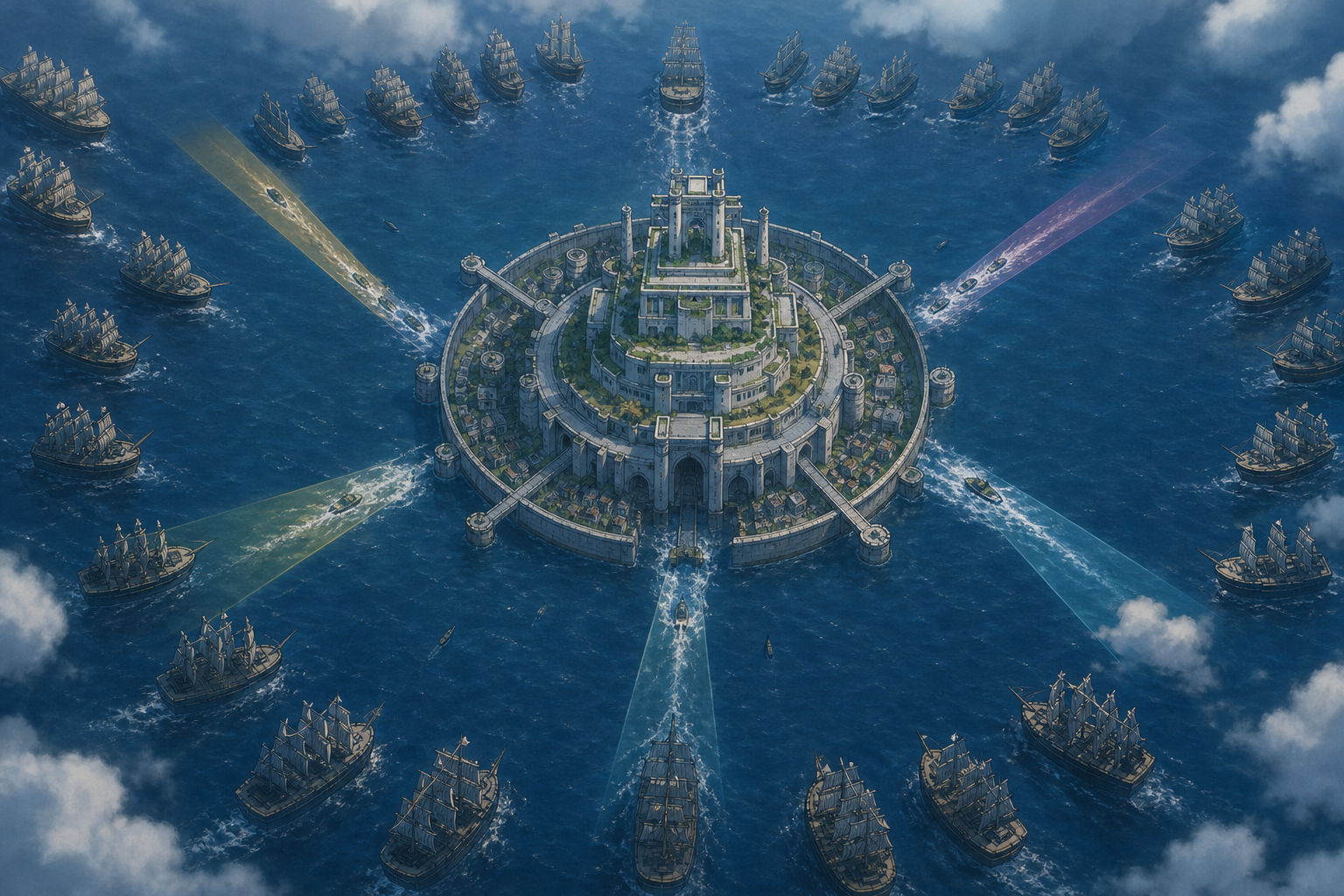
Diagram of Buster Call authorization and fleet response
The signal can summon overwhelming force, but authority and access do not always sit with the same person.

The series presents that signal as the Golden Den Den Mushi. Its limited access is supposed to make it an exceptional emergency measure. In practice, the person who can activate it can turn a local crisis into an island-wide assault.

Authority matters as much as firepower

The chain of command is part of what makes a Buster Call frightening. It turns an extreme act into a procedure. Once the order is accepted, people carrying it out can frame bombardment as duty rather than a personal decision.

That structure also creates a weakness: authority can be delegated, mishandled, or used by someone with incomplete information. Enies Lobby makes that danger especially clear.

When a Buster Call is threatened, separate two questions:

  1. Who has the political or legal power to order it?
  2. Who has the signal and can activate it?

Those are not always the same person.

The fleet is powerful, not perfect

The familiar image of a Buster Call is a group of warships led by senior Marines, firing until the target is destroyed. That gives the Government a huge advantage against a fixed island or trapped civilians.

Still, fleets have limits. Ships need time to arrive and take position. Commanders need reliable information. A hidden route, difficult coast, rough seas, or capable defender can create an opening. The Buster Call’s strength is scale, not precision.

Why Ohara Received a Buster Call

Ohara was targeted because its archaeologists studied the Void Century and the Poneglyphs. The World Government regarded that research as forbidden knowledge capable of threatening its rule.

The attack shows the Buster Call at its most severe. The goal was not simply to punish a crime. It was to erase a source of information. The scholars, their library, and the island became targets because of what they might reveal.

For the wider event, including the scholars’ work and the Government cover-up, read The Ohara Incident in One Piece.

Who saved Nico Robin in Ohara?

Jaguar D. Saul gave Robin a chance to escape. His choice matters because he refused to treat a child as an acceptable casualty of the operation.

Robin’s survival is also the clearest sign that a Buster Call can fail at total erasure. Ohara was destroyed, but the Government did not remove every witness or every piece of knowledge. Robin carried both into the future.

That survival connects Ohara to the larger mystery of the world and its lost history. For broader context, see What Is the One Piece?.

What Ohara proves about the system

Ohara shows the intended result: overwhelming force, broad destruction, and a public story that protects those in power. It also shows the system’s central weakness. The Government can destroy an island, but it cannot completely control memory, conscience, or the choices of people like Saul and Robin.

Enies Lobby and Episode 294: The Buster Call in Motion

Enies Lobby is the clearest early example of a Buster Call outside Ohara. The order unfolds during an active crisis, while the Straw Hats and their allies are still fighting to escape.

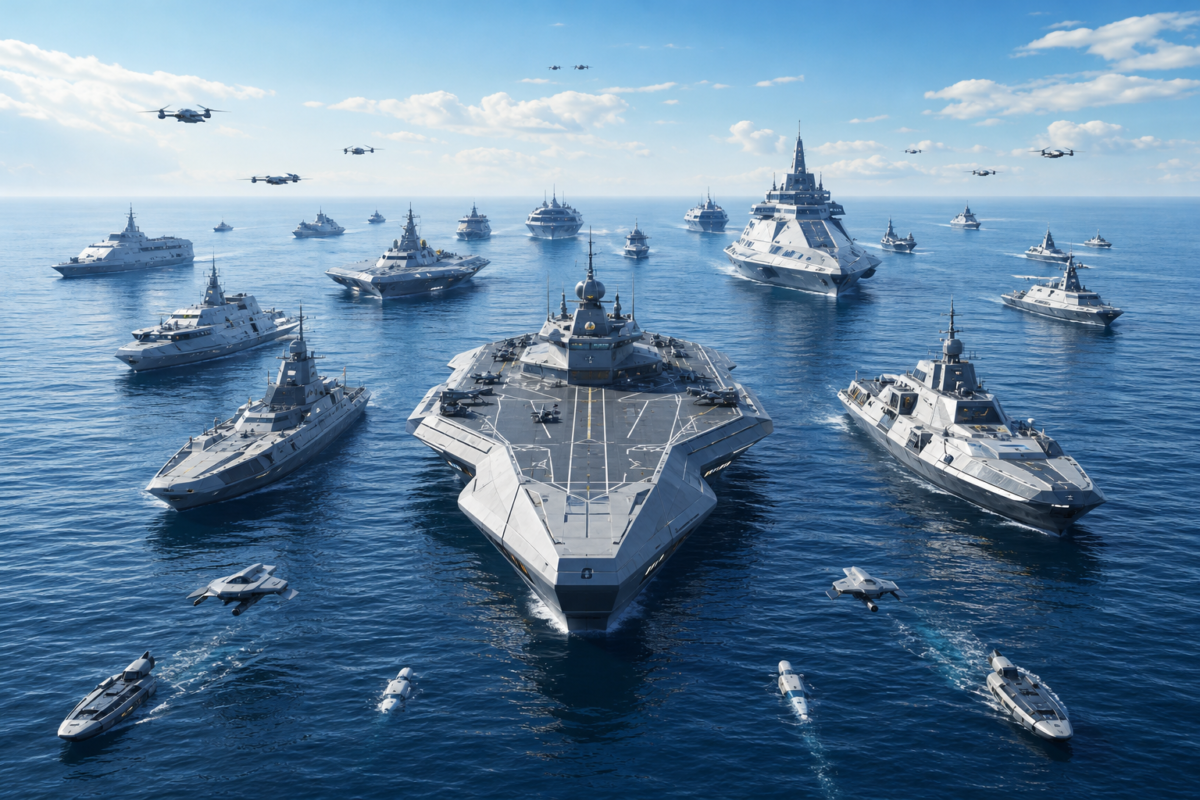
Marine warships surrounding Enies Lobby during a Buster Call
Enies Lobby shows the gap between destroying a location and securing every target.

What happens in Episode 294 of One Piece?

Episode 294 is the point at which the Enies Lobby Buster Call is invoked. The important development is not only that Marines are called in. The conflict shifts from a rescue and pursuit into a destruction order that endangers everyone nearby.

It also demonstrates why the Golden Den Den Mushi is so dangerous. One activation can summon an enormous response even when the person using it is panicking or pursuing the wrong objective.

What Enies Lobby reveals about its limits

Enies Lobby exposes several weaknesses in the Buster Call model:

  • The main targets can escape. Destroying the battlefield does not guarantee the Government captures or kills the people it wants most.
  • Friendly forces are at risk. In a confused battle, wide bombardment can threaten Marines and allies as well as enemies.
  • Bad intelligence produces bad results. A fleet can have huge firepower and still misunderstand who is where.
  • Chaos is difficult to control. A blunt attack gives commanders few clean ways to separate enemies, prisoners, civilians, and allies.
  • Organized resistance can break the plan. A rescue route, skilled crew, or unexpected intervention can defeat the intended blockade.

This is the practical answer to what is the buster call outside ohara: it is a devastating system, but it can cause massive damage without giving its leaders the control they wanted.

The Real Rules and Limits of a Buster Call

The story does not provide a neat rulebook that guarantees results. A Buster Call works better as a set of conditions that lets the Marines apply overwhelming force.

What needs to be in place

A Buster Call is most effective when these pieces line up:

  1. Authorization: Someone with the necessary standing approves or activates the order.
  2. A reachable target: The fleet needs an island, coast, or enclosed area it can surround and bombard.
  3. Fleet coordination: Ships must arrive, take position, and follow a shared command.
  4. Useful intelligence: Marines need to know where the real targets are and how they might flee.
  5. Political will: The World Government must be prepared to accept the damage and fallout of the order.

If one piece is missing, the operation becomes less reliable. A Buster Call can still do terrible damage, but damage and mission success are not the same thing.

The limits shown in practice

The Buster Call has three broad kinds of limits.

Operational limits include travel time, geography, weak communication, and escape routes. A fleet is most dangerous when it can form a perimeter before the target reacts.

Human limits include fear, mistakes, doubt, and compassion. Saul’s choice at Ohara matters because even a huge institution still relies on people to carry out its orders.

Combat limits include powerful fighters and organized allies. The stronger and more mobile the defenders are, the less likely a naval assault is to settle everything on its own.

Why Egghead Is Part of the Conversation

Fans searching for Buster Calls now often have Egghead in mind. Without getting into major plot details, Egghead returns to the same question: what happens when the World Government considers a place, its research, or its witnesses too dangerous to preserve?

The later arc does not need to change the basic definition to make the comparison useful. A Buster Call remains an escalation signal: routine enforcement has ended, and the Government is prepared to sacrifice a location to contain a threat.

The key comparison is not whether every case looks exactly like Ohara. It is whether the same pattern appears:

  • Knowledge or people are treated as unacceptable risks.
  • Containment matters more than due process.
  • The Government chooses mass force over a targeted response.
  • Survivors and hidden truths can undermine the official result.

Quick Buster Call Checklist

When a new One Piece arc hints at a Buster Call, ask:

  • Who has the power to call it?
  • Who has access to the Golden Den Den Mushi or the order itself?
  • What is the Government trying to erase: a person, an island, evidence, or history?
  • Where can people escape?
  • Which Marines might question the order?
  • Can the fleet identify its real target before it begins firing?

Ohara shows the Buster Call at its most ruthless. Enies Lobby shows why overwhelming force can still miss its true goal. Together, they make the answer clear: it is a World Government weapon of destruction and intimidation, not a guaranteed way to erase a problem.

Voice of All Things Can Hear Poneglyphs: Evidence

If you’re searching whether voice of all things can hear poneglyphs, you’re really asking one of three different questions: can someone sense a Poneglyph nea…

Can voice of all things can hear poneglyphs be treated as canon? Not yet—not if “hear” means receiving the stone’s full written message.

The story gives us a real connection between the Voice of All Things, ancient mysteries, and Roger’s journey. It does not show a Voice user reading a Poneglyph line by line without help. That distinction matters. Sensing a presence, hearing an emotional message, and translating an ancient script are three different feats.

The best current answer is this: the Voice of All Things may help someone notice or respond to something connected to a Poneglyph, but it has not been confirmed as a replacement for Poneglyph literacy.

Start with the key distinction: hearing is not reading

Poneglyphs are stone records written in an ancient script. Reading one means decoding that script. Translation then turns the meaning into language a modern reader can use.

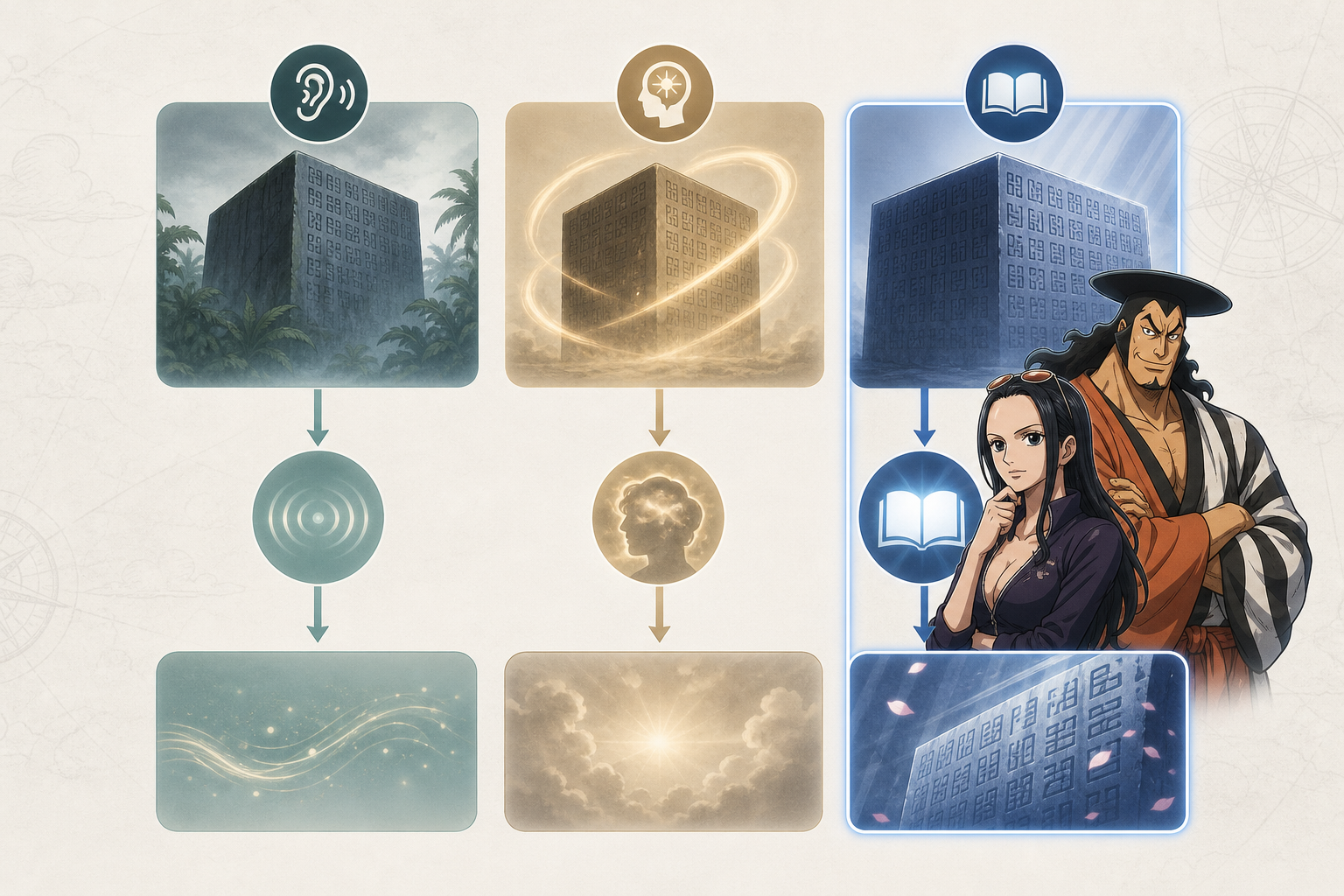
Diagram separating Poneglyph sensing, message interpretation, and script translation.
The central distinction: perception may point to a clue, while literacy reveals its wording.

The Voice of All Things is presented differently. It lets rare characters perceive voices that most people cannot. Those voices can come from beings such as Sea Kings and Zunesha. The ability may convey urgency, emotion, or intent, but its limits are still unclear.

That gives us three separate claims:

Claim What it would mean Current support
A character senses a Poneglyph They notice an unusual presence or call near the stone Possible, but not directly established as a rule
A character understands a Poneglyph’s general message They identify a warning, request, or topic without reading symbols Unconfirmed
A character reads a Poneglyph through the Voice They state precise names, places, or instructions without a translator Not shown

This is where many theories go too far. A character can hear Zunesha and still be unable to translate a carved inscription.

For a related theory-led look at the connection, see our Voice of All Things and Poneglyphs guide. The more careful version of the theory is stronger: the Voice may guide a traveler toward truth, while a reader is still needed to unlock the text.

What canon actually links to Poneglyphs

Roger is the strongest link—and also the strongest limit

Gol D. Roger is central to this debate. He had the Voice of All Things, reached Laugh Tale, and encountered Poneglyphs on his final voyage. That makes him the most plausible example of a person who could sense something unusual around the stones.

But Roger’s voyage also supplies the main counterpoint. Kozuki Oden traveled with the Roger Pirates and could read the ancient script. If the Voice gave Roger full, reliable translations, Oden’s skill would be far less important to the journey.

So Roger supports a narrow conclusion: the Voice may have helped him find, recognize, or respond to key clues. It does not prove that he could read every Poneglyph by hearing it.

A supplied character overview also treats Roger’s Voice as a possible aid to his journey rather than settled proof of automatic translation: Every Voice Of All Things User In One Piece. That is useful context, but the manga and anime scenes remain the best standard for any firm conclusion.

Luffy can hear voices, but he has not read a Poneglyph

Can Luffy hear the Voice of All Things? He has clearly perceived voices that ordinary people miss, especially in major lore scenes. That puts him in the conversation.

Can Luffy read Poneglyphs? No confirmed scene shows that. He does not look at a stone, repeat its wording, or provide details later verified by Robin. When the Straw Hats need an inscription explained, Robin remains the crew member who does that work.

Luffy is therefore a plausible sensing candidate, not a confirmed reader.

Momonosuke has an even clearer communication feat

Momonosuke can hear Zunesha and, unlike Luffy in that moment, can communicate with and command Zunesha. That is a remarkable use of the Voice of All Things.

Still, it does not establish Poneglyph literacy. Zunesha is a living being speaking with intent. A Poneglyph is a written record on stone. The two could be related in the wider mystery, but the story has not said that they function the same way.

Robin and Oden show why literacy remains its own skill

Robin’s role is not simply that she knows secrets. She can read the ancient writing. Oden could do the same. Their knowledge lets a crew turn a stone’s symbols into usable history, warnings, or directions.

That separation is probably deliberate. One Piece often divides major tasks across a crew: someone finds the clue, someone survives the obstacle, and someone understands the message. If every Voice user could translate Poneglyphs at will, Robin’s hard-won expertise would lose much of its story weight.

For the larger idea of inherited roles and hidden history, our Inherited Will, Void Century, and All Blue theory is a useful companion read.

The evidence test: what would prove a Poneglyph was “heard”?

A good theory needs a standard that can be proven wrong. Here is a simple rubric for new chapters, episodes, or fan claims.

Score 0: no direct connection

A character stands near a Poneglyph, reacts dramatically, or happens to be important to the Void Century plot. That can create a fun theory, but it is not evidence that they received information from the stone.

Score 1: a character senses a presence

A Voice user says they hear something or feel drawn somewhere near a Poneglyph. This would support a possible link, but not comprehension.

Score 2: the character identifies a general message

A character describes the stone as an apology, a warning, or a location clue before anyone translates it. This would be meaningful evidence that the Voice can convey more than presence.

Score 3: the character gives specific, verified content

This is the proof threshold. A Voice user would need to state a name, event, coordinate, or instruction from a Poneglyph without Robin, Oden, prior notes, or another translator. A later translation would need to match.

Until a scene reaches score 3, saying voice of all things can hear poneglyphs should mean “may perceive something connected to them,” not “can read their script.”

Counterexamples that keep the theory in check

The strongest theories take awkward evidence seriously. Several points argue against treating the Voice as an all-purpose Poneglyph decoder.

Voice users still need readers

Roger had Oden on the final voyage. The Straw Hats rely on Robin. This repeated pattern suggests that locating truth and decoding truth are separate jobs.

The Voice does not produce clear text on demand

When Luffy and Momonosuke hear extraordinary voices, their experiences are not presented as a convenient language lesson. The communication is selective and tied to specific beings or moments.

Poneglyphs are designed as writing

The Kozuki created inscriptions meant to endure censorship. Their form matters: they preserve knowledge through text. If anyone with the right sensitivity could bypass that text, the elaborate system would serve a much smaller purpose.

None of this proves that a Poneglyph can never “speak.” It simply means the story has not shown that it does in a way that replaces reading.

Who could plausibly hear a Poneglyph?

Gol D. Roger: the best historical candidate

Roger has the clearest overlap between the Voice, Poneglyphs, and the journey to Laugh Tale. He is the best candidate for sensing a Poneglyph or receiving some form of guidance from one.

His limit is just as important: Oden’s presence strongly suggests Roger did not depend on the Voice for every translation.

Monkey D. Luffy: likely to sense, unproven to understand

Luffy has the right kind of rare perception and sits at the center of the endgame mystery. He could plausibly hear a Poneglyph if the stones have a voice to hear.

But there is no confirmed basis to say he can extract written facts from one. Any claim beyond sensing remains theory.

Kozuki Momonosuke: a strong communicator, not a confirmed reader

Momonosuke’s link with Zunesha makes him a serious candidate for future Voice-related revelations. His Kozuki heritage also ties him to the people who made the Poneglyphs.

Even so, heritage is not proof of literacy. He has not been shown translating a Poneglyph.

The Kozuki line: important to the stones, but not automatically fluent

The Kozuki connection is vital because their ancestors made the Poneglyphs. That supports deep knowledge of their purpose and construction. It does not tell us which living Kozuki can read every inscription.

Pudding and the Three-Eye Tribe: a separate possibility

Pudding’s potential third-eye awakening is often brought into this debate. The theory is interesting because it offers a possible path to reading ancient text. But it should not be folded into the Voice of All Things without evidence. A future ability to read Poneglyphs would still be different from hearing them.

Poneglyph basics that matter to this theory

What did the Alabasta Poneglyph say?

The Poneglyph in Alabasta contained information about Pluton, the Ancient Weapon. Robin did not reveal its full wording to Crocodile, but the stone’s connection to Pluton was later established.

This scene shows why translation matters. The stone held information with world-changing value, yet most people in the room could not access it. A vague supernatural feeling would not be enough to replace a precise reading.

Is Robin the only person who can read Poneglyphs?

Robin is the only active, reliable Poneglyph reader clearly established in the present-day story. Oden could read them in the past. The Kozuki family’s historical link to their creation adds important context, but it is not proof that every descendant has the skill.

The safest answer to “Who can read Poneglyphs other than Robin?” is Oden, historically. Beyond that, treat claims with care unless the story shows a character translating the script directly.

Which Road Poneglyphs does Luffy have?

By the end of Wano, the Straw Hats had obtained rubbings from the Road Poneglyphs at Zou, Whole Cake Island, and Wano. Those copies matter because the four Road Poneglyphs together provide the route to Laugh Tale.

A rubbing is not the same as instantly understanding the route. The crew still needs Robin to read the inscriptions and make sense of the information. That is another practical reason the Voice-versus-reading distinction matters.

One Piece arcs in order for Poneglyph and Voice clues

If you are revisiting one piece arcs in order for this mystery, focus on these stops rather than trying to scan every arc for a hidden answer:

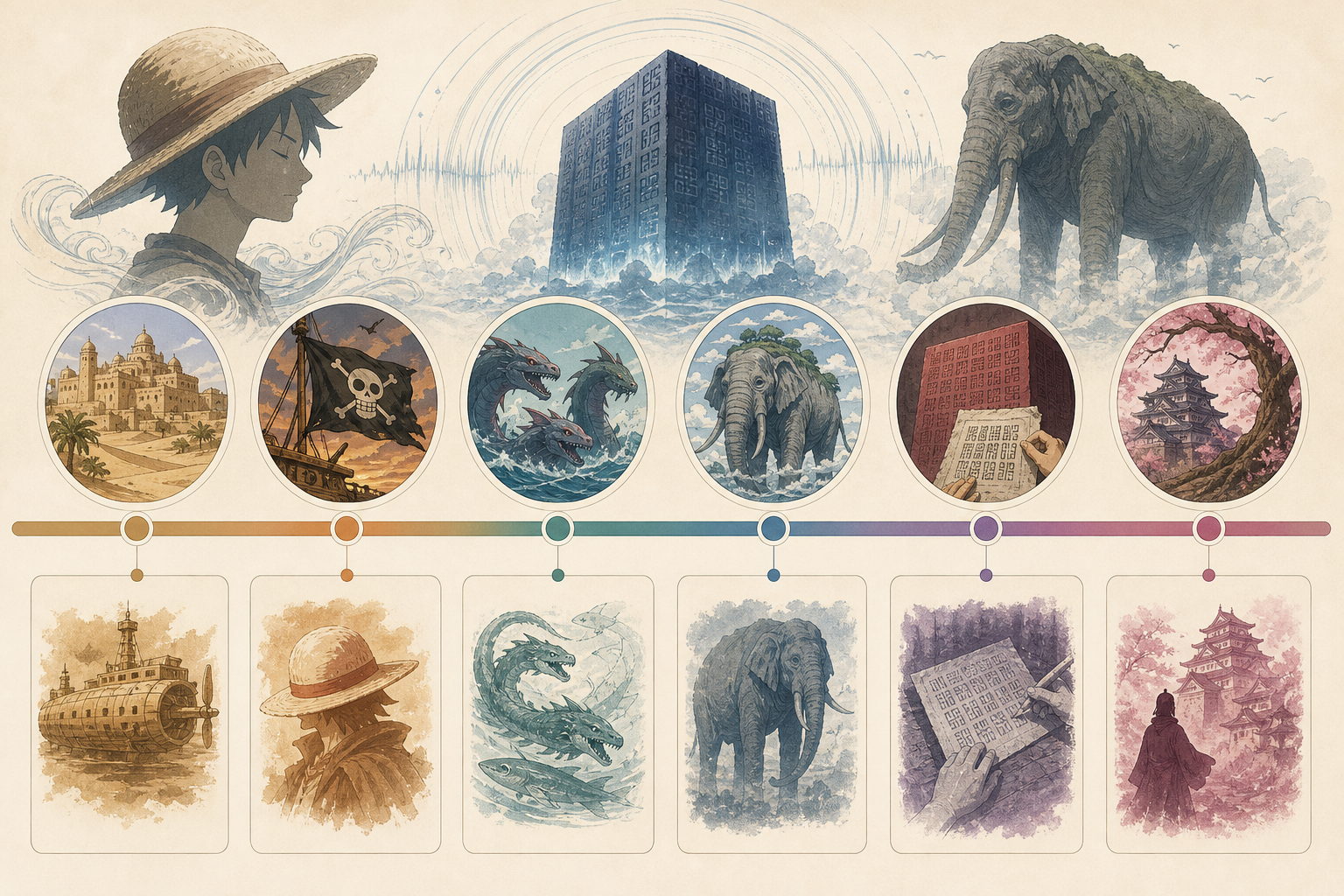
Timeline of One Piece arcs with major Poneglyph and Voice of All Things moments.
A focused rewatch and reread route for the evidence discussed in this article.
  • Alabasta: Robin reads the Poneglyph tied to Pluton.
  • Skypiea: Ancient writing and Roger’s connection to the past deepen the mystery.
  • Fish-Man Island: Joy Boy, Sea Kings, and the scale of the old promise come into view.
  • Zou: The Road Poneglyph race becomes clear, while Zunesha makes the Voice impossible to ignore.
  • Whole Cake Island: The crew secures a Road Poneglyph rubbing.
  • Wano: Kozuki history, Oden’s journey, and the Road Poneglyph plot converge.

For a close look at Wano-era story discussion, revisit our One Piece Chapter 927 review and reactions. If you want to check wording and scenes for yourself, our guide to reading the One Piece manga can help you choose a format.

A quick checklist for judging future reveals

When a new scene seems to prove that someone heard a Poneglyph, ask:

  1. Did the character receive information from the stone itself, or did they infer it from context?
  2. Did they provide specific details, not just a feeling or direction?
  3. Was Robin, a Kozuki reader, a record, or another translator involved?
  4. Did a later translation verify the information?
  5. Does the scene show sensing, communication, or actual reading?

That checklist keeps the debate fun without turning every mysterious reaction into proof.

Final verdict

The Voice of All Things and Poneglyphs are clearly adjacent mysteries. Roger’s voyage, Luffy’s sensitivity, Momonosuke’s communication with Zunesha, and the Kozuki legacy all make a future connection believable.

But the canon line is still clear: hearing a voice is not the same as reading a language. Roger is the best case for a Poneglyph connection, while Robin and Oden remain the clearest proof that ancient-script literacy is a distinct skill.

If Oda eventually shows a Voice user giving a Poneglyph’s exact message without help, the theory moves from plausible to confirmed. Until then, the best answer is: they may be able to sense a Poneglyph, but they have not been shown to read one by hearing it.