
Tony Tony Chopper looks like a toy. That’s the point.
One Piece has a habit of hiding its most emotionally devastating characters behind disarming designs, and Chopper is the clearest example. He’s small, blue-nosed, and wears a little pink hat. He blushes when complimented and covers his face with his hooves while obviously wanting more. He is, objectively, very cute.
He’s also a doctor who swore to cure any disease in existence. A reindeer who spent his childhood being rejected by both humans and animals for being neither. And one of the characters whose backstory hits hardest in a series full of heavy backstories.
This is the full breakdown: who Chopper is, what the Drum Island arc reveals, how his Devil Fruit works, every transformation explained, and what his live action adaptation needs to get right.
Who Is Tony Tony Chopper?
Tony Tony Chopper is the doctor of the Straw Hat Pirates and the sixth member to join the crew. He’s a reindeer who ate the Hito Hito no Mi (Human-Human Fruit), a Zoan-type Devil Fruit that granted him human intelligence, speech, and the ability to shift between multiple physical forms. He joined the crew during the Drum Island arc and has been their ship’s doctor ever since.
His core goal: become a doctor capable of curing any disease.
That’s not ambition for the sake of power. It’s a promise he made to a dead man — the person who was the first to treat Chopper as worth saving.
Chopper’s Backstory: The Drum Island Arc
The Drum Island arc is where Eiichiro Oda gives Chopper his origin story, and it’s one of the cleanest character introductions in the series. It’s also where the show first slows down long enough to ask a serious question: what happens to someone that every world rejects?
A Reindeer Nobody Wanted
Chopper was born a reindeer with a blue nose — unusual enough that his herd treated him as an outcast from the start. When he ate the Human-Human Fruit, he didn’t gain acceptance. He gained a new category of rejection. Now he was too human to belong with reindeer, and too obviously a reindeer to be accepted by people. He walked on two legs and could speak, but humans looked at him and saw a monster.
The specific cruelty Oda builds into this arc is that Chopper keeps encountering warmth and then losing it. Every time someone accepts him, something takes that away. It teaches him the lesson that abandoned children often learn: care is temporary, and attachment is a setup for loss.
Dr. Hiluluk and Dr. Kureha
Two doctors shape who Chopper becomes, and they couldn’t be more different.
Dr. Hiluluk is a quack — genuinely, objectively incompetent as a physician, with a habit of making his patients worse. He’s also the first human who looks at Chopper and sees something worth protecting. He takes Chopper in, names him, and teaches him that medicine is about more than technique: it’s about refusing to give up on someone. He’s dying of an illness he’s kept secret from Chopper, spending his last months trying to create a cure he believes will save the Kingdom of Drum.
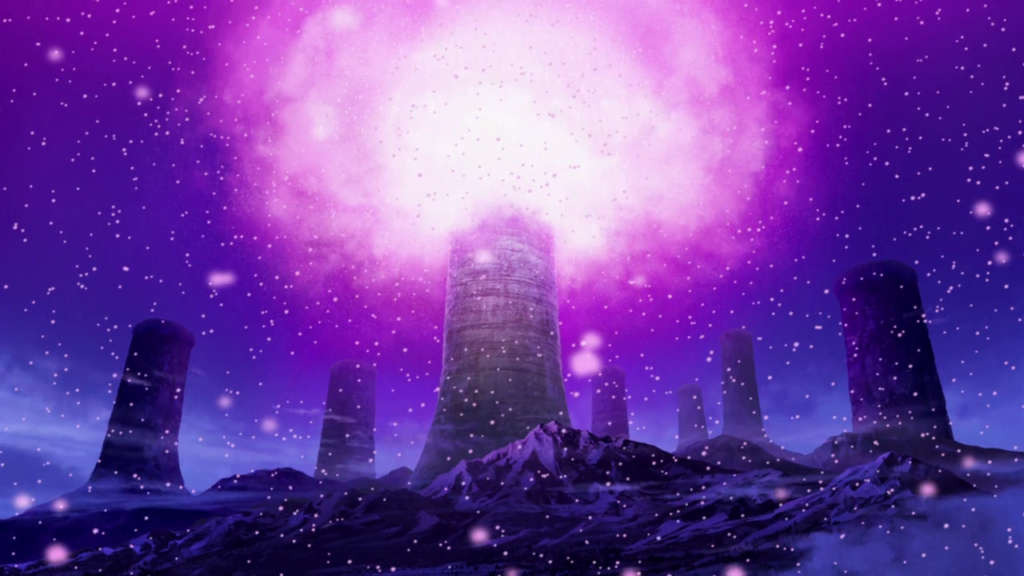
His death is one of the great gutpunches of the series. The image that follows — cherry blossoms blooming in the snow, the thing Hiluluk spent his life trying to create — has become one of One Piece’s most iconic visual moments for a reason.
Dr. Kureha is Hiluluk’s opposite: an extraordinarily skilled doctor, famously ruthless, who takes Chopper in after Hiluluk’s death and actually trains him. Where Hiluluk gave Chopper the why of medicine, Kureha gives him the how. She’s the one who turns a grieving reindeer into a physician who might actually achieve what he promised.
Chopper’s dream of curing any disease is inherited directly from Hiluluk’s belief that medicine could do anything — and Kureha’s certainty that skill, not wishes, is what makes that possible.
Why He Joins the Straw Hats
Luffy doesn’t recruit Chopper with a speech. He doesn’t promise him anything grand. He just treats Chopper the same way he treats everyone: as a person whose value isn’t up for debate.
For someone who has spent his entire life being rejected by humans and animals alike, that’s more radical than it sounds. The Straw Hats earn Chopper’s trust the same way they earn everyone’s — by backing it up with action, repeatedly, until the trust becomes impossible to deny.
The Hito Hito no Mi: Every Chopper Form Explained
Chopper’s Devil Fruit is a Zoan-type — specifically the Hito Hito no Mi (Human-Human Fruit). Zoan fruits grant animal-human hybrid transformations; because Chopper is already an animal, his version grants him humanoid traits and intelligence instead. The result is a unique three-way flexibility between full reindeer, various hybrids, and a nearly human form.
He supplements this with Rumble Balls — a drug he developed himself that temporarily alters how the fruit’s transformations work, unlocking additional forms the fruit doesn’t naturally provide.
Here’s every form, what it looks like, and what it’s for:
Brain Point (Default Small Form)
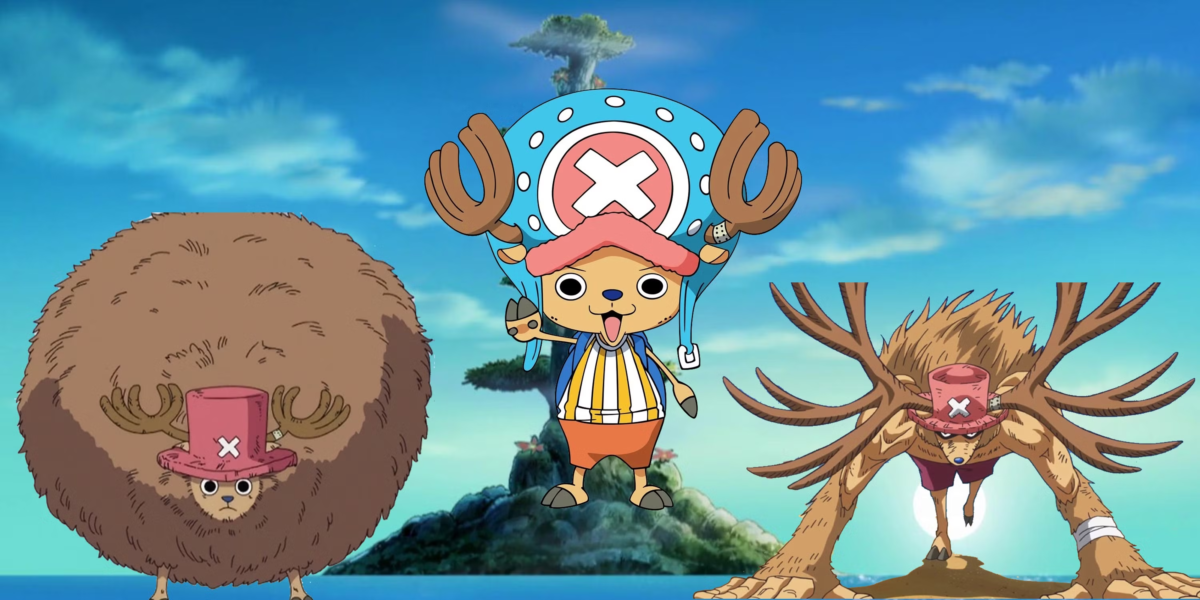
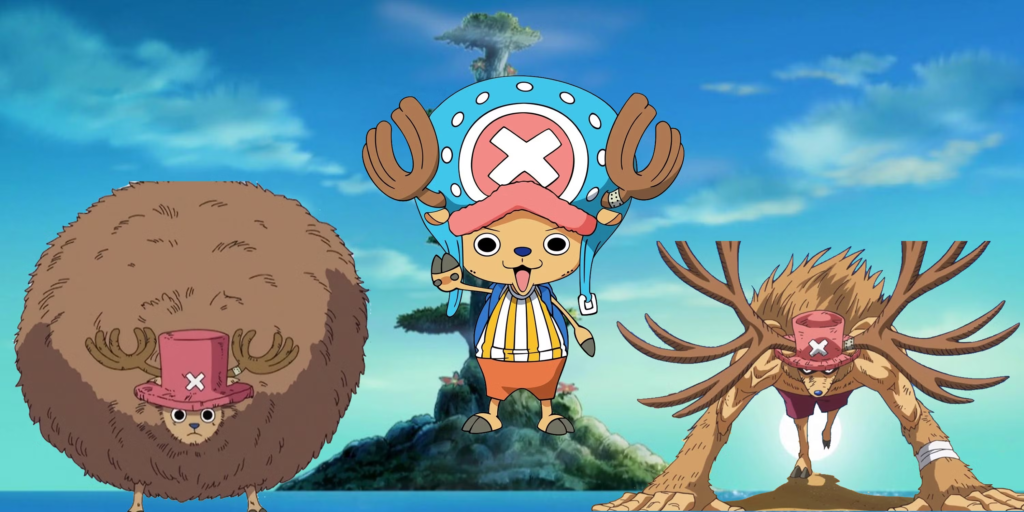
The little blue-nosed reindeer everyone recognises. Small, lightweight, low physical threat. This is Chopper’s base form for daily life on the ship — easy to move around in, good for medical work that requires dexterity, and disarming enough that civilians don’t panic. He also processes information fastest in this form, which is why it’s called Brain Point: it’s his thinking mode.
Walk Point (Full Reindeer)
His natural reindeer body, four legs included. Fastest movement speed of any form on flat ground. Used for travel, scouting, and occasionally carrying crew members. Not a combat form — it’s pure mobility.
Heavy Point (Large Human-Like Form)
The one that surprises people who only know chibi Chopper. Heavy Point is a large, muscular humanoid form — Chopper at roughly human-adult scale, capable of real physical force. This is his primary combat form before the timeskip, and the one that demonstrates his Devil Fruit gives him something significantly more than “being slightly human.”
Guard Point (Expanded Fur Shield)
Chopper expands his fur dramatically to create a large, shock-absorbing defensive sphere. Used to shield crewmates from explosions, blunt force, or projectiles. His body is the armour. It’s not a fighting form — it’s a sacrifice form, designed to take hits that would kill the people around him.
Arm Point (Enlarged Arms)
Chopper’s arms swell to enormous size while the rest of his body stays relatively compact. Maximum punching force. Used for specific combat situations where he needs to break something, break someone, or break through something. Less versatile than Heavy Point but significantly harder-hitting.
Jumping Point (Legs Enlarged)
Legs expand for dramatically increased jump height and distance. Used for rapid repositioning in three-dimensional environments — useful on ships, in ruins, in areas where combat is happening vertically as much as horizontally.
Horn Point (Reindeer Horns Enlarged)
Chopper’s horns grow to massive size, turning him into something between a reindeer and a battering ram. High offensive power, specifically suited to charging attacks. One of his more visually dramatic forms — and one of the clearer reminders that underneath the blue nose and pink hat is a genuinely dangerous animal.
Monster Point (Rumble Ball — Pre-Timeskip)
The dangerous one. Before the timeskip, Monster Point is what happens when Chopper takes too many Rumble Balls in succession — an enormous, barely-controlled transformation that dramatically multiplies his physical power while removing his ability to distinguish friend from enemy. It’s effective in the same way a natural disaster is effective. Pre-timeskip, using it is a last resort that always comes with a cost.
Monster Point (Post-Timeskip — Controlled)
After two years training with Dr. Kureha and the medical knowledge of the Revolutionary Army, Chopper can enter Monster Point without Rumble Balls and maintain control. Same devastating power, no blackout, no aftermath. The transformation that used to be his body turning against him becomes a weapon he can actually aim. It’s one of the cleaner examples of how the timeskip changes characters from “capable but limited” to “capable, period.”
Chopper’s Relationships in the Crew
With Luffy: Chopper hero-worships Luffy in a way that the show plays mostly for comedy — the frantic denial of compliments while obviously wanting more — but the emotional core is real. Luffy was one of the first humans who looked at Chopper without flinching. That means something specific to someone with Chopper’s history.
With Robin: They have a dynamic that is almost certainly intentional on Oda’s part. Robin regularly says mildly disturbing things to Chopper in a calm voice and watches him panic. He is an extraordinarily good audience for this. It brings out the only genuinely playful version of Robin we regularly see in the series.
With Usopp: The two are frequently placed together in dangerous situations and respond to those situations in near-identical ways: initial loud panic, followed by pulling through when it matters. Their friendship feels real in the specific way that shared cowardice overcome together tends to.
With Nami: Chopper respects Nami’s authority more consistently than most of the crew. She’s also one of the more pragmatic members about his role — she values him as a doctor with genuine skill, not just as the crew’s emotional comfort object, and that respect goes both ways.
Chopper in the One Piece Live Action: Season 2 Verdict
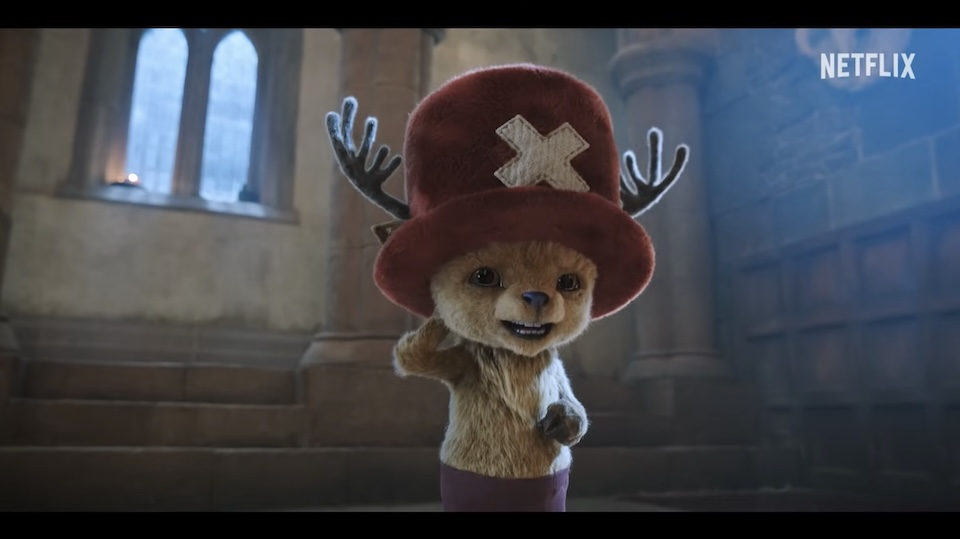
Season 2, subtitled Into the Grand Line, covers the Loguetown arc through to the Drum Island arc — meaning Chopper’s full origin story made it into the season. He appears only in the final three episodes, with one dedicated almost entirely to his tragic backstory.
The approach Netflix landed on: full CGI executed by VFX company Framestore, with Mikaela Hoover providing both the voice and facial motion capture. The on-set solution was clever — a South African performer, N’kone Mametja, was cast as the physical proxy on set, wearing a large antler piece so actors had a real scene partner rather than a tennis ball. Showrunner Joe Tracz compared the setup to the Guardians of the Galaxy approach, with Hoover as the Bradley Cooper equivalent and Mametja as the Sean Gunn equivalent.
How did it land? Mostly well, with one honest caveat. The Drum Island arc is the emotional heartbeat of the season — reviewers who went in sceptical came out crediting Hoover’s vocal performance and the Hiriluk flashback as the standout of the whole run. The cherry blossom scene made it in and the pink snow cloud — Hiriluk’s last concoction turning Drum Mountain into something resembling a giant cherry blossom tree — was adapted faithfully, with Chopper weeping until Zoro lifts him onto his shoulder.
The caveat: while the CGI is not bad, some reviewers noted it falls short of what the character demands — particularly during Chopper’s transformations, which blend digital and practical VFX with mixed results. The static scenes and emotional close-ups work well; the wider action sequences expose the budget ceiling more clearly.
Oda himself admitted he “was worried” initially, which should tell you something about how difficult this adaptation problem was — and also that it cleared his bar, given the show has his continued involvement.
Dr. Kureha is played by Katey Sagal. Dr. Hiriluk by Mark Harelik. Both anchor the Drum Island arc in a way that makes Chopper’s introduction feel genuinely earned, with Sagal’s sharp, whiskey-voiced cynicism balancing out the crew’s wide-eyed optimism.
Frequently Asked Questions
Does Chopper die in One Piece?
No. As of 2026, Chopper has not died in the canon manga or anime. The “Chopper dies” claims that circulate online come from misleading video thumbnails, out-of-context clips, and clickbait. Before believing any major death claim in One Piece, check that a specific chapter or episode number is being cited.
What is Chopper’s Devil Fruit?
Chopper ate the Hito Hito no Mi (Human-Human Fruit), a Zoan-type Devil Fruit. Because he’s a reindeer, the fruit grants him human-level intelligence, speech, and the ability to shift between multiple hybrid forms rather than a standard animal-human transformation. He also developed Rumble Balls — a drug that extends his transformation range beyond what the fruit naturally allows.
How many forms does Chopper have?
Seven naturally, plus Monster Point. Before the timeskip: Brain Point, Walk Point, Heavy Point, Guard Point, Arm Point, Jumping Point, Horn Point, and an uncontrolled Monster Point via Rumble Balls. After the timeskip, he can use Monster Point without Rumble Balls and maintain full control.
Who voices Chopper in One Piece?
Ikue Otani voices Chopper in the Japanese anime — the same actress who voices Pikachu in Pokémon, which is why fans frequently draw that comparison. The vocal range required is demanding: Otani plays innocence, panic comedy, and genuine emotional resolve across the same episode, and the performance is a significant part of why Chopper works as well as he does in the anime.
What is Chopper’s backstory in One Piece?
Chopper grew up as a rejected reindeer on Drum Island — outcast by his herd for his blue nose, then further isolated after eating his Devil Fruit. He was taken in by Dr. Hiluluk, a quack with a genuine heart, who died before Chopper could repay him. He was then trained properly by Dr. Kureha. His dream — to become a doctor who can cure anything — is a direct inheritance from Hiluluk’s belief and Kureha’s discipline. The full backstory is told in the Drum Island arc.
Is Chopper male in One Piece?
Yes. Chopper is canonically male. His cute design, high-pitched voice in some adaptations, and comedic moments involving costumes or exaggerated reactions don’t change what the manga establishes.
Where does Chopper appear in the One Piece live action?
Chopper debuts in Season 2 (Into the Grand Line, released March 10, 2026 on Netflix). He appears in the final three episodes of the eight-episode season, with one episode dedicated almost entirely to his backstory with Dr. Hiriluk. Mikaela Hoover provides his voice and facial performance. The season ends with Luffy asking Chopper to join the crew — and Chopper, characteristically, doing so reluctantly. Season 3 is already in production and will cover the Alabasta arc.
For more on the characters heading into Season 2, read our complete Alabasta arc breakdown and the Nico Robin character guide.