How to Compare Anime and Manga Character Portrayals: A Practical Rubric for One Piece Fans

Switching between manga and anime can make the same character feel different. If you want to learn how to compare anime and manga character portrayals withou…

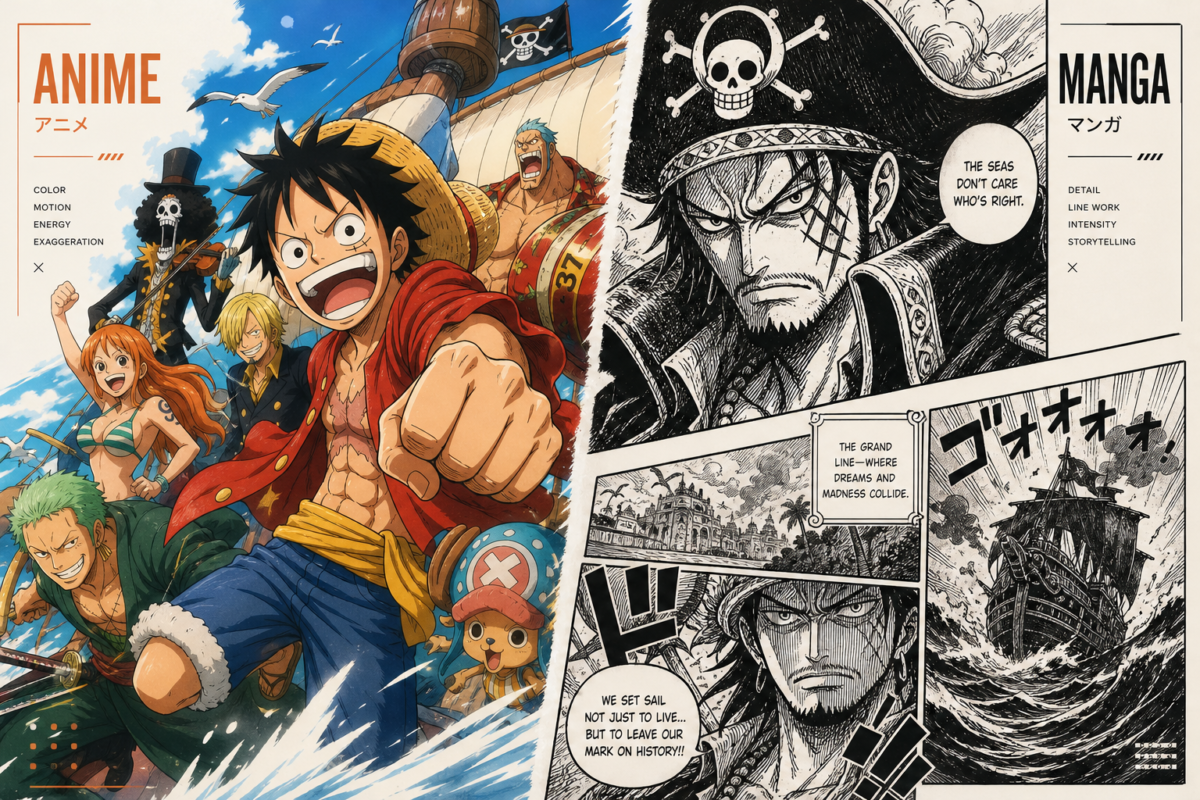
If you want to know how to compare anime and manga character portrayals, start with the same scene in both versions. Do not compare a famous manga panel with a random anime frame. Match the same goal, conflict, action, and outcome first. Then ask what each medium adds or changes.

A character can feel calmer on the page but more emotional in the anime. They may seem more capable in a quick manga fight, or more vulnerable when an episode adds pauses, reaction shots, music, and voice acting. That does not always mean the character changed. It may mean the delivery changed.

This guide gives One Piece fans a simple way to compare those differences. Use it to decide which version fits your taste, not to force a winner.

Plot and portrayal are different things

Plot asks, “What happened?” Portrayal asks, “What impression does this moment give us of the character?”

Two versions can keep the same plot point but create a different feeling.

For example, a character refuses to retreat:

  • In manga, one sharp panel may make the choice feel cool and certain.
  • In anime, a long pause, a close-up, and a shaky voice may make it feel painful and brave.
  • If the episode adds a joke after the scene, the character may seem less severe.

The action is still the same. The emotional weight is not.

When you compare a character, look for these signals:

  • Personality: Do they seem patient, reckless, proud, cruel, kind, or awkward?
  • Emotional tone: Is the scene tense, funny, sad, triumphant, or light?
  • Agency: Does the character drive events or only react to them?
  • Competence: Do they seem skilled, prepared, lucky, slow, or overwhelmed?
  • Relationships: Who do they trust, protect, fear, tease, or respect?
  • Framing: Does the story present them as heroic, threatening, silly, suspicious, or sympathetic?
  • Expression: What do posture, faces, movement, color, shadows, and staging tell you before dialogue begins?

After each matched scene, write one sentence. For example: “This version frames Vivi as determined but overwhelmed.” That is more useful than trying to compare every panel with every frame.

Why anime and manga can make the same character feel different

Most differences come from the medium, the adaptation choices, or anime-only material.

Manga lets you set the pace

When you read manga, you control the rhythm. You can stop on a panel, reread a line, or race through a page. Layout, page turns, white space, and panel size still guide your attention, but you decide how long a moment lasts.

Anime sets the rhythm for you. The episode controls each pause, cut, reaction, and close-up. A held shot can make a character look uncertain. A fast cut can make the same character look decisive.

That is why image-only debates are often unfair. A striking manga image and a routine anime screenshot do not show the same thing. One fan discussion makes this point well: picking cool manga images and plain anime images can decide the result before the comparison starts (Reddit discussion). Compare a full story beat instead.

Anime adds performance

Anime adds voice acting, music, color, motion, sound effects, camera work, and editing. These can change how a character lands even when the dialogue and plot stay close to the manga.

A voice can make a character sound tired, smug, gentle, frightened, or commanding. Music can make the same line feel heroic, tragic, comic, or ominous. A long silence can make an emotion clearer than it was on the page.

When a scene feels different, ask this first:

> Did the character change, or did the delivery change?

That question stops many weak comparisons.

Additions and cuts can shift the emphasis

Anime may expand a short scene, add comedy, repeat a flashback, change the order of material, or cut a detail. Some changes only help an episode fill time. Others can change how viewers read a character.

Watch for these common shifts:

  • Long reaction shots can make a person seem more shocked, cruel, embarrassed, or unsure.
  • Repeated flashbacks can make a motive feel more emotional or more obsessive.
  • Added jokes can make a serious character seem warmer or more childish.
  • Longer fights can change how skilled, tough, or dangerous someone appears.
  • Extra dialogue can explain a motive that manga left unclear.
  • Cuts can remove context, soften an action, or reduce an emotional setup.

Do not label every addition “filler” and move on. Some anime-only scenes fit the character well. Others are fun but should not be treated as proof of the manga version’s intent.

If you are moving from the anime to the source material, Read One Piece Manga – All the choices can help you plan that switch.

Start with fair scene alignment

The easiest way to make a bad comparison is to compare non-matching material. Do not put a manga canon scene against an anime-only scene. Do not compare a chapter with an episode full of recap. Do not use your memory of a later reveal to judge an early scene.

Use a small window instead.

Pick one clear story beat

Avoid starting with “this whole arc.” Begin with one moment, such as:

  • a choice under pressure;
  • a first entrance;
  • an argument;
  • a battle turning point;
  • a reaction after a loss;
  • a promise, refusal, or betrayal.

Then find the manga chapters and anime episodes that cover the same core event.

A matched scene should have the same:

  1. Setting
  2. Goal
  3. Conflict
  4. Outcome

Anything outside that shared core is an adaptation change. Mark it instead of quietly treating it as baseline material.

Use a pacing-correction sheet

A small table keeps your notes honest.

Scene Manga location Anime location Change Possible effect
S1 Chapter and pages Episode and timestamp Longer reactions May make the character seem less certain
S2 Chapter and pages Episode and timestamp Added joke May make the character seem more playful
S3 Chapter and pages Episode and timestamp Repeated flashback May make the motive feel heavier
S4 Chapter and pages Episode and timestamp Music and acting May heighten emotion without changing the action

Use one of these labels for each difference:

  • Canon-consistent expansion: The anime adds time or texture but no clear new motive, action, or result.
  • Neutral padding: The material mainly extends the runtime.
  • Portrayal-altering addition: The anime adds behavior, dialogue, conflict, motive, or relationship detail that changes the impression of the character.
  • Compression or omission: The anime shortens or removes manga material, which may reduce context.

This gives you better language than “the anime ruined the character.” You can say, “The longer pause makes this choice read as hesitation, even though the decision itself is the same.”

Control for filler bias

“Filler” is often used for every anime-only moment. It helps to separate three questions:

  1. Is this scene in the manga?
  2. If not, does it fit the character we already know?
  3. Does it change how the audience understands that character?

Score the matched scenes first. Then treat anime-only scenes as a second layer.

For example: “This anime-only scene makes the character seem warmer, and I like it.” That is a fair personal view. It is different from saying, “This proves the manga character is warm in this exact way.”

The 10-part portrayal rubric

Once your scenes match, use the same categories each time. The goal is not fake precision. The goal is to explain what changed.

Score each category from 1 to 5:

  • 1 — Meaningfully different: You would describe the character differently after seeing this version.
  • 2 — Noticeably different: The core trait is similar, but the framing changes the impression.
  • 3 — Mostly aligned: Same character, with a different level of intensity or flavor.
  • 4 — Very close: Small presentation changes with little effect on the overall read.
  • 5 — Near-identical: The change is mostly cosmetic.

Your note matters more than the number.

1. Dialogue and wording

What does the character say? Are lines shorter, softer, harsher, clearer, or more direct? A small wording change can affect how smart, warm, confident, or threatening a person seems.

2. Emotional intensity

How strong do fear, anger, joy, grief, or resolve feel? Check panel composition, close-ups, pauses, facial focus, and vocal delivery.

3. Comedic framing

Does the adaptation make the moment funnier through reaction cuts, sound effects, timing, or exaggerated faces? Comedy can change whether a character feels cool, scary, immature, or easy to approach.

4. Competence and agency

Does the character make choices and carry them out? Look for added struggle, delayed action, extra rescues, or changed fight choreography. A longer fight can make someone look tougher, but it can also make them look less efficient.

5. Moral framing

How does the scene guide your judgment? Notice who gets the final line, whose pain is shown, and whether the story stresses harm, remorse, courage, or cruelty. This matters a lot with antagonists.

6. Relationships and chemistry

Track warmth, rivalry, fear, trust, and respect. An added conversation can make a bond feel richer. A removed reaction can make that bond feel colder.

7. Visual design and expression

Compare linework, shadows, faces, posture, motion, color, and staging. Manga may use hard ink contrast. Anime may use color, movement, and smoother designs to create a different effect.

8. Voice, music, and acting

This is anime-only, but it often explains why viewers love an anime version. Is the voice calm, playful, harsh, worn down, or commanding? Does the music make a scene feel hopeful, ominous, tragic, or comic?

9. Localization, censorship, and release version

Use this only when you know there is a specific change. Subs, dubs, broadcast edits, and other releases may handle dialogue or violence differently. Check which version you watched before making a broad claim.

10. Narrative focus

How much time does the story give the character? More screen time can add weight. It can also slow a scene so much that a character seems indecisive. Keep this category separate from competence.

Use this template for your own notes:

Character:
Arc / chapter range / episode range:
Matched scene(s):

Scoring key: 1 = meaningfully different | 3 = mostly aligned | 5 = near-identical

1) Dialogue / wording:
2) Emotional intensity:
3) Comedic framing:
4) Competence / agency:
5) Moral framing:
6) Relationships / chemistry:
7) Visual design and expression:
8) Voice / music / acting:
9) Localization / censorship, if relevant:
10) Narrative focus:

Anime-only additions worth noting:
Manga-only details worth noting:
One-sentence takeaway:
Which version fits my preferences, and why:

Weight the categories that matter to you

There is no formula that can prove one portrayal is best for every fan. Your priorities matter.

If you care most about source material and fast story flow, give more weight to matched manga scenes, dialogue, and narrative focus.

If you care most about emotion and atmosphere, give more weight to acting, music, animation, and emotional intensity.

If you care most about power and credibility, focus on competence, agency, action staging, and consequences.

If you care most about relationships, focus on chemistry, emotional intensity, and small interaction beats.

Two fans can watch the same scene and reach different preferences without either one being dishonest. One may prefer the manga’s speed and room for interpretation. Another may prefer an anime performance that makes the feeling hit harder.

The useful question is: What is each version doing well for me?

Compare design as a signal, not a beauty contest

“Which version looks better?” is a fair fan question, but it is not enough for character analysis. Ask what the art is telling you.

A sharper jawline, deep shadows, a low camera angle, or stiff posture can make a character feel older, colder, or more dangerous. Rounder features, brighter colors, loose movement, and broad reactions can make the same character feel younger, friendlier, or more comic.

Anime and manga also use stylized features. Big eyes, unusual hair, simple noses, and varied colors are not reliable real-world ethnicity markers. When people ask why anime characters look “Caucasian,” the better question is usually what the style is trying to communicate: clear expressions, glamour, youth, genre tone, or instant visual recognition.

For a useful comparison, ask:

  • Does anime color and lighting soften the character compared with manga ink and shadow?
  • Does movement make them seem athletic, clumsy, graceful, or aggressive?
  • Does an anime close-up show vulnerability that manga leaves quiet?
  • Does limited movement weaken an expression that was strong on the page?

Manga and anime are related but distinct forms, even when they adapt the same story (Sequential Tart). A different visual effect is not automatically a bad adaptation.

Production context explains a change, but does not settle the debate

Anime has episode lengths, recaps, previews, schedules, and a large production team. Manga has its own limits, but it can use page turns and panel rhythm in ways animation cannot copy exactly.

That context can explain longer pauses, repeated information, added comedy, or clearer emotion. It does not mean every change is harmless. Your rubric still asks the key question: what did the choice do to the character?

Try to name the likely purpose:

  • Clarity: The anime makes an implied reaction easier to see.
  • Pacing: The episode needs to stretch, combine, or rearrange material.
  • Tone: The adaptation adds humor, tension, spectacle, or sentiment.
  • Compliance: A release changes violence, language, or imagery.
  • Character expansion: The anime gives the character new material that may enrich or alter the impression.

This approach leaves room to enjoy what anime brings. One Piece’s animation, performances, music, and shared viewing culture are part of its appeal; Why Is One Piece Anime So Famous? looks at that larger question.

One Piece walkthrough: Vivi and Crocodile

You do not need to compare a whole saga. Pick a few scenes from one contained stretch, and avoid using later spoilers to explain an early moment.

Vivi: leadership, fear, and resolve

For Vivi, choose matched scenes from a pre-Alabasta or early Alabasta stretch where she must persuade someone, make a choice, or endure pressure.

For each scene, note:

  1. What does Vivi do?
  2. What does she say?
  3. How does the manga frame the action?
  4. What does the anime add through timing, music, close-ups, or reactions?
  5. Does that addition change your sense of her leadership, fear, or resolve?

An extended pause may make Vivi’s fear easier to see. That can be powerful. It may also make some viewers read more hesitation into the scene than they did in manga.

A fair conclusion could be: “Both versions show resolve. The manga feels brisk and purposeful, while the anime makes the emotional cost clearer.”

That is a comparison. It is not a disguised claim that one version is universally better.

Crocodile: menace, charisma, and control

Crocodile is useful because villain portrayal often depends on aura. In an early Alabasta window, track three things:

  • Threat: Does he feel dangerous before action proves it?
  • Charisma: Do other characters and the framing make him seem powerful or commanding?
  • Intent: Do his words and actions show what he values, or only what he wants?

Anime can build villain presence with music, silence, close-ups, smirks, and shots of other characters reacting. These choices can make Crocodile feel larger than life. They can also feel too heavy if the added emphasis lasts longer than the scene needs.

Matched moment Signal Manga read Anime read What may cause the difference?
Entrance or reveal Threat Controlled and direct More theatrical Music and held shots
Exchange with another character Charisma Cool confidence More open dominance Reaction cuts and vocal delivery
Statement of intent Intent Concise or unclear More emotionally pointed Pacing, acting, or added dialogue

Do not jump to later material to prove your reading of an early scene. Ask what each version has shown at that point.

For help organizing version-by-version Crocodile notes, see the Crocodile Timeline Anime Manga Live Action Guide. For a character-focused look at a major shift in the series, see How Usopp Changed After the One Piece Time Skip.

Which version should you choose?

After you score a few scenes, do not overstate the result. A character can be closer to the manga in dialogue but more affecting in anime because of the performance. An anime-only scene can work well even if it is outside the manga baseline.

Use your notes to make a preference choice:

  • Choose manga first if you want faster pacing, control over reading speed, original page composition, and a source-first experience.
  • Choose anime first if you value voices, music, movement, color, and a shared viewing experience.
  • Use both if you enjoy seeing how different tools shape the same character.

A strong approach is to keep one medium as your default and use the other for a second view. Read the manga for story flow, then watch favorite scenes for acting and music. Or watch the anime first, then read a favorite arc to see what moved faster and what details stood out.

FAQ

How do I compare anime and manga character portrayals without mixing non-equivalent scenes?

Match the same setting, goal, conflict, and outcome. Keep anime-only scenes in a separate note. Do not compare a recap-heavy episode with a short manga sequence as if every second has equal value.

Is the manga always more canon than the anime?

When a manga is the original work, it is usually the clearest baseline for comparing the main story. The anime can still be an official adaptation with valuable performances and additions. Treat manga material and anime-only material as separate categories.

How do I avoid filler bias?

Score matching scenes first. Then describe additions clearly: “This anime-only scene makes the character feel warmer,” or “This extended fight makes them seem less efficient.” You can enjoy an addition without confusing it with the original baseline.

What portrayal differences matter most when switching mediums?

Start with motivation, emotional tone, competence, moral framing, and relationships. These are the areas most likely to change how you describe the character afterward. Fan discussions also often point to tone and action intensity as major differences between formats (Facebook discussion).

Why can anime make a character feel more emotional?

Anime adds acting, music, held shots, motion, and editing. These tools can make feelings more direct without changing the character’s basic motive.

What if I love an anime-only scene?

It still matters to your experience. Call it anime-only characterization and explain why it works for you. That lets you praise the scene without making a claim about the manga version that the manga does not support.

Why are some anime girls drawn as curvy?

Character designs vary by creator, genre, audience, and visual style. A curvy design can be used for glamour, comedy, exaggeration, or simple variety. It is better to judge the specific character and story role than to treat one design trend as a rule for anime as a whole.

What are the “Big 3” of manga?

The phrase usually refers to One Piece, Naruto, and Bleach. It is a fan and media label tied to a period of major shonen popularity, not an official award.

Why is anime popular with Gen Z and younger viewers?

There is no single reason. Streaming, clips, memes, fan communities, cosplay, and a wide range of genres make anime easy to find and discuss. That culture also makes adaptation debates more common, since fans can quickly share manga panels, anime clips, subs, and dubs.

What anime took seven years to make?

That question needs a specific title and source. Production timelines vary, and “seven years” can refer to planning, animation, delays, or the time between announcements and release. Do not use a production claim in a portrayal comparison unless you can verify what the timeline refers to.

Final checklist

Before posting your take, check these points:

  • Did I match equivalent scenes?
  • Did I separate manga material, anime expansion, neutral padding, and clear portrayal changes?
  • Did I name the cause of the difference: dialogue, pacing, framing, music, design, or acting?
  • Did I avoid using later spoilers to judge an earlier scene?
  • Did I state my preference as a preference, not as a universal fact?

That is the practical core of how to compare anime and manga character portrayals. Match the scene, control for pacing and filler, and identify what truly changed. You will be able to explain why a character feels different across mediums—and choose the One Piece experience you enjoy most.

How to Build a Theory From Unsolved Mysteries

If you want to learn how to build a theory from unsolved mysteries without sliding into headcanon, treat it like a mini research project. Start with what the…

Learning how to build a theory from unsolved mysteries starts with one rule: separate what the story confirms from what you think it means. Gather the strongest canon clues, keep each clue in context, offer an explanation, and say what later chapters would need to show for you to be right—or wrong.

That keeps a fun One Piece theory from becoming unsupported headcanon. It also gives you a post you can update when new chapters change the picture.

Start by separating facts, guesses, and headcanon

A theory is more than a prediction. It is an explanation that fits the known evidence and gives you ways to test it later.

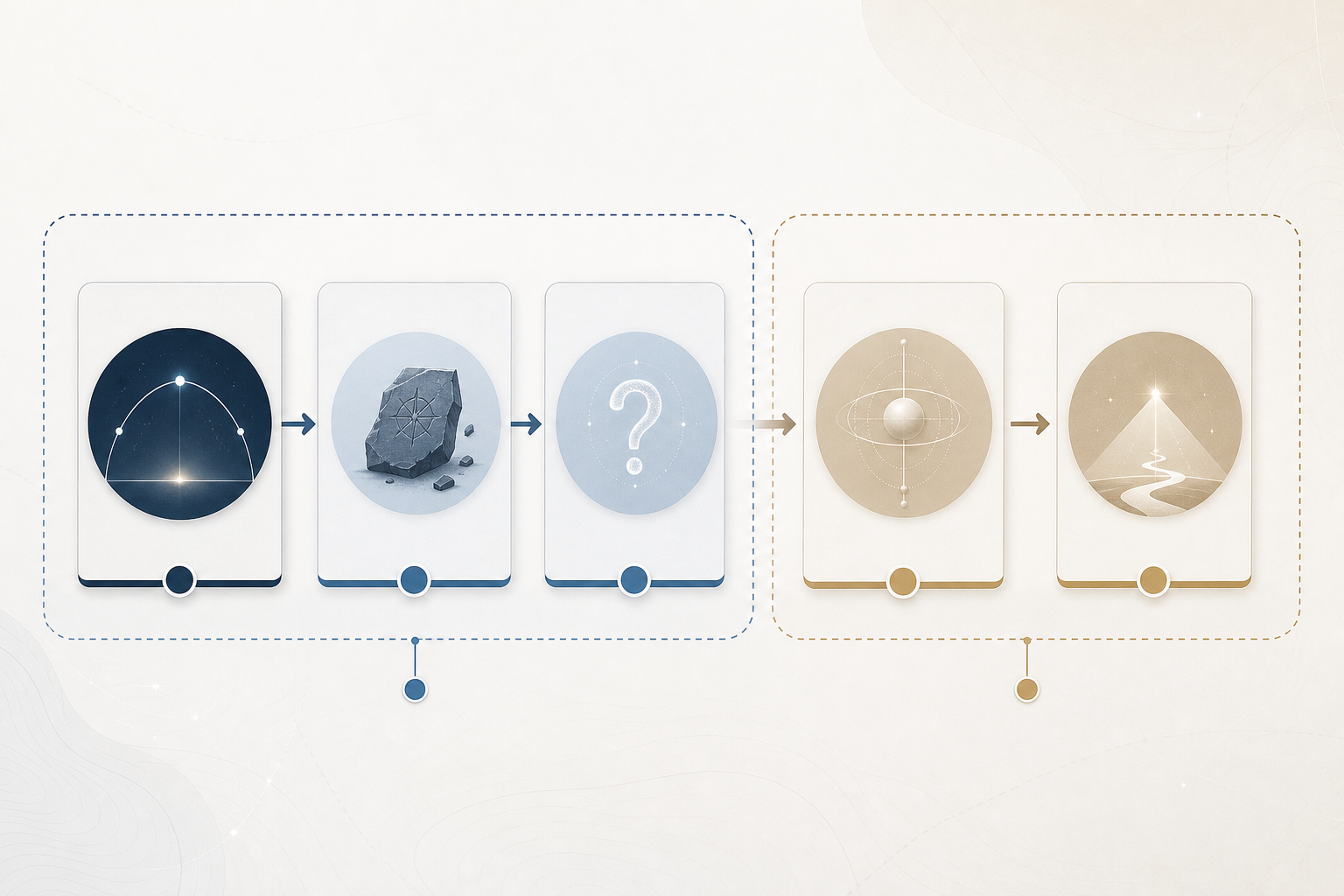
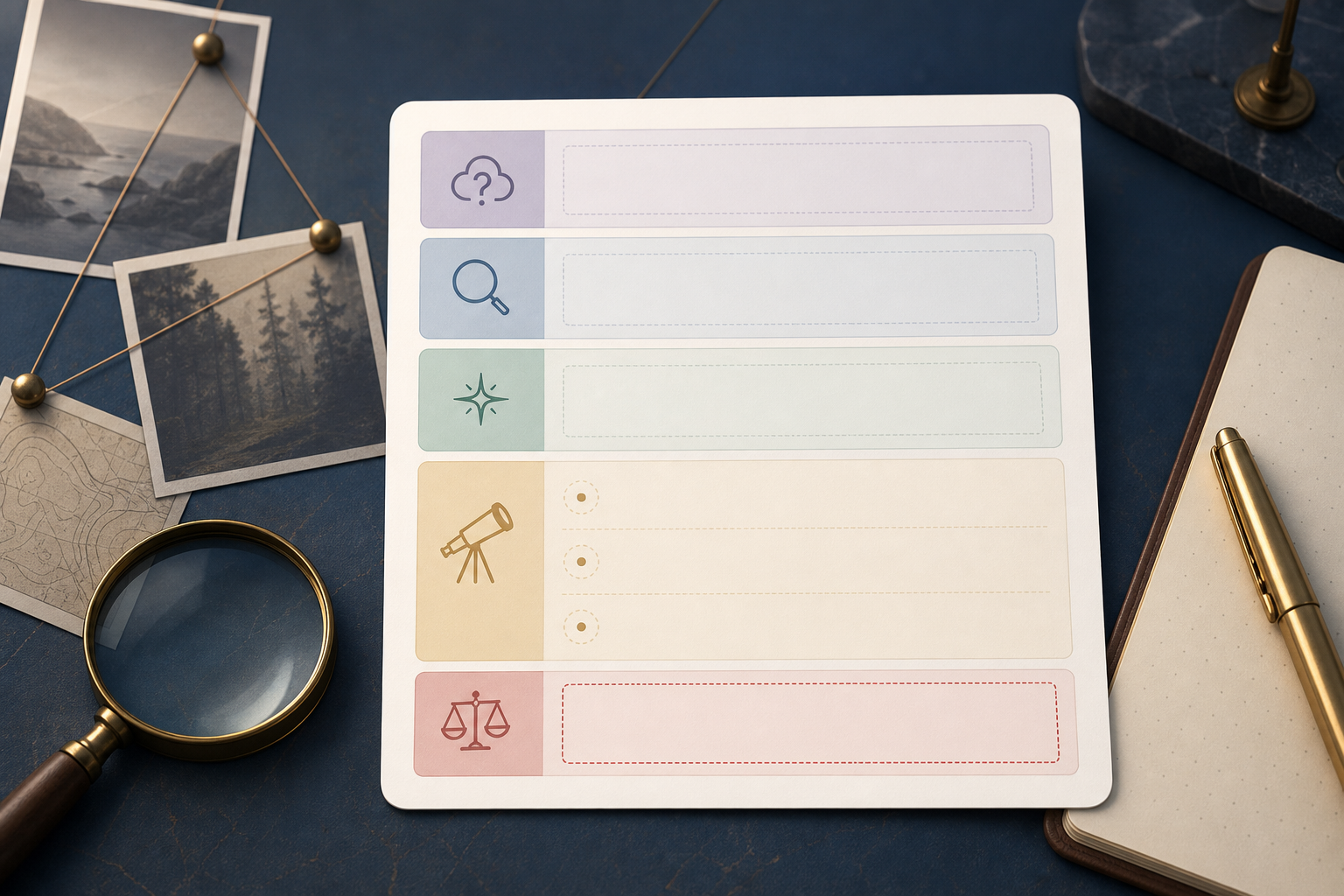
Example template for a falsifiable fan theory.
A theory earns trust when it states what could disprove it.
  • Fact: A manga panel, line of dialogue, narrator statement, or other source you can point to.
  • Interpretation: What that fact may mean.
  • Prediction: A later reveal that should happen if your interpretation is right.
  • Headcanon: An idea you enjoy but cannot support with the text yet.

Use a three-column note for every clue:

Canon fact Interpretation Testable prediction
A character reacts to a name or symbol They may know its history A later flashback or conversation explains that link

This makes weak links easy to spot. If the first column is empty, the claim may still be fun, but it is not evidence.

For practice, start with a mystery that has several clear clues. Our list of Top Mysteries in One Piece – Still Unsolved is a useful place to find one.

Map the mystery before you explain it

Do not start with the answer you want. Start with a narrow question.

Workflow for turning One Piece canon clues into testable theory predictions.
Keep the canon record separate from the interpretation at every stage.

“Who is linked to this shadow?” is manageable. “What is the whole truth behind the Void Century, the One Piece, Joy Boy, and every Ancient Weapon?” is several mysteries at once. Split a large topic into smaller questions first.

Build a canon timeline

Make a short timeline with four fields:

  1. Arc and chapter or episode anchor
  2. What the source says or shows
  3. What remains unknown
  4. How certain the clue is

The phrase one piece arcs in order matters here because a clue can change meaning when it is pulled out of its story context. Use arc order to file your notes, not as proof that every repeated image is a planned link. Arc names and boundaries can vary between guides, so use chapter numbers when precision matters.

For example, a Void Century note might look like this:

  • Alabasta: Robin encounters a Poneglyph; the full historical message remains unknown.
  • Skypiea: Another Poneglyph adds to the pattern; its link to the wider history still needs an answer.
  • Enies Lobby: The Ohara flashback gives direct context for why historical research is dangerous.

The timeline does not solve the mystery. It stops you from treating scenes from different eras, speakers, or situations as if they say the same thing.

Set canon constraints

A good theory has rails. Write down the facts your explanation cannot break:

  • Character motives and known relationships
  • The known timeline
  • Rules for powers, technology, and the World Government
  • Direct statements that have not been contradicted
  • The difference between a narrator statement and a character’s belief

For a wider example that connects inherited will, history, and endgame questions, compare your notes with Theory About One Piece – Inherited Will, Void Century and All Blue. Treat any theory page as commentary, then trace its key claims back to canon yourself.

Rank evidence before you build on it

Not every clue has the same weight. A strong theory may have fewer clues than a popular one, but its clues are easier to check.

What sources count as the strongest supporting evidence?

For One Piece, use an evidence ladder:

  1. Manga chapters and cover stories: The best starting point for story events and dialogue.
  2. Official author material, such as SBS answers: Useful context, but read the wording closely.
  3. Official reference material and interviews: Helpful when you can identify the original source and date.
  4. Anime adaptation: Useful for revisiting scenes, but it can add pacing, dialogue, or filler details not found in the manga.
  5. Translations, recaps, wikis, videos, and fan posts: Good for finding leads, not for proving a claim on their own.

Save the chapter number with every note. If one translation choice carries your whole argument, check more than one translation. Do not treat a disputed word as a hard fact.

This follows a basic research habit: separate primary material from later commentary. PBS’s Crack the Case: History’s Toughest Mysteries frames mystery research around studying sources before building an explanation. That works well for fandom theorizing too.

Watch for common traps

Some evidence looks strong because it is specific. Be careful with:

  • Silhouettes and shadows: They can suggest a link, but rarely prove identity.
  • Anime-only details: Check whether the manga supports them.
  • Character testimony: A character can lie, be mistaken, or lack key facts.
  • Single-panel patterns: One visual parallel may be a callback, not a secret rule.
  • Timeline jumps: A clue may appear later but happen earlier in the story world.

A focused character question is good practice. In How Did Kid Lose His Arm In One Piece?, separate what the story establishes about the event from any guess about the full fight or its timing.

Turn clues into a theory that can be wrong

A theory becomes useful when it risks being wrong. You do not need to predict an exact chapter or every twist. You do need to name the kind of evidence that would support or hurt your explanation.

How do you define falsifiable theory predictions?

A falsifiable prediction is a clear result you could observe if your theory is true. Write it in an if/then form:

> If this explanation is correct, then the story should reveal this kind of evidence in this likely context.

Weak prediction: “The reveal will be huge.”

Stronger prediction: “If the mystery is tied to a character’s hidden past, a flashback or direct conversation should link that character to the earlier symbol or event.”

Also write the reverse:

> I will revise or drop this theory if the story confirms __.

That is not a weakness. It shows readers that you can separate evidence from attachment.

Make three to five predictions

Three to five predictions are enough to test a theory without turning it into a wish list. Mix direct and indirect tests:

  • A reveal that should happen
  • A detail that should return
  • A motive that should match earlier behavior
  • A limit the theory should explain
  • A fact that would disprove the theory

Here is a simple example using the question of why Blackbeard can hold two Devil Fruit powers:

  • Theory claim: His ability comes from an unusual biological trait.
  • Prediction: Earlier flashbacks or a scientific explanation should point to that trait.
  • Prediction: The story should explain why most people cannot repeat the process.
  • Disconfirming evidence: A confirmed method that any person can use with the right tool or ritual would weaken a biology-only explanation.

Notice what this does not do: it does not pretend the answer is already known.

This is the heart of how to build a theory from unsolved mysteries: make a claim, show its support, and leave room for canon to prove you wrong.

Stress-test the theory against other answers

Before you publish, give your own idea a fair fight. Write two competing explanations and see which one fits the most evidence with the fewest extra assumptions.

Compare competing hypotheses

Suppose you are studying a character’s power. You might test:

  • Hypothesis A: The power comes mainly from a Devil Fruit mechanism.
  • Hypothesis B: The effect comes mainly from Haki, fear, or another known ability.
  • Hypothesis C: Both matter, but only under a stated condition.

Ask the same questions of each one: Does it fit the timeline? Does it explain the direct dialogue? Does it need invented rules? Does it make useful predictions?

A Big Mom discussion is a good reminder that power-scaling claims need clear terms. If you are exploring that topic, How Strong Is Big Mom In One Piece? – Is She A Former Homie? can help you spot claims worth checking against manga evidence.

Use a simple scorecard

You do not need false precision. A short written scorecard is enough:

Check Question to ask
Evidence strength Is the main support a direct source or a loose visual hint?
Coverage Does the theory explain several clues, not just one?
Canon fit Does it break a known rule, motive, or date?
Simplicity Does it need many unproven steps?
Predictive power Could later canon support or weaken it?
Alternatives Does another explanation fit the same clues better?

If you find a contradiction, do not hide it. Narrow the theory, lower your confidence, or replace it. “Possible” is often more honest—and more interesting—than “confirmed.”

Publish a theory readers can check and revisit

A clear structure lets readers follow your reasoning without agreeing with every conclusion.

Use this theory-post template

  1. Mystery recap: State the exact unanswered question.
  2. Canon timeline: List the key scenes in order.
  3. Evidence table: Separate facts from interpretations.
  4. Theory statement: Give the explanation in one or two sentences.
  5. Predictions: Include three to five tests.
  6. Counterarguments: Present the strongest alternative.
  7. What would change my mind: Name the evidence that would disprove it.
  8. Confidence level: Use plain labels such as low, medium, or high.

This also works for older character theories. For example, when reading One Piece Kaido Theory – The King of the Beasts, ask which claims are direct observations and which are interpretations made before later story events.

Update the theory when new canon arrives

Add a dated update at the top when a new chapter or episode affects your argument. For each prediction, mark it:

  • Supported: New material fits the prediction.
  • Weakened: New material creates doubt but does not settle it.
  • Disproven: New material clearly conflicts with it.
  • Still open: Nothing relevant has changed.

Keep a brief edit log at the end. Readers can see how the theory changed instead of wondering whether old claims were quietly rewritten.

FAQ

What are some unsolved theories to practice on?

Choose mysteries with several canon clues and one clear unanswered question. In One Piece, readers often practice on the Void Century, Blackbeard’s unusual abilities, hidden identities, the national treasure of Mariejois, or the meaning of repeated symbols. Start with one question, not an entire endgame theory.

What is the 12-step mystery formula?

There is no single 12-step formula for every mystery. A useful version for fandom work is: define the question, gather sources, map the timeline, label facts, rank evidence, list unknowns, set constraints, write alternatives, choose a working explanation, make predictions, name disconfirming evidence, and update after new clues appear.

The goal is not to force every theory into twelve boxes. It is to make your reasoning easy to follow.

What is the greatest unsolved mystery of all time?

There is no objective answer. “Greatest” may mean the mystery with the biggest historical impact, the least surviving evidence, or the most compelling competing answers. For theory practice, ask whether the mystery has reliable sources and a claim you can test.

Has anything been solved from Unsolved Mysteries?

Individual cases can receive new leads, identifications, or resolutions over time, while others remain open. The lesson for theorists is simple: new evidence can change the best explanation. Updating a theory is part of doing it well, not proof that the first effort was pointless.

Why will an embedded source or video not load?

A blank embed may come from an ad blocker, privacy extension, blocked scripts, disabled JavaScript, cached page data, or a network issue. Try reloading the page, temporarily turning off conflicting extensions, allowing scripts for the site, clearing your browser cache, or opening the page in another browser. If the text source is available as a normal link, use that while you troubleshoot.

One Piece Watch Order: Minimal-Filler Arc Guide

If you searched for one piece watch order, you’re not asking for lore. You want a practical workflow: what to watch first, what to skip, and when optional st…

A One Piece watch order is simple at its core: watch the main anime story in release order, skip filler only when you want to, and treat movies as optional extras. The hard part is keeping momentum through a very long series without skipping an arc that matters.

This guide uses arc checkpoints instead of a brittle episode-by-episode list. That makes it useful whether you are starting from episode one, returning after a break, or trying to catch up without turning the show into homework.

The short version: the best way to watch One Piece

For most new viewers, this is the safest plan:

  1. Watch the canon story arcs in order.
  2. Skip clearly labeled anime-original filler if catch-up speed matters to you.
  3. Do not skip a canon arc simply because it is slower or less popular. It may set up characters, places, or ideas that return later.
  4. Use the manga when anime pacing starts to wear you down, then return to the anime for scenes you want to see performed and animated.
  5. Save movies, specials, and OVAs for arc breaks. They are bonuses, not required plot steps.

If you need a legal platform first, start with our guide on where to watch the One Piece anime. Streaming catalogs differ by country, but the story order does not.

Understand canon, filler, and padding before you skip

Canon is the main story

Canon material adapts Eiichiro Oda’s manga. It includes the plot, character growth, world history, and reveals that the series builds on over time. For a first watch, canon arcs are the core route.

That does not mean every canon episode moves at the same speed. The anime may extend reactions, travel, flashbacks, or fights. Slow pacing is not the same thing as filler.

Filler is optional anime-original material

Filler is story material made for the anime rather than adapted from the manga. It often appears as a short side adventure between larger arcs. Most of it can be skipped without losing the main plot.

A useful rule is simple: skip an arc only when a reliable episode guide identifies it as anime-original filler. Do not guess based on whether an episode feels low stakes. One Piece often hides meaningful setup in quiet moments.

Padding needs a different solution

Some episodes are partly canon but feel stretched. Skipping them can create confusion because the main story is still present. Try one of these options instead:

  • Watch at a faster playback speed if that works for you.
  • Skip recaps after you have already seen them.
  • Read that section in the manga, then return for scenes you want to experience in animation.

For a broad arc-by-arc reference while checking a possible filler break, Collider’s One Piece arcs in order guide is a useful second opinion. Always prioritize the story sequence over a platform’s season labels.

Minimal-filler One Piece watch plan by arc checkpoint

Every main arc below belongs to the larger story. The labels tell you where most viewers should slow down, where they may prefer the manga for pace, and where optional anime-original detours are easiest to leave out.

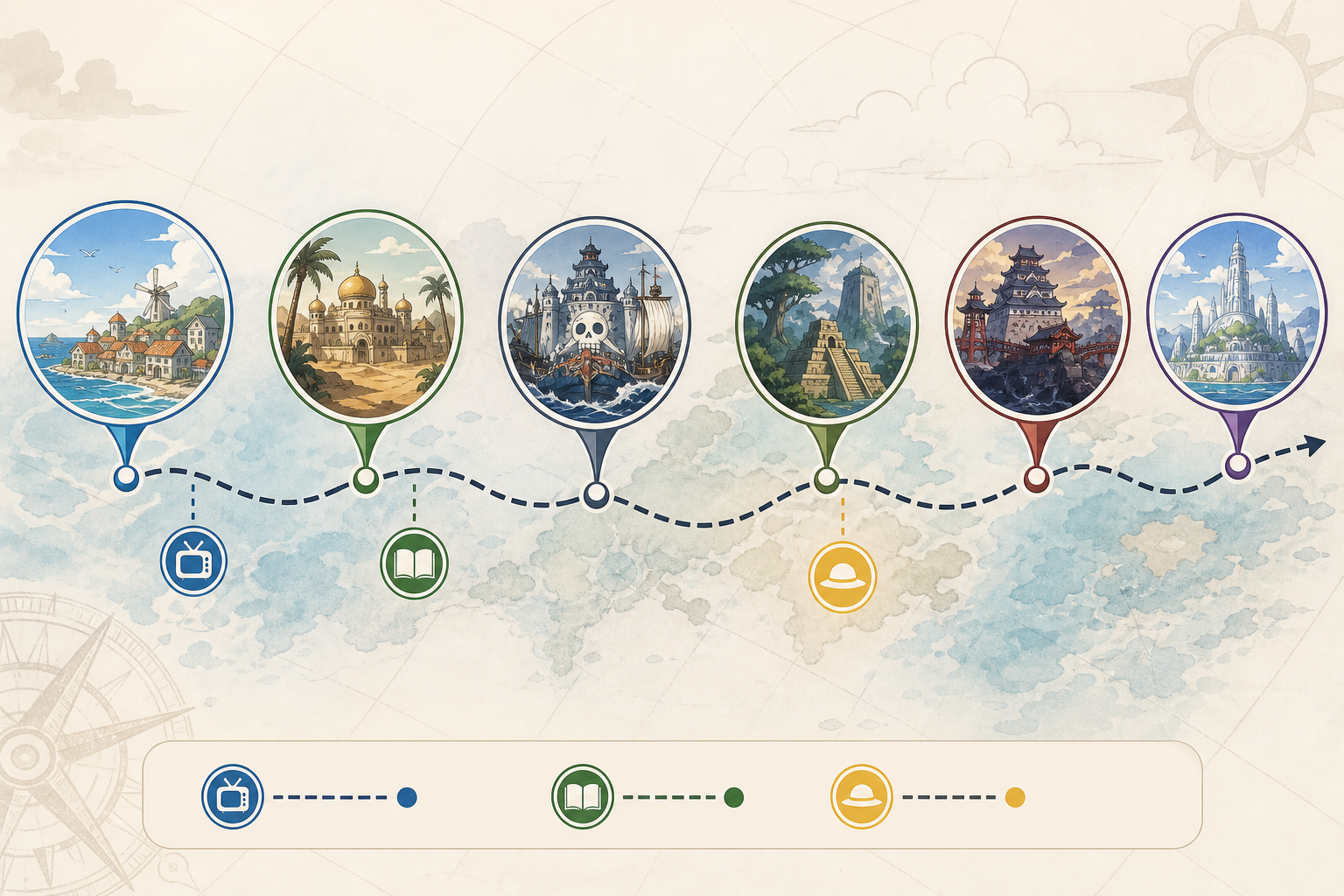
Spoiler-free One Piece arc checkpoint route from East Blue to the current anime story.
Use arc names as your progress markers when episode lists and streaming seasons differ.

East Blue through Alabasta: build the crew first

Watch: Romance Dawn, Orange Town, Syrup Village, Baratie, Arlong Park, Loguetown, Reverse Mountain, Whiskey Peak, Little Garden, Drum Island, and Alabasta.

This is the foundation. The early arcs introduce the crew’s values, the Grand Line, and the way One Piece connects personal dreams to a much larger world. Some early stories are lighter than others, but they are not disposable.

Minimal-filler move: Skip only the filler blocks that appear between these canon arcs. Keep the canon route intact.

Manga switch option: If the earliest anime pacing is not clicking, read a short stretch in the manga and return for Baratie, Arlong Park, Drum Island, and Alabasta. These arcs are especially rewarding with voices, music, and animation.

Mystery radar: Notice every mention of the World Government, old legends, and the difference between authority and freedom. Those ideas keep growing.

Jaya through Enies Lobby: do not rush the setup

Watch: Jaya, Skypiea, Long Ring Long Land, Water 7, Enies Lobby, and the post-Enies Lobby aftermath.

Water 7 and Enies Lobby are major emotional and plot landmarks, but the earlier material matters too. Jaya and Skypiea carry themes and worldbuilding that become more valuable as the series goes on. Long Ring Long Land is lighter in tone, yet it still belongs to the canon path.

Minimal-filler move: Take filler breaks only after a completed canon arc. Do not interrupt Water 7 or Enies Lobby once you begin.

Manga switch option: Skypiea is a reasonable manga-first choice for viewers who find its pace difficult. Return to the anime before Water 7 if you want the full impact of the performances.

Mystery radar: Watch how the story treats history, forbidden knowledge, inherited will, and the meaning of dreams. If you want a wider look at why these long-term payoffs work, read why the One Piece anime is so famous.

Thriller Bark through the Summit War: watch the turning point

Watch: Thriller Bark, Sabaody Archipelago, Amazon Lily, Impel Down, Marineford, and the post-war story.

This stretch changes the scale of the series. Earlier arcs show a crew finding its place in the world. Here, the world pushes back hard.

Minimal-filler move: Skip anime-original detours between arcs, but keep the main arc sequence. The post-war material is essential context for what comes next.

Manga switch option: Thriller Bark is a common point to read if you want to move faster. From Sabaody through the post-war story, many viewers prefer the anime because sound and performance add a great deal to key moments.

Mystery radar: Pay attention to the balance of power among pirates, Marines, and other major groups. The series is laying out rules that matter far beyond this era.

After the time skip through the current anime story: choose your pace

Watch: Return to Sabaody, Fish-Man Island, Punk Hazard, Dressrosa, Zou, Whole Cake Island, Reverie, Wano, and the current anime arc.

All of these arcs are part of the main story. They connect more tightly than the early saga structure may suggest, so skipping a whole canon arc will usually cost you setup later.

Minimal-filler move: This is the era where pacing concerns are most common. Skip pure filler, recaps you have just watched, and optional specials. Keep the canon plot, even when you decide to read it instead.

Manga switch option: Fish-Man Island, Dressrosa, and Wano are sensible checkpoints for a manga-first approach if you want faster progress. Finish a completed anime arc, then begin the next arc from its opening manga chapter or volume section. This avoids jumping formats in the middle of a fight or reveal.

The time skip itself is a major line between the two halves of the story. For a refresher once you reach it, see our breakdown of the One Piece two-year time skip.

Where to switch to the manga without losing the story

The best time to switch is at an arc boundary. Finish an arc in the anime, identify the title of the next arc, and start there in the manga. Avoid switching in the middle of a major conflict unless you have checked the matching chapter carefully.

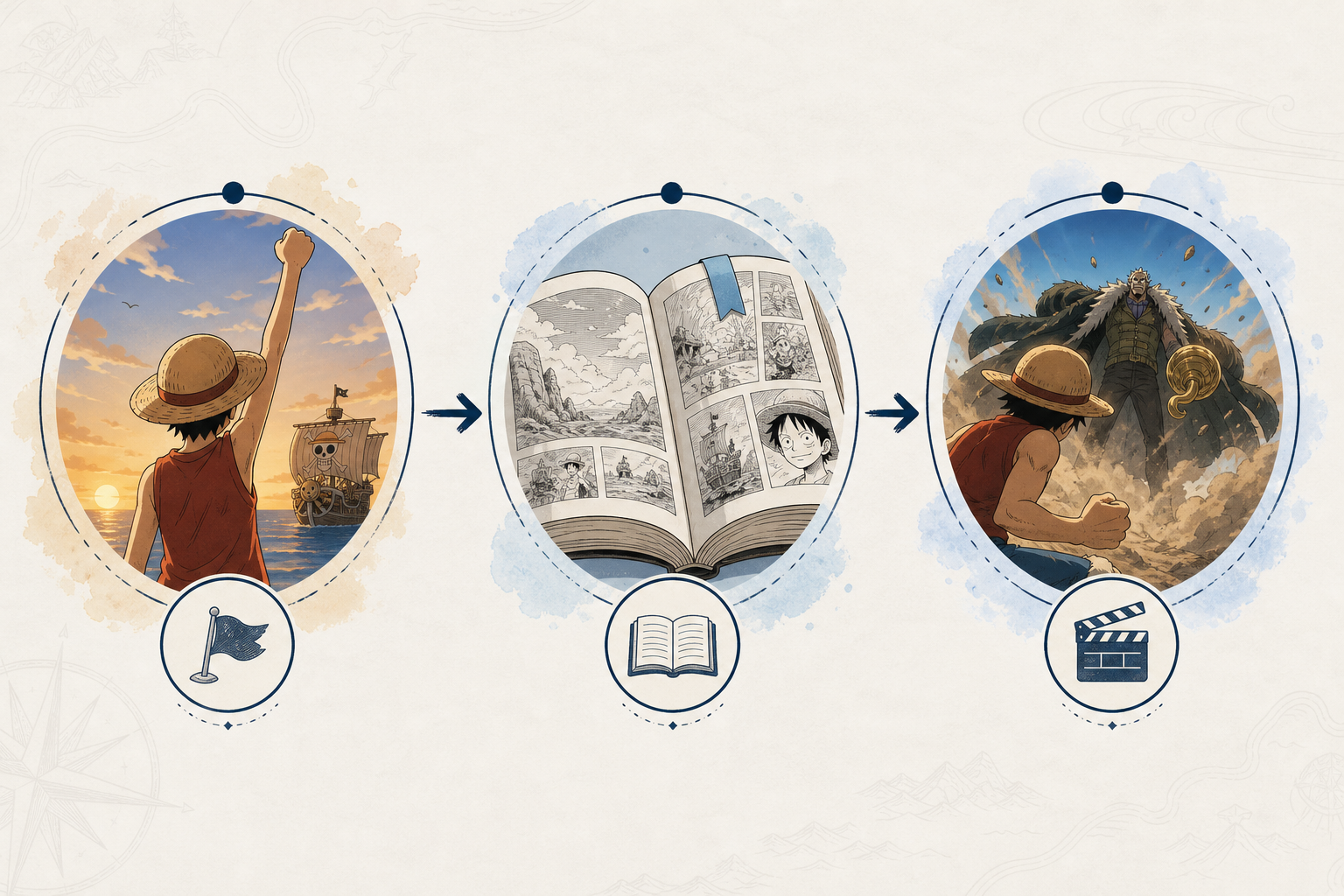
Three-step process for switching from the One Piece anime to the manga at an arc boundary.
Switching at an arc boundary reduces duplicate viewing and avoids mid-scene confusion.

Choose anime-first if you want the full performance

Stay with the anime if music, voice acting, color, and extended action are the parts you enjoy most. You can still skip filler and recaps without changing the main order.

This route works well if you are not in a hurry. One Piece is built around long setup and emotional release, and animation can make those releases hit harder.

Choose manga-first if you want clean pacing

Read the manga if you want a faster route through canon material, clearer scene flow, and an easier way to revisit clues. It is especially useful during large arcs with many locations and characters.

Then return to the anime selectively for favorite scenes, major fights, or episodes friends recommend. This is not “missing” the anime. It is using both formats for what they do best.

For official and digital reading options, see our guide to reading One Piece manga.

Keep yourself spoiler-safe when changing formats

New manga readers can run into spoilers fast. Search tools, video thumbnails, and character pages may show information beyond your place in the anime.

Use arc names rather than character names in searches. Read only to the end of your current arc before looking up explanations. If you are taking notes for theories, record the chapter or episode number beside each clue.

Movies, specials, and OVAs: where they fit

Most One Piece movies are not part of the manga’s central continuity. They may borrow characters, places, or ideas from the main story, but you do not need them to understand the next canon arc.

The safest movie rule

Watch a film only after you have reached the point where its cast, outfits, powers, and setting will not spoil you. If a trailer shows a person or ability you have not met, save the movie for later.

The easiest placement is between completed arcs. Never stop halfway through a tense arc just to fit in a movie.

A movie-inclusive reference such as TheGamer’s viewing-order overview can help with release context. Treat any placement as optional and spoiler-check the film before pressing play.

A spoiler-light movie plan

  • Early films: Save them until the first core crew introductions are complete.
  • Mid-series films: Watch them after a major arc ending, not during the main story.
  • Later films: Wait until you have reached the post-time-skip era they visually reference.
  • Newest films: Save these until you are close to the relevant modern anime material. Promotional art alone can reveal designs and abilities.

Specials and recap episodes follow the same rule. They are best used as a break, not as a required step in the One Piece watch order.

Netflix, Crunchyroll, and missing arcs

Netflix availability changes by region and licensing period. Crunchyroll or another service may have a different range of episodes. That does not create a new story order.

If a platform ends partway through a saga:

  • Write down the saga and arc name, not just the episode number.
  • Find the next legal service carrying that same arc.
  • If no stream is available, use the manga to cover the missing canon section.
  • Do not jump to the next arc merely because it is the next one in the app.

Platform seasons can be grouped in confusing ways. Arc names are the most reliable map.

FAQ

Should I skip filler episodes in One Piece?

Yes, if your goal is faster catch-up. Skip confirmed anime-original filler, but keep canon arcs. If you enjoy crew comedy and low-stakes side adventures, try a filler arc after a major story climax and decide for yourself.

Is One Piece episode 1155 the last episode?

Do not treat a single episode number as a final endpoint. One Piece is an ongoing anime, and listings can vary by platform and region. Check the current official listing for the most up-to-date release status. For planning, arc checkpoints are more useful than a fixed total.

Does the One Piece watch order change on Netflix?

No. The canonical order stays the same. Only the selection of episodes available in your region may change. Follow the next story arc, even if that means switching services or using the manga for a gap.

What makes One Piece worth the long watch?

Its biggest strength is payoff. Characters, mysteries, and small details can return far later with new meaning. The story also draws from a wide range of cultural ideas without feeling like a history lesson. For more on those layers, explore hidden Japanese cultural references in One Piece.

What is the fastest way to catch up?

Watch canon arcs in order, skip confirmed filler, skip recaps you have already seen, and switch to the manga at an arc boundary when pacing becomes a chore. Come back to the anime for moments you most want to hear and see.

The goal is not to finish as fast as possible. It is to reach the current story with the characters, mysteries, and emotional turns intact.

Why the Crew Helps in Alabasta: Vivi and Straw Hat Ethics

If you’re searching why the crew helps in Alabasta, you probably don’t want a scene-by-scene recap. You want the motive: what flips the Straw Hats from “trav…

The short answer to why the crew helps in Alabasta is that Vivi becomes their friend before Alabasta becomes their problem. The Straw Hats do not set out to fix a kingdom for glory. They see Vivi carry an impossible burden, learn that Crocodile is driving her country toward war, and decide that walking away is not an option.

Alabasta matters because it turns a familiar One Piece instinct—protecting a friend—into a crisis involving an entire nation. The crew can fight beside Vivi, but they cannot make her choices for her. That balance is the heart of the arc.

How Vivi turns a detour into a personal mission

Vivi first meets the Straw Hats while working undercover as Miss Wednesday. Her identity as Alabasta’s princess changes the scale of the story, but it is not her title that wins the crew over. It is her conduct.

She has already put herself in danger to investigate Baroque Works from within. Once her mission is exposed, she is not asking Luffy to win a throne for her. She is trying to stop people in her country from killing one another. That distinction matters: Vivi’s goal is protection, not power.

The crew also sees that she is willing to act. She travels with them, faces enemies herself, and keeps trying to reach Alabasta even when the odds are bad. For more on her role before, during, and after the arc, see Princess Vivi One Piece Explained.

The commitment happens in stages

There is no single contract that makes the Straw Hats responsible for Alabasta. Their commitment builds through a series of choices:

  • Vivi reveals what is at stake. Baroque Works is not merely chasing her; its plan threatens Alabasta’s people.
  • The crew agrees to take her home. Escorting her is dangerous, but it gives Vivi a chance to act before the conflict worsens.
  • They keep going when the trip becomes costly. Pursuit, hostile terrain, and injuries do not make them abandon her.
  • Luffy treats Vivi’s crisis as a friend’s crisis. Once he accepts that bond, the mission is no longer a favor with an easy exit.

This is why the arc feels more personal than a standard “save the kingdom” plot. The country matters because Vivi matters to them.

Crocodile’s plan makes neutrality impossible

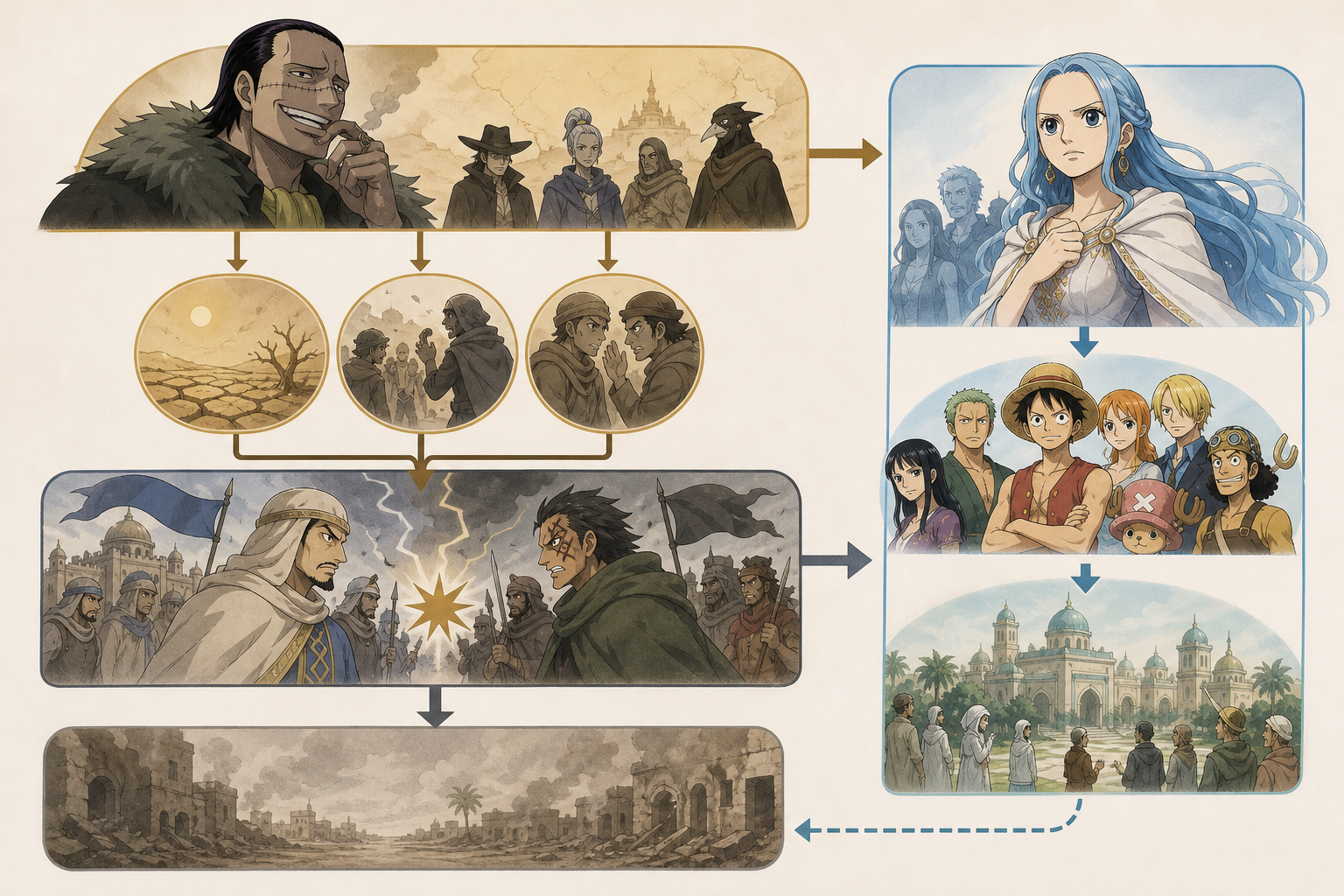
Crocodile, secretly Mr. 0 of Baroque Works, aims to seize control of Alabasta through Operation Utopia. He fuels distrust between the royal army and the rebels, exploits the kingdom’s drought, and lets both sides believe the other is responsible. His end goal is power, including access to the ancient weapon Pluton said to be connected to Alabasta.

Diagram of Crocodile’s manipulation of Alabasta’s civil conflict
The conflict is engineered to make Alabasta easier for Crocodile to control.

For a fuller event and battle guide, read Alabasta Arc One Piece Explained.

It is not simply a war between two sides

The conflict can look like a simple clash between a monarchy and a rebellion. The tragedy is that Crocodile engineers the conditions that make the clash possible. People who believe they are defending their homes or seeking justice are being used as pieces in his scheme.

That is exactly the kind of cruelty the Straw Hats cannot ignore. Crocodile does not only threaten Vivi or challenge Luffy. He treats ordinary people as tools and turns fear into a weapon.

The crew is not interested in ruling Alabasta or choosing its politics. Their role is more direct: expose the person manufacturing the disaster, protect their friend, and help prevent the catastrophe from becoming irreversible.

Why defeating Crocodile is not enough on its own

Even after Crocodile is confronted, Alabasta still faces a ticking clock. Rumors, anger, and armed conflict have a momentum of their own. The crew therefore cannot solve the problem with one fight alone.

That pressure gives the arc its moral weight. Luffy’s battle with Crocodile matters, but so do Vivi’s efforts to make herself heard and stop the fighting. The Straw Hats create an opening; Vivi remains the person trying to reach her people.

An official recap of the story also highlights the crew’s willingness to keep moving through danger, including their escape from the Marine blockade with Bon Clay’s help (Bandai Namco Entertainment).

What Alabasta reveals about Straw Hat ethics

Alabasta is an early, clear statement of the Straw Hats’ moral code. They are pirates, not formal heroes, and they do not take on every injustice they hear about. But several triggers reliably move them from concern to action.

A chosen friend is worth the risk

The crew does not protect Vivi because she is a princess. In fact, her rank means little to them. They protect her because she has shared danger with them and earned their trust.

That is the key answer to why the crew helps in Alabasta: friendship is not a light promise in this crew. Once someone is accepted as one of their own, inconvenience and danger stop being reasons to leave.

They reject power built on manipulation

Crocodile’s strength is not just his Devil Fruit. It is his ability to hide behind a public image while he creates misery in private. The Straw Hats have little patience for that kind of power.

They do not need a political theory to recognize the problem. They see a powerful person trapping civilians in a conflict they did not choose, and they push back. For a closer look at Mr. 0’s place in the story, see Crocodile One Piece Explained.

Helping is not the same as taking over

The Straw Hats help Vivi, but they do not replace her. She has knowledge of her country, ties to its people, and a responsibility she chooses to carry. Luffy cannot speak to the citizens of Alabasta in her place, and he does not try.

That division of roles is one reason the ending works. The crew fights the forces blocking Vivi’s path. Vivi faces her people and works for peace herself. It is support without possession.

The scenes that make Vivi a non-negotiable friend

The arc has many fights, but its most important turns are emotional decisions. These are the moments to watch when revisiting the story.

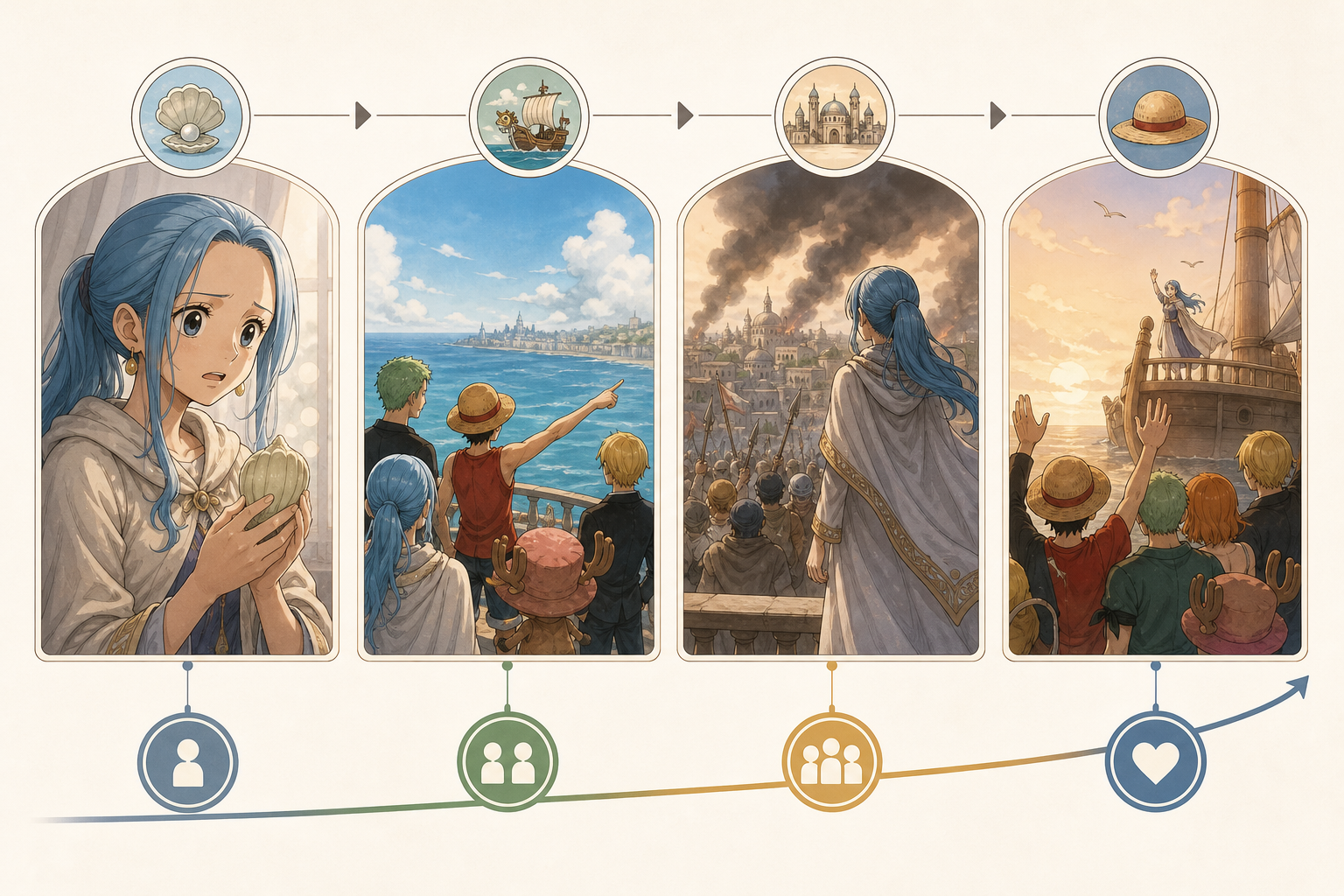
Four key stages in Vivi becoming a trusted Straw Hat friend
Alabasta becomes personal through repeated choices, not one request for help.

Vivi drops the disguise and shows the cost of her mission

Once the Straw Hats understand that Miss Wednesday is Vivi, they also understand how much she has risked alone. Her royal status does not erase her fear or make the task easy. It makes the stakes more painful: she is watching her own country slide toward violence.

The crew responds to that sincerity, not to royal authority.

Luffy refuses to let her carry everything alone

Vivi often tries to bear the full responsibility for Alabasta. Luffy pushes against that instinct. His response is not a detailed plan for governing a country. It is a blunt refusal to let a friend suffer alone while he can act.

That is a recurring Straw Hat pattern: when someone insists they must handle a crisis by themselves, the crew challenges the isolation before it challenges the enemy.

The crew accepts the cost of staying

Traveling to Alabasta brings heat from Baroque Works and the Marines, as well as the hazards of the Grand Line. The crew has chances to treat Vivi as a temporary passenger and move on. Instead, they keep choosing the harder route.

Their loyalty is practical, not ceremonial. They show it by continuing the journey, sharing the danger, and fighting for the chance that Vivi can reach her people.

The farewell proves the friendship is not conditional

The farewell is powerful because Alabasta has already established the rule: friendship does not require ownership. Vivi belongs with her people, while the Straw Hats must continue their voyage. Separation does not undo what they chose together.

That idea becomes especially important when considering other characters whose loyalty is unclear at first.

Nami, Robin, and Bon Clay: three useful contrasts

Questions about betrayal and shifting alliances often get folded into Alabasta discussions. These characters show three different forms of loyalty under pressure.

Nami did not betray Luffy in Alabasta

When fans ask why Nami “betrayed” Luffy, they are usually referring to the Arlong Park story, not Alabasta. Nami works under Arlong because she is trying to protect Cocoyasi Village. Her secrecy is a survival strategy under coercion.

Vivi’s situation is different in scale but similar in one key way: both women try to carry a crushing responsibility alone. The Straw Hats’ response in both stories is to look past the apparent betrayal or distance and see the pressure underneath.

Robin helps Luffy, but her motives stay guarded

Nico Robin, then known as Miss All Sunday, is one of the arc’s deliberate mysteries. She opposes Crocodile at key moments, including helping Luffy survive, but she does not suddenly become an open Straw Hat ally. Her actions are tied to her own goals, especially the poneglyph in Alabasta, and the story keeps her motives partly hidden.

That uncertainty is what makes her later place in the crew meaningful. Alabasta begins the question of whether an enemy can become someone worth trusting. Explore that later journey in Nico Robin One Piece Explained.

Bon Clay shows that honor can cross enemy lines

Mr. 2 Bon Clay begins as an opponent, but he also follows his own code. His actions complicate the simple labels of friend and enemy. In an arc driven by deception, he stands out because a promise can still mean something to him.

Together, Vivi, Robin, and Bon Clay show that One Piece treats loyalty as a choice shaped by pressure, values, and action—not as a fixed team label.

Why Alabasta remains important in One Piece

Alabasta is one of the first arcs to show that the Straw Hats can affect a world much larger than their ship. It expands the story beyond island adventures without losing the personal reason the crew gets involved.

The formula is simple but powerful: a friend is in danger, a corrupt force is hurting ordinary people, and the crew refuses to stand aside. Yet the arc also avoids making the Straw Hats the sole owners of the victory. Vivi’s voice, the citizens’ choices, and the truth behind the conflict all matter.

That is why Alabasta is more than a Crocodile fight or a royal rescue plot. It is the point where the Straw Hats’ chosen-family ethics meet a national crisis—and where their willingness to help becomes impossible to mistake.

Quick reference: chapters, episodes, and common questions

Which chapters and episodes cover Alabasta?

The Alabasta Arc is commonly listed as manga chapters 155–217 and anime episodes 92–130. Lists sometimes differ because fans and platforms may include earlier Baroque Works setup arcs in the wider Alabasta Saga. The One Piece Wiki arc guide is a useful cross-check, though streaming services may group episodes differently.

Is Alabasta one of the most disliked One Piece arcs?

There is no single answer because fan opinion changes by platform, pacing preference, and whether someone watches the anime or reads the manga. Alabasta is often discussed as a major early arc rather than a consensus “most disliked” one. Its long-term importance comes from Vivi, Crocodile, Robin, Baroque Works, and the way it broadens the world’s political stakes.

How should a live-action version handle Alabasta?

Any adaptation would need to preserve the core relationship, not just the desert setting or major fights: Vivi’s agency, Crocodile’s manipulation of public fear, and the crew’s decision to treat her problem as their own. Specific adaptation choices should not be assumed until they are officially announced.

What Would Abolishing Shichibukai Change in One Piece?

Abolishing the Shichibukai would change the shape of power in One Piece overnight: the Marines lose legal “free agents,” Pirates lose a shortcut to safety, a…

The Shichibukai system has already been abolished in One Piece. So the real question is: what would abolishing Shichibukai change in the balance of the seas?

It takes away the World Government’s right to work with selected pirates. The Marines must now hunt former Warlords. Pirates gain new chances to seize territory. And the Government needs a replacement it can control.

That does not make the world safer overnight. It makes the map less stable.

> Spoiler note: This article covers the Reverie decision and later manga and anime developments.

The short answer: power becomes harder to manage

The Shichibukai were pirates with government approval. Their goals were never the same, but the title gave the World Government a useful shortcut. It could tolerate powerful criminals, call on them in war, and point them toward larger threats.

After abolition, three things happen at once:

  • Former Warlords become targets. The Marines can no longer leave them alone for political reasons.
  • The Marines take on more work. They must deal with threats the Warlords once discouraged or contained.
  • Pirate power becomes more fluid. Crews can seek new allies, grab land, and build new networks.

The system had always been full of risks. Crocodile used his title to hide his plan for Alabasta. Doflamingo used his status to protect a criminal network. Abolition ends that official cover, but it also removes a deterrent before the Government can prove its replacement works.

For more on the Marine mindset behind strict enforcement, read What Is Absolute Justice in One Piece?.

Was the Warlord system abolished in canon?

Yes. At the Reverie, the member nations voted to end the Seven Warlords of the Sea program. The choice came after years of proof that the system gave dangerous pirates political protection.

The direct result is clear: former Warlords lose their protected status and become targets for capture. One overview of the decision also describes the program as ending after repeated abuses by its members (VCGamers’ overview of the disbandment).

But ending a title does not make Mihawk, Hancock, Buggy, or the other former Warlords weaker. It changes their legal position. They now have to choose between escape, open conflict, independence, or a new alliance.

Who were the Seven Warlords?

The roster changed over time. When fans ask “who are the 7 warlords,” they often mean this early lineup:

Warlord Why the title mattered
Dracule Mihawk His strength alone made him a major deterrent.
Crocodile He used government trust to hide a plan against Alabasta.
Donquixote Doflamingo He mixed royal status, underworld power, and Warlord protection.
Bartholomew Kuma He became closely linked to Government science and military work.
Gecko Moria He built power through an army of zombies.
Boa Hancock She accepted the title in part to protect Amazon Lily.
Jinbe He brought political weight through Fish-Man Island.

Other holders included Marshall D. Teach, Trafalgar Law, Buggy, and Edward Weevil. This shifting roster was part of the flaw. The Government was not managing one united force. It was making deals with people who had very different aims.

Who benefits most from the power vacuum?

The biggest winners are not always the best fighters. They are the people who can move fast, recruit talent, and turn fear into influence.

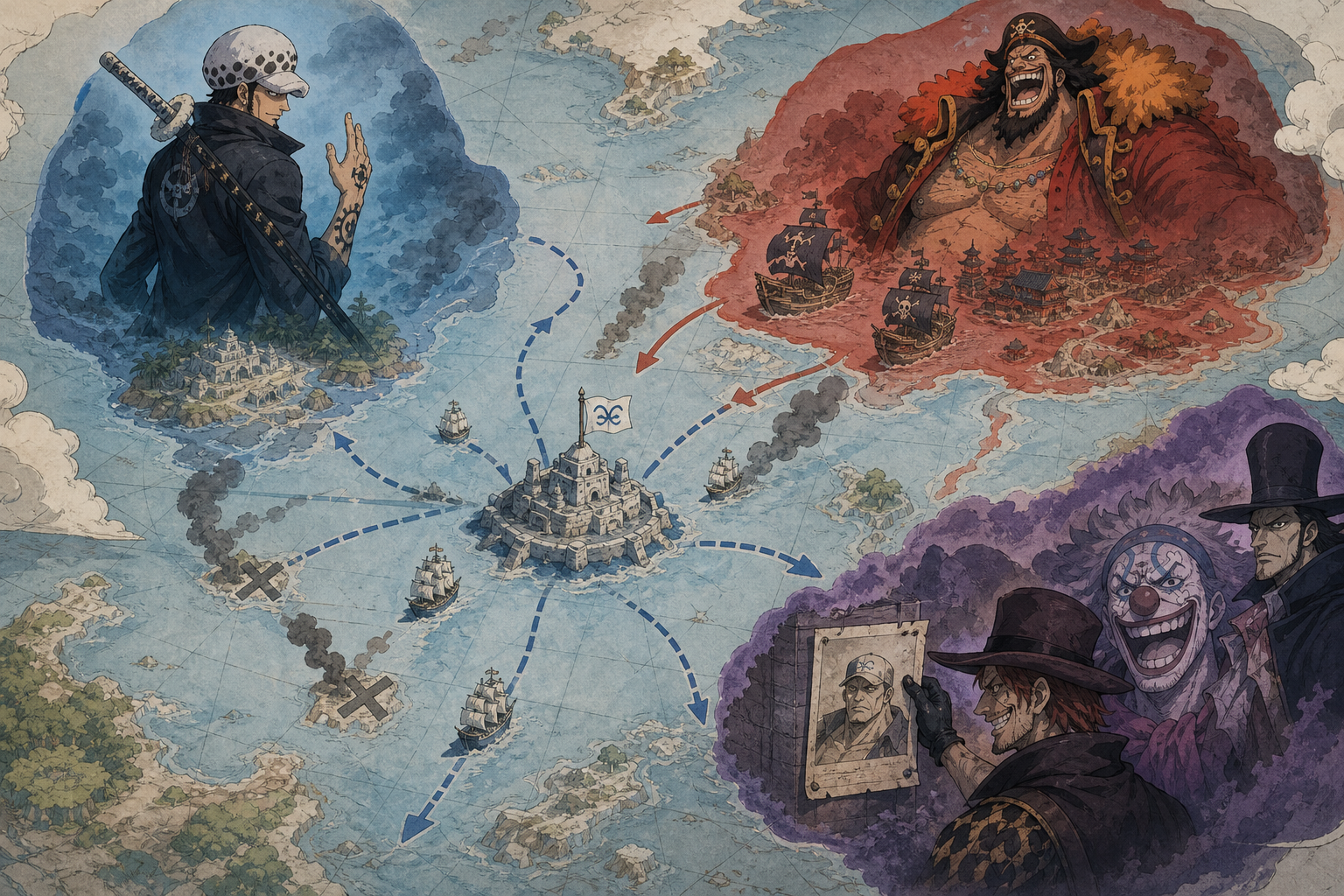
Illustration of competing powers after the Warlord system ends.
The post-Warlord era creates several competing centers of power rather than a simple Marine victory.

Large pirate groups

In the Yonko era, power rests on territory, supply routes, crews, and reputation. When a former Warlord loses legal cover, a large pirate group can offer another option: join us, work with us, or become our enemy.

Former Warlords become valuable free agents. Their names can draw recruits, scare rivals, and change the safety of an entire route. Yet these alliances can be weak. A deal made to avoid the Marines may end when a better offer appears.

Cross Guild and reputation-based power

The post-abolition era shows that the Warlord title was not the only way to organize fear. Cross Guild, formed by Buggy, Mihawk, and Crocodile, puts bounties on Marines.

That flips an old incentive. The Marines used bounties to encourage people to hunt pirates. Cross Guild uses the same idea against them. It does not erase Marine power, but it makes enforcement more dangerous.

Crocodile is a good example of why combat strength is only one kind of power. He also has ambition, planning skill, and connections. Doflamingo filled a similar role through the underworld before his defeat in Dressrosa. For Dressrosa context, see One Piece Sabo Kills Burgess – What Really Happened?.

Independent crews and underworld brokers

Small crews can find openings when larger forces are distracted. A local pirate may raid a route, take an island, or sell protection before a Marine force arrives.

Brokers also gain from uncertainty. When official deals collapse, people need information, weapons, safe passage, and introductions to stronger crews. Still, this is risky. The same chaos that helps a small crew can bring a Yonko crew, a Marine fleet, or a former Warlord to its door.

The Marines, but at a price

The Marines gain a clearer legal position. They no longer have to defend a program that protected pirates who abused their status.

But this is an expensive win. They need ships, soldiers, intelligence, and powerful officers to pursue targets that once sat outside normal enforcement. Remote bases and poorly defended islands may feel that pressure most.

Civilians may benefit the least in the short term. A contested sea can mean broken trade routes, more raids, and fewer reliable protectors.

What replaces the Shichibukai system?

The World Government did not end the Warlords without another plan. Its answer is the Special Science Group, or SSG, based on Dr. Vegapunk’s science.

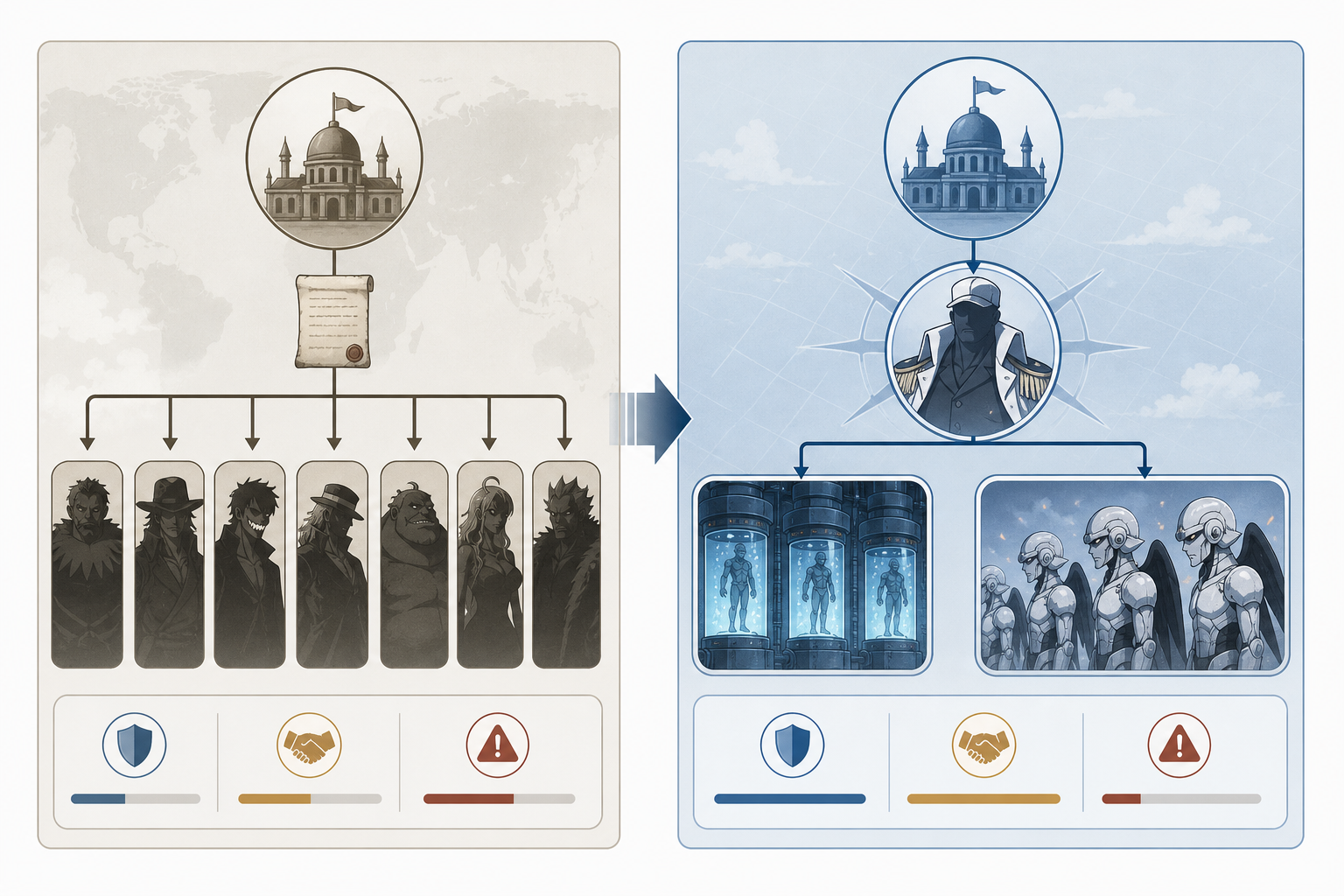
Diagram comparing the Warlord system with the SSG-based enforcement model.
Abolition shifts the Government from negotiated pirate power toward direct control of military science.

The basic goal is simple: replace pirate allies with forces the Government can command.

SSG and the Seraphim: control instead of contracts

The Seraphim are the clearest new enforcement tool. They are powerful Government weapons with traits tied to former Warlords. They are meant to give the Marines force without having to bargain with pirates.

Old system: Shichibukai New direction: SSG and Seraphim
The Government makes deals with pirates The Government relies on science and its own chain of command
Loyalty is personal and conditional Obedience is built into the force
Warlords follow private goals The Government seeks more direct control
Political cover can shield crimes State power can be used more directly

The new system has its own danger. A Warlord could ignore orders or betray the Government. A controlled weapon raises another question: who gives the orders, and what happens if that power is misused?

More strain on Marine resources

Technology can add firepower, but it cannot be everywhere at once. The Marines still need ships, supplies, intelligence, and officers across a huge world.

That creates an enforcement gap. Some islands may be safer without a predatory Warlord acting as their “protector.” Others may face more raids until the Marines can establish a real presence.

This is the practical answer to what would abolishing Shichibukai change: the Government gives up a morally compromised shortcut for a more direct and costly kind of control.

How former Warlords change the map

Each former Warlord creates a different problem. What matters is not only personal strength, but also the kind of disruption each one can cause.

Mihawk: a target the Marines cannot take lightly

Mihawk does not need a huge crew or a large territory to force a response. Hunting him takes planning and enough force to avoid a costly defeat. That makes him an expensive target.

His independence matters too. He does not fit neatly under a Yonko flag or in a normal pirate crew. In a world built on crews and alliances, that makes him hard to predict.

Boa Hancock: Amazon Lily faces new risks

Hancock’s title helped protect Amazon Lily. When it was revoked, the island became more open to a Government attack and to outside pirates drawn by its location and reputation.

Her case shows that the system was not only about combat. The title could act as a shield for a community. Removing it may fit the Government’s policy, but the people behind the title face the first danger.

Buggy and Crocodile: organization can matter more than rank

Buggy’s public image draws followers. Crocodile brings strategy and ambition. Their partnership shows that ending the Warlords does not reduce pirate influence. It can push powerful pirates to build groups that are more flexible than the old, state-approved system.

That is why the post-Warlord era feels less stable. Power no longer fits neatly into Marines, Yonko, and Warlords. New groups can mix fame, money, and force in unexpected ways.

One Piece arcs in order: the route to abolition

For one piece arcs in order, these are the key stops for the Warlord story:

  1. Baratie introduces Mihawk and shows the gap between a Warlord and most pirates.
  2. Alabasta reveals how Crocodile used his title to hide a plot against a kingdom.
  3. Thriller Bark shows Moria acting with broad freedom despite the harm he causes.
  4. Sabaody Archipelago highlights the Celestial Dragons and the World Government’s unequal justice.
  5. Marineford shows the Warlords as part of the Government’s wartime balance.
  6. Dressrosa exposes Doflamingo’s mix of Warlord status, royalty, and criminal power.
  7. Reverie brings the vote to abolish the system.

In this order, abolition is not a sudden change of heart. It is the result of a long-running question: can the World Government claim justice while protecting pirates who serve its interests?

For the broader stakes around freedom, Government secrets, and the Pirate King’s dream, see What Is The One Piece? – Plus Theory!.

FAQ

Is Law still Luffy’s ally?

Law and Luffy formed an alliance to take down Kaido. They share history and have worked together when their goals match. But they are not one permanent crew, and neither commands the other. They are best seen as allies when the situation calls for it.

Who is the Shichibukai that Ace defeated?

Ace did not defeat Jinbe in a clear victory. They fought for five days, and the battle ended with no decisive winner. Their later respect for each other matters more than a simple power-ranking answer.

Did abolition make the world safer?

Not right away. It removes official protection for dangerous pirates and ends a deeply flawed system. But it also starts a fight over territory, resources, and allies. In the short term, that can make the seas more dangerous, especially for small islands and weak crews.

What changes most after the Shichibukai are abolished?

Control changes hands. The Government shifts from negotiated pirate power to direct force through the SSG. Former Warlords must defend themselves or form new alliances. That pressure changes Marine goals, pirate behavior, and the safety of the seas.