What Would Abolishing Shichibukai Change in One Piece?

Abolishing the Shichibukai would change the shape of power in One Piece overnight: the Marines lose legal “free agents,” Pirates lose a shortcut to safety, a…

The Shichibukai system has already been abolished in One Piece. So the real question is: what would abolishing Shichibukai change in the balance of the seas?

It takes away the World Government’s right to work with selected pirates. The Marines must now hunt former Warlords. Pirates gain new chances to seize territory. And the Government needs a replacement it can control.

That does not make the world safer overnight. It makes the map less stable.

> Spoiler note: This article covers the Reverie decision and later manga and anime developments.

The short answer: power becomes harder to manage

The Shichibukai were pirates with government approval. Their goals were never the same, but the title gave the World Government a useful shortcut. It could tolerate powerful criminals, call on them in war, and point them toward larger threats.

After abolition, three things happen at once:

  • Former Warlords become targets. The Marines can no longer leave them alone for political reasons.
  • The Marines take on more work. They must deal with threats the Warlords once discouraged or contained.
  • Pirate power becomes more fluid. Crews can seek new allies, grab land, and build new networks.

The system had always been full of risks. Crocodile used his title to hide his plan for Alabasta. Doflamingo used his status to protect a criminal network. Abolition ends that official cover, but it also removes a deterrent before the Government can prove its replacement works.

For more on the Marine mindset behind strict enforcement, read What Is Absolute Justice in One Piece?.

Was the Warlord system abolished in canon?

Yes. At the Reverie, the member nations voted to end the Seven Warlords of the Sea program. The choice came after years of proof that the system gave dangerous pirates political protection.

The direct result is clear: former Warlords lose their protected status and become targets for capture. One overview of the decision also describes the program as ending after repeated abuses by its members (VCGamers’ overview of the disbandment).

But ending a title does not make Mihawk, Hancock, Buggy, or the other former Warlords weaker. It changes their legal position. They now have to choose between escape, open conflict, independence, or a new alliance.

Who were the Seven Warlords?

The roster changed over time. When fans ask “who are the 7 warlords,” they often mean this early lineup:

Warlord Why the title mattered
Dracule Mihawk His strength alone made him a major deterrent.
Crocodile He used government trust to hide a plan against Alabasta.
Donquixote Doflamingo He mixed royal status, underworld power, and Warlord protection.
Bartholomew Kuma He became closely linked to Government science and military work.
Gecko Moria He built power through an army of zombies.
Boa Hancock She accepted the title in part to protect Amazon Lily.
Jinbe He brought political weight through Fish-Man Island.

Other holders included Marshall D. Teach, Trafalgar Law, Buggy, and Edward Weevil. This shifting roster was part of the flaw. The Government was not managing one united force. It was making deals with people who had very different aims.

Who benefits most from the power vacuum?

The biggest winners are not always the best fighters. They are the people who can move fast, recruit talent, and turn fear into influence.
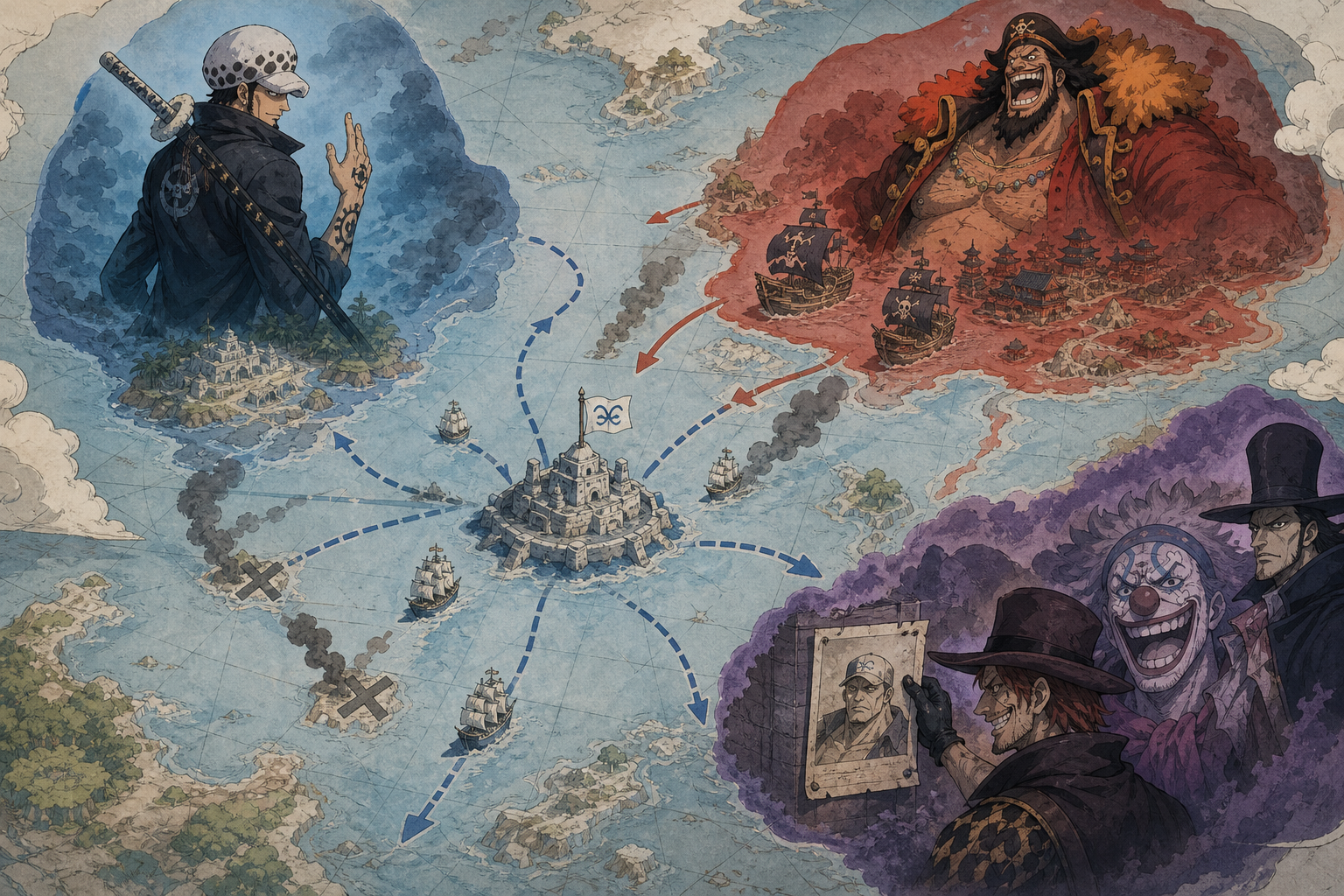
Illustration of competing powers after the Warlord system ends.
The post-Warlord era creates several competing centers of power rather than a simple Marine victory.

Large pirate groups

In the Yonko era, power rests on territory, supply routes, crews, and reputation. When a former Warlord loses legal cover, a large pirate group can offer another option: join us, work with us, or become our enemy.

Former Warlords become valuable free agents. Their names can draw recruits, scare rivals, and change the safety of an entire route. Yet these alliances can be weak. A deal made to avoid the Marines may end when a better offer appears.

Cross Guild and reputation-based power

The post-abolition era shows that the Warlord title was not the only way to organize fear. Cross Guild, formed by Buggy, Mihawk, and Crocodile, puts bounties on Marines.

That flips an old incentive. The Marines used bounties to encourage people to hunt pirates. Cross Guild uses the same idea against them. It does not erase Marine power, but it makes enforcement more dangerous.

Crocodile is a good example of why combat strength is only one kind of power. He also has ambition, planning skill, and connections. Doflamingo filled a similar role through the underworld before his defeat in Dressrosa. For Dressrosa context, see One Piece Sabo Kills Burgess – What Really Happened?.

Independent crews and underworld brokers

Small crews can find openings when larger forces are distracted. A local pirate may raid a route, take an island, or sell protection before a Marine force arrives.

Brokers also gain from uncertainty. When official deals collapse, people need information, weapons, safe passage, and introductions to stronger crews. Still, this is risky. The same chaos that helps a small crew can bring a Yonko crew, a Marine fleet, or a former Warlord to its door.

The Marines, but at a price

The Marines gain a clearer legal position. They no longer have to defend a program that protected pirates who abused their status.

But this is an expensive win. They need ships, soldiers, intelligence, and powerful officers to pursue targets that once sat outside normal enforcement. Remote bases and poorly defended islands may feel that pressure most.

Civilians may benefit the least in the short term. A contested sea can mean broken trade routes, more raids, and fewer reliable protectors.

What replaces the Shichibukai system?

The World Government did not end the Warlords without another plan. Its answer is the Special Science Group, or SSG, based on Dr. Vegapunk’s science.
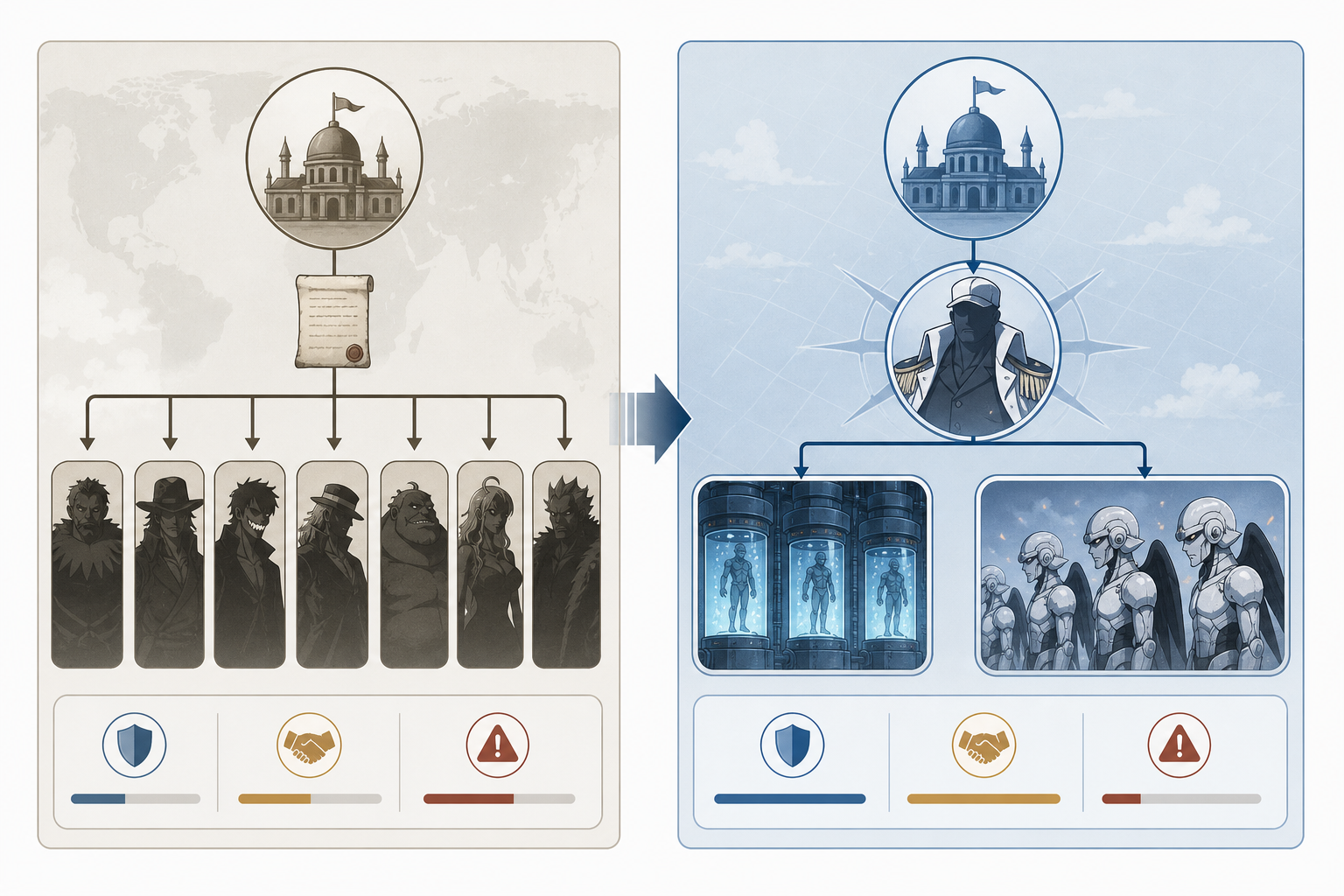
Diagram comparing the Warlord system with the SSG-based enforcement model.
Abolition shifts the Government from negotiated pirate power toward direct control of military science.

The basic goal is simple: replace pirate allies with forces the Government can command.

SSG and the Seraphim: control instead of contracts

The Seraphim are the clearest new enforcement tool. They are powerful Government weapons with traits tied to former Warlords. They are meant to give the Marines force without having to bargain with pirates.

Old system: Shichibukai New direction: SSG and Seraphim
The Government makes deals with pirates The Government relies on science and its own chain of command
Loyalty is personal and conditional Obedience is built into the force
Warlords follow private goals The Government seeks more direct control
Political cover can shield crimes State power can be used more directly

The new system has its own danger. A Warlord could ignore orders or betray the Government. A controlled weapon raises another question: who gives the orders, and what happens if that power is misused?

More strain on Marine resources

Technology can add firepower, but it cannot be everywhere at once. The Marines still need ships, supplies, intelligence, and officers across a huge world.

That creates an enforcement gap. Some islands may be safer without a predatory Warlord acting as their “protector.” Others may face more raids until the Marines can establish a real presence.

This is the practical answer to what would abolishing Shichibukai change: the Government gives up a morally compromised shortcut for a more direct and costly kind of control.

How former Warlords change the map

Each former Warlord creates a different problem. What matters is not only personal strength, but also the kind of disruption each one can cause.

Mihawk: a target the Marines cannot take lightly

Mihawk does not need a huge crew or a large territory to force a response. Hunting him takes planning and enough force to avoid a costly defeat. That makes him an expensive target.

His independence matters too. He does not fit neatly under a Yonko flag or in a normal pirate crew. In a world built on crews and alliances, that makes him hard to predict.

Boa Hancock: Amazon Lily faces new risks

Hancock’s title helped protect Amazon Lily. When it was revoked, the island became more open to a Government attack and to outside pirates drawn by its location and reputation.

Her case shows that the system was not only about combat. The title could act as a shield for a community. Removing it may fit the Government’s policy, but the people behind the title face the first danger.

Buggy and Crocodile: organization can matter more than rank

Buggy’s public image draws followers. Crocodile brings strategy and ambition. Their partnership shows that ending the Warlords does not reduce pirate influence. It can push powerful pirates to build groups that are more flexible than the old, state-approved system.

That is why the post-Warlord era feels less stable. Power no longer fits neatly into Marines, Yonko, and Warlords. New groups can mix fame, money, and force in unexpected ways.

One Piece arcs in order: the route to abolition

For one piece arcs in order, these are the key stops for the Warlord story:

  1. Baratie introduces Mihawk and shows the gap between a Warlord and most pirates.
  2. Alabasta reveals how Crocodile used his title to hide a plot against a kingdom.
  3. Thriller Bark shows Moria acting with broad freedom despite the harm he causes.
  4. Sabaody Archipelago highlights the Celestial Dragons and the World Government’s unequal justice.
  5. Marineford shows the Warlords as part of the Government’s wartime balance.
  6. Dressrosa exposes Doflamingo’s mix of Warlord status, royalty, and criminal power.
  7. Reverie brings the vote to abolish the system.

In this order, abolition is not a sudden change of heart. It is the result of a long-running question: can the World Government claim justice while protecting pirates who serve its interests?

For the broader stakes around freedom, Government secrets, and the Pirate King’s dream, see What Is The One Piece? – Plus Theory!.

FAQ

Is Law still Luffy’s ally?

Law and Luffy formed an alliance to take down Kaido. They share history and have worked together when their goals match. But they are not one permanent crew, and neither commands the other. They are best seen as allies when the situation calls for it.

Who is the Shichibukai that Ace defeated?

Ace did not defeat Jinbe in a clear victory. They fought for five days, and the battle ended with no decisive winner. Their later respect for each other matters more than a simple power-ranking answer.

Did abolition make the world safer?

Not right away. It removes official protection for dangerous pirates and ends a deeply flawed system. But it also starts a fight over territory, resources, and allies. In the short term, that can make the seas more dangerous, especially for small islands and weak crews.

What changes most after the Shichibukai are abolished?

Control changes hands. The Government shifts from negotiated pirate power to direct force through the SSG. Former Warlords must defend themselves or form new alliances. That pressure changes Marine goals, pirate behavior, and the safety of the seas.

What Is the Peter Pan Theme in Crocodile? Explained

If you’re asking what is the peter pan theme in crocodile, you’re usually not looking for an Alabasta recap. You want the parallel: a way to read Crocodile a…

If you are asking what is the peter pan theme in crocodile, the useful answer is not that Crocodile is secretly Captain Hook. It is that he can be read through a Hook-like lens: a powerful man who relies on status, planning, and fear because losing control would destroy the image he built.

This is a fan interpretation, not confirmed One Piece canon. Still, it fits Alabasta surprisingly well. Crocodile creates a crisis with a deadline, turns public fear into a weapon, and tries to make one future feel unavoidable. That gives the arc a strong time-and-control theme.

The short answer: Crocodile as a Hook-like villain

The Peter Pan reading connects Crocodile with Captain Hook, not with Peter Pan himself.

Hook is a pirate captain defined by wounded pride, a theatrical public image, and fear of the ticking crocodile that pursues him. Crocodile shares the parts that matter for a thematic comparison:

  • He presents himself as untouchable.
  • He hides insecurity behind titles, threats, and careful planning.
  • He treats humiliation as dangerous.
  • He tries to control the setting before anyone can challenge him.
  • His Alabasta scheme runs on mounting pressure and a clear sense that time is running out.

So, what is the peter pan theme in crocodile? It is the idea that Crocodile is trying to outrun vulnerability by becoming the person who controls everyone else’s fate. Like Hook, he needs the performance of power as much as power itself.

For the plot facts behind that reading, see our guide to Crocodile’s powers, Baroque Works role, and Operation Utopia. The theory works best when it stays grounded in what he actually does in Alabasta.

Peter Pan basics: the crocodile, Hook, and the ticking clock

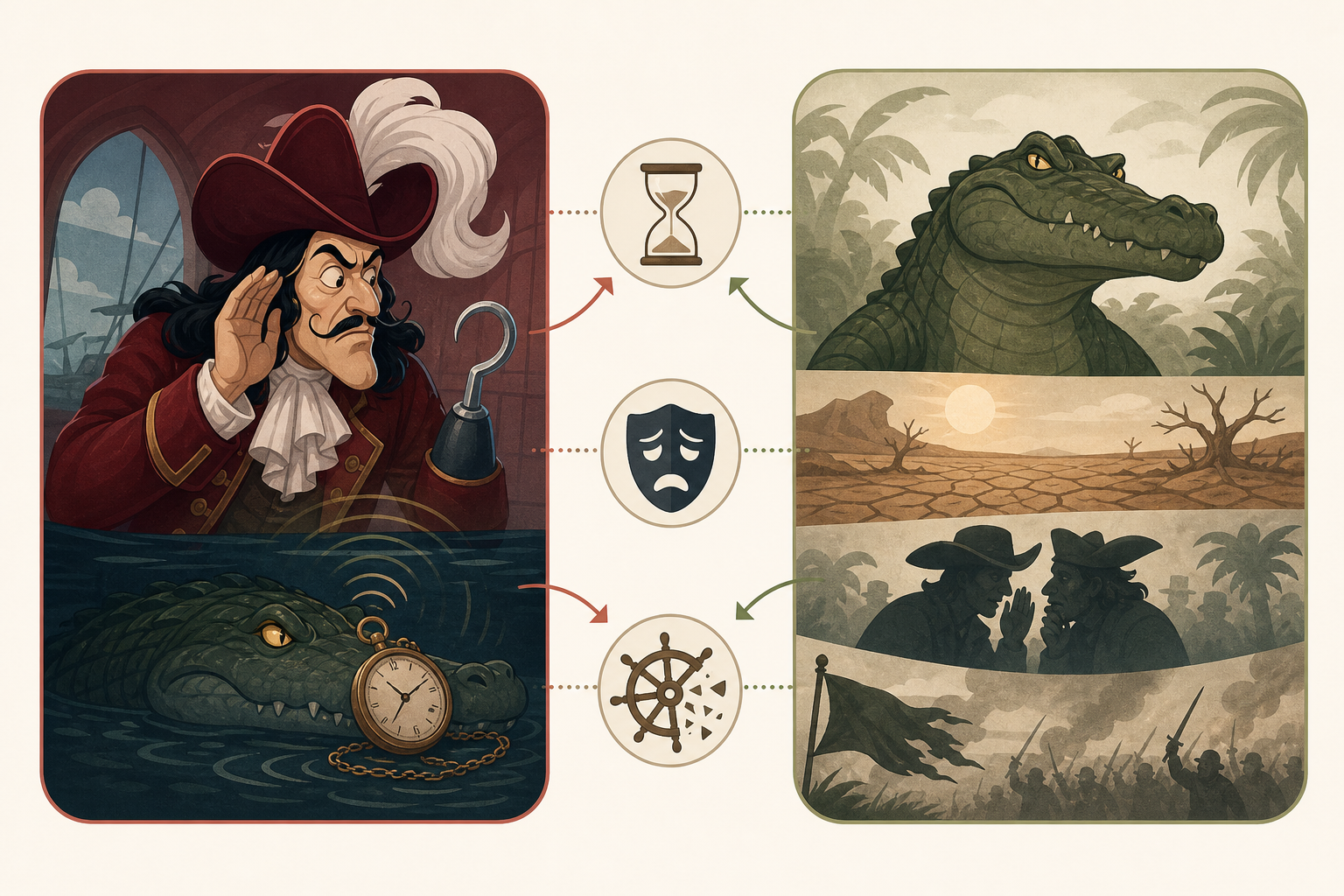
In the familiar Peter Pan story, Captain Hook loses a hand to Peter Pan. A crocodile swallows the hand along with a clock, then pursues Hook. The ticking becomes a warning that the predator is near.

Diagram comparing Hook’s ticking crocodile with Crocodile’s time pressure in Alabasta.
The parallel is thematic: both stories use looming consequences and fear of lost control.

That is why the crocodile is often called Tick-Tock in Disney-related material. The supplied Disney soundtrack listing includes “The Legend of the Croc,” reflecting how central the crocodile is to Hook’s fear in that adaptation (Disney’s Peter Pan soundtrack sequence). Names and details can vary between adaptations, but the symbolic role stays clear: the crocodile makes time feel like a hunter.

What does Captain Hook represent?

A single symbol never has one fixed meaning, but Hook often reads as a character afraid of decline. He values rank, ceremony, revenge, and being taken seriously. The ticking crocodile threatens all of that. It reminds him that his control has limits.

That makes Hook useful for reading Crocodile. Crocodile is not literally chased by a clock or a monster. Instead, the “tick” appears in the pressure of his own operation. His plan depends on events happening before the truth reaches the right people and before Alabasta can pull itself back from collapse.

Why the clock matters more than the crocodile’s name

The strongest parallel is not “there is a character named Crocodile.” It is the clock.

In Peter Pan, the ticking sound tells Hook that consequences are coming. In Alabasta, drought, unrest, mistrust, and the coming civil war create a similar feeling. Crocodile benefits when everyone believes there is no time left to verify claims or find another path.

That is a useful way to watch the arc: notice every moment when panic makes people act before they have enough information.

Four parallels that support the Peter Pan reading

1. Time pressure is part of the villainy

Crocodile does not simply seek treasure or pick fights. He builds a long plan that relies on timing. Baroque Works operates in secret, the public story is carefully managed, and the conflict in Alabasta is pushed toward a breaking point.

This resembles the ticking-clock idea because the pressure is not background detail. It is a tool. The closer the country gets to disaster, the harder it becomes for anyone to slow down and think clearly.

A good rewatch question is: Who gains when people feel they must choose immediately? In Alabasta, the answer is usually Crocodile.

2. Public image matters as much as raw strength

Hook performs authority. His ship, crew, manners, and title all help him look like the captain he wants to be.

Crocodile does something similar, though in a more political way. His public role gives him credibility while his real operation stays hidden. The gap between his image and his agenda is central to why his scheme works.

That split also helps explain why exposure matters so much. A defeated fighter can recover. A mastermind revealed as a fraud loses the story he was using to control others.

For a more spoiler-heavy discussion of Crocodile’s identity and secrets, read Sir Crocodile’s dark secret.

3. The hook is a persona, not just a weapon

Captain Hook’s name turns an injury into an identity. The hook is part of the threat he performs for the world.

Crocodile’s own hook can be read in a similar way. It is a visual warning, but it also fits a character who makes every part of his appearance serve his authority. His titles, controlled voice, and ruthless confidence all send the same message: he is the person in charge.

This does not mean the two characters have the same backstory or purpose. It means both use a striking public persona to keep others off balance.

4. Control fails when people refuse the script

Crocodile plans around fear, scarcity, and predictable self-interest. His mistake is assuming those forces will always decide what people do.

Alabasta pushes back against that assumption. Characters share information, take risks, and keep moving even when the situation looks hopeless. Crocodile’s system is powerful, but it is not absolute.

That is where the Hook comparison becomes most useful. Both villains want a world that stays arranged around their authority. Both are threatened when other people stop playing their assigned roles.

How this theme changes the meaning of Alabasta

The Peter Pan lens makes Alabasta feel less like a simple battle between a kingdom and a criminal organization. It becomes a story about who gets to define the future.

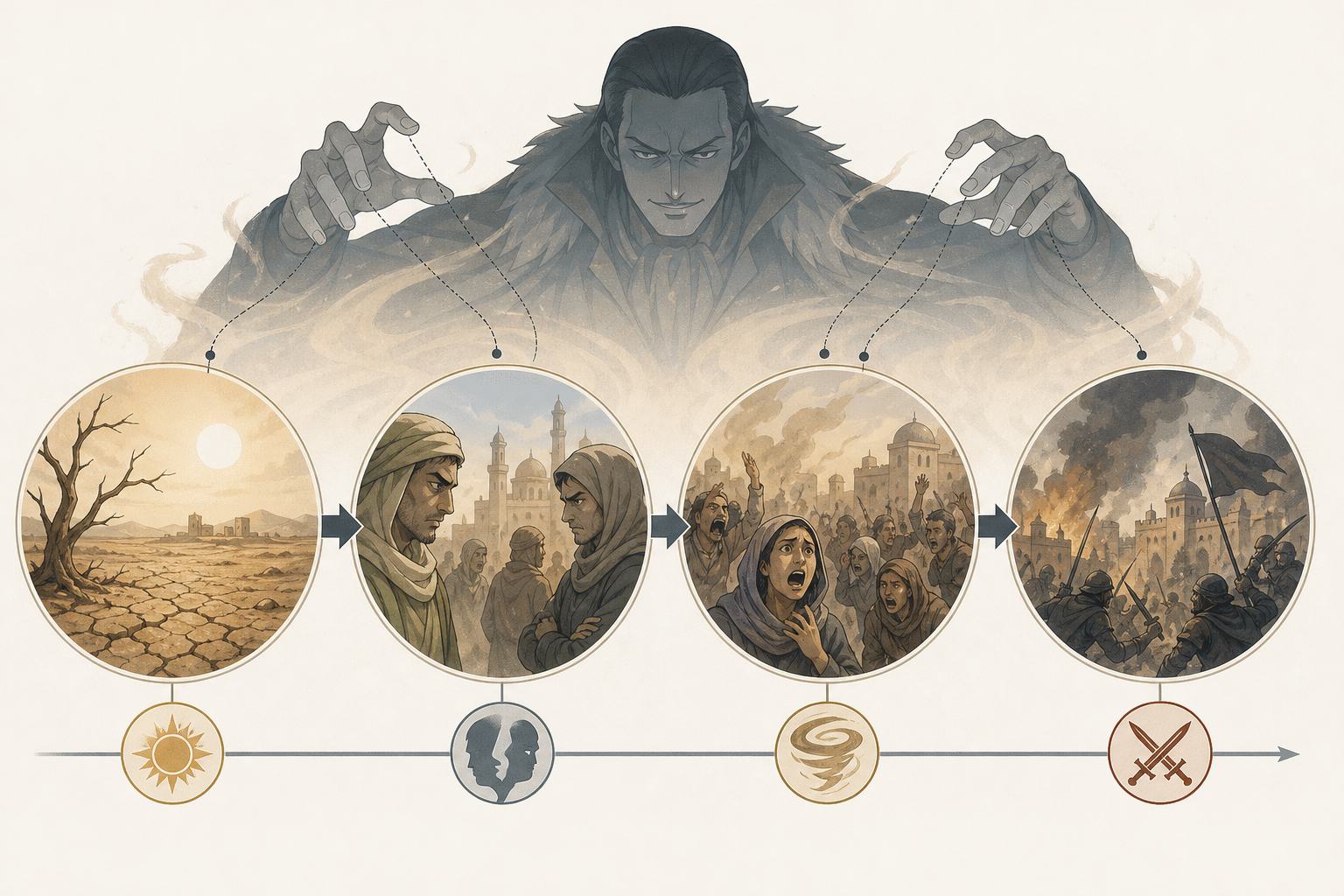
Flow diagram of how Crocodile turns Alabasta’s pressure into a takeover plan.
Operation Utopia depends on making disaster feel inevitable.

Crocodile manufactures inevitability

Crocodile’s great weapon is the sense that collapse cannot be stopped. Drought creates desperation. Rumors and violence destroy trust. The civil war becomes easier to trigger because people are already primed to expect the worst.

Under this reading, Crocodile is not merely causing chaos. He is trying to make chaos seem natural and final. If everyone accepts that the country is doomed, he can present his victory as the only possible outcome.

That is the “ticking” element of the arc: not an actual clock, but a crisis designed to make alternatives disappear.

Luffy represents movement, not a one-to-one Peter Pan role

It is tempting to label Luffy as Peter Pan, but that flattens both stories. The comparison is stronger when it stays focused on Crocodile’s behavior.

Luffy does, however, challenge the worldview Crocodile relies on. Crocodile believes people can be managed through fear and incentives. Luffy keeps acting on loyalty and direct conviction, even when that response seems irrational to a strategist.

The clash is therefore control versus freedom, not childhood versus adulthood in any simple sense.

Alabasta also questions official authority

Crocodile’s public standing helps his deception. That makes the arc partly about the danger of trusting a respectable role without examining the person behind it.

This connects with a wider One Piece concern: authority can look stable while causing harm. For another angle on how the series frames power and institutional certainty, see our explanation of Absolute Justice in One Piece.

Where the theory stops: important limits

This interpretation has limits, and those limits make it more useful.

First, there is no supplied evidence that Eiichiro Oda confirmed a direct Peter Pan reference for Crocodile. Treating it as fact would overstate the case.

Second, the Peter Pan crocodile and One Piece’s Crocodile have opposite story roles. The crocodile pursues Hook as an outside force of consequence. Crocodile tries to become the force that controls consequences for everyone else.

Third, Crocodile’s animal name has its own obvious predator imagery. Crocodiles suggest patience, ambush, and danger beneath a calm surface. That imagery already fits his hidden organization and gradual takeover plan without requiring any Peter Pan connection.

The best conclusion is modest: the Hook-and-clock framework adds a convincing layer to Crocodile’s ambition, but it does not replace the text or prove authorial intent.

A practical checklist for spotting this kind of parallel

When a One Piece theory draws on another story, test it before treating it as meaningful:

  1. Start with the text. What does the character repeatedly do, fear, or control?
  2. Identify the shared structure. Here, it is time pressure, status anxiety, performance, and control.
  3. Avoid surface-only matches. A crocodile name alone is not enough.
  4. Check where the comparison breaks. Differences often reveal more than similarities.
  5. Separate canon from interpretation. Say “this can be read as” rather than “this proves.”

Using that method keeps theory discussion fun without turning every coincidence into a hidden confirmation.

FAQ

Is the Peter Pan theme in Crocodile confirmed?

No. It is a fan reading, not confirmed canon. The evidence is thematic: Crocodile’s controlled image, his need to manage outcomes, and Alabasta’s constant countdown pressure all resemble aspects of Captain Hook’s relationship with time and fear.

What is the name of the crocodile from Peter Pan?

In Disney-related usage, the crocodile is commonly called Tick-Tock or Tick-Tock Croc because it swallowed a clock. Some versions simply call it the crocodile, so the name can depend on the adaptation.

How did Captain Hook lose his hand?

In the familiar version of the story, Peter Pan cuts off Hook’s hand and a crocodile eats it. The crocodile then keeps pursuing Hook. This is the origin of the clock-and-consequences image used in the Crocodile theory.

What does a crocodile symbolize in this reading?

The crocodile can symbolize a patient threat that waits beneath the surface. In Peter Pan, it also becomes a sign of time catching up with Hook. In One Piece, Crocodile reverses that idea: he wants to be the hidden force that makes everyone else feel trapped by events.

Does this theory change Crocodile’s role in Alabasta?

It does not change the plot, but it changes the emphasis. Crocodile becomes more than a clever schemer. He becomes a villain who tries to control time, public belief, and the future of an entire country because uncertainty is the one thing he cannot tolerate.

Best Anime of All Time – A Definitive Guide

Anime has captivated audiences worldwide, establishing itself as a potent cultural force. Whether it’s breathtaking animation, complex storytelling, or impactful themes, anime continues to push creative boundaries. In curating this list of the best anime of all time, we considered audience reception, critical acclaim, and innovative narratives. It’s important to acknowledge that ranking such diverse works can be subjective, given the variety of genres and styles. Join us as we delve into the masterpieces that have significantly shaped the world of anime.

Continue reading “Best Anime of All Time – A Definitive Guide”

One Piece And Japanese Culture: Hidden References Explained

Hello there, manga enthusiasts and anime aficionados! Today we are sliding the doors open to One Piece‘s fascinating universe. As we embark on this journey, we’ll cast a light on the riveting world that One Piece threads into and let you in on its deep-seated Japanese cultural roots.

Continue reading “One Piece And Japanese Culture: Hidden References Explained”

Is Big Mom Dead? – Will She Return On Elbaf?

Ahoy, fellow anime enthusiasts! Today, we’re diving headfirst into the colorful world of One Piece. Specifically, we’ll be unmasking one of its most massive and equally magnetic characters – Big Mom! In the saturated realm of anime antagonists, Big Mom, the Captain of the Big Mom Pirates and one of the Four Emperors, is truly a force to be reckoned with.

Continue reading “Is Big Mom Dead? – Will She Return On Elbaf?”