
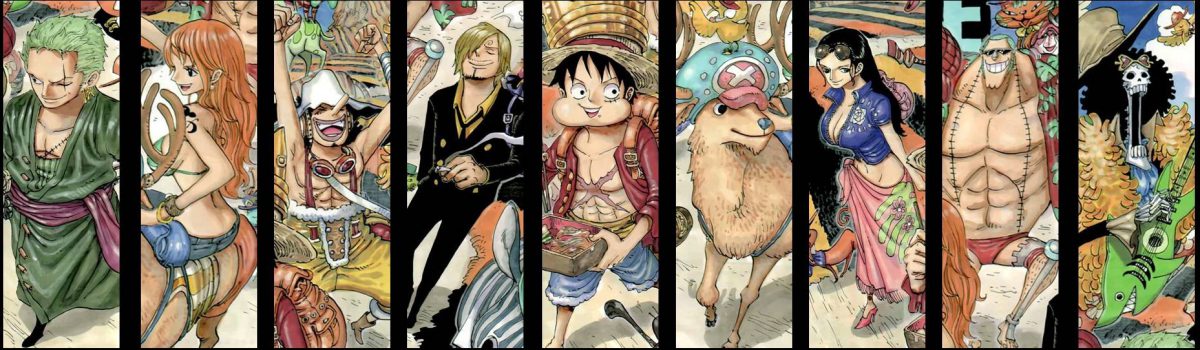
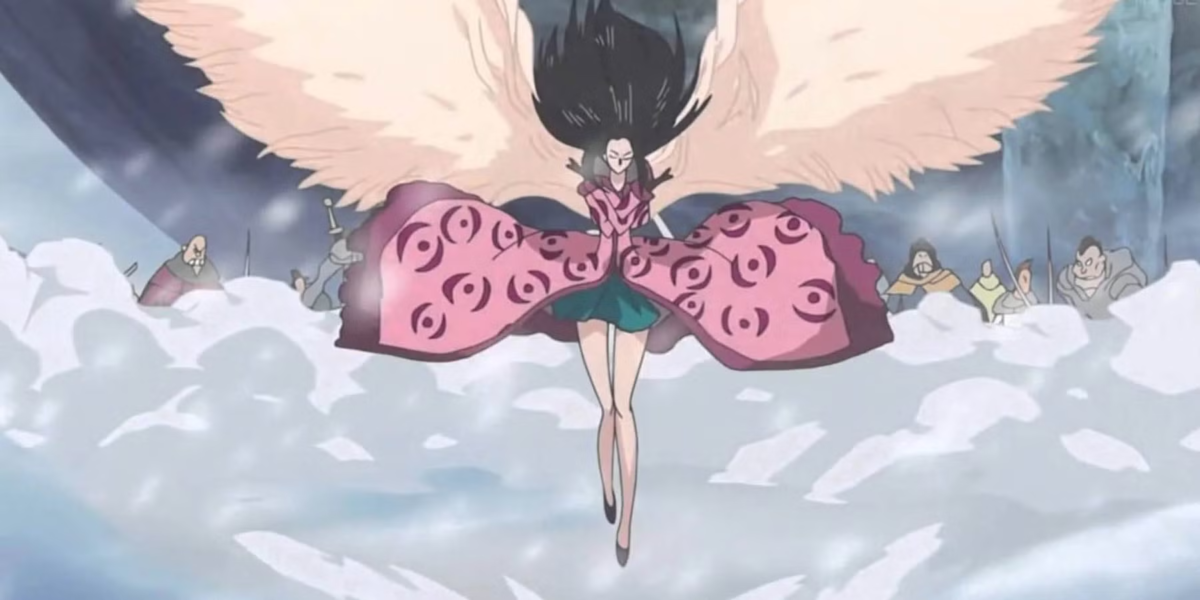
Nico Robin is introduced as a villain. She works for Crocodile. She wears all black, speaks in half-sentences, and has a bounty of 79 million berries at age eight. Eight. The World Government put a price on a child’s head because she could read.
That detail alone tells you everything about what kind of character she is — and what kind of story One Piece is actually telling underneath all the punching.
This is the full breakdown: her backstory, her Devil Fruit, her best moments, what to expect from the Netflix live action, and why she matters more to the endgame than almost anyone else in the crew.
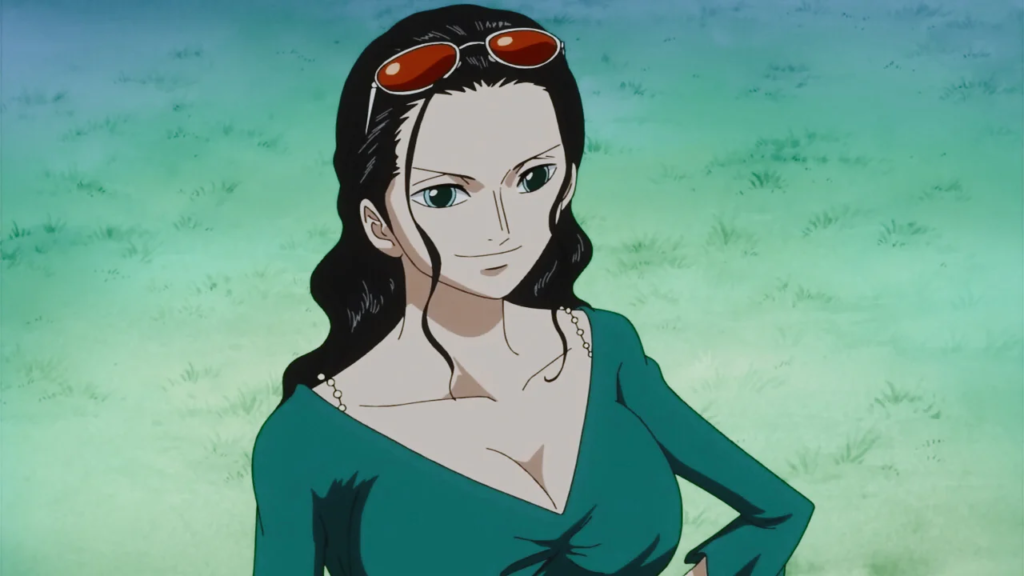
Who Is Nico Robin?
Nico Robin is the archaeologist of the Straw Hat Pirates and the seventh member to join the crew. She ate the Hana Hana no Mi (Flower-Flower Fruit), a Paramecia-type Devil Fruit that lets her sprout copies of her body parts on any surface. She’s quiet, dry-humoured, and routinely the most dangerous person in the room — she just doesn’t make a big deal of it.
Her defining trait isn’t her power, though. It’s her knowledge. Robin is the only person alive who can read the ancient script on Poneglyphs — indestructible stone tablets scattered across the world that contain the true history the World Government has spent centuries trying to erase. That’s why she’s been hunted since childhood. Not for what she’s done, but for what she can understand.
Her arc in the series is, at its core, about learning to trust people again after a lifetime of being betrayed by everyone who was supposed to protect her.
Nico Robin’s Backstory: The Tragedy of Ohara
Robin grew up on Ohara, a small island populated almost entirely by scholars — men and women who dedicated their lives to studying the ancient world, including the Poneglyphs. She was born with the ability to read the ancient script, and by age eight she’d passed the archeology exam that most adults failed.
Her mother, Nico Olvia, had abandoned her years earlier to pursue the True History. Robin was raised by a distant uncle and his wife, treated as an afterthought, and regarded by the rest of Ohara as something between a curiosity and a nuisance. The Devil Fruit didn’t help. Sprouting hands from the floor as a child gets you called a demon.
The Buster Call
When Robin was eight, the Marines arrived.
Nico Olvia had returned — but she’d been captured, interrogated, and followed back to the island. The World Government had confirmed what the Ohara scholars were researching, and their response was total: a Buster Call, the highest-level military command in One Piece, ordering the complete destruction of the island.
Every scholar was killed. The island was destroyed. One of the few marine officers present — Vice Admiral Jaguar D. Saul, a giant who had defected to help Robin escape — was executed on the shore.
The only survivor was Robin. She escaped with the help of Vice Admiral Kuzan (Aokiji), who made a quiet decision not to kill a child and let her go. It’s the kind of small mercy that reshapes a person’s life, and it haunts both of them for the rest of the series.
Robin was eight years old. She had a bounty of 79 million berries. She was alone.
Twenty Years on the Run
For the next two decades, Robin survived by making herself useful to people more powerful than herself. She joined pirate crews and criminal organisations — at least six of them. Every single one was destroyed. Every time, Robin was the only survivor.
Whether she caused those collapses or simply outlived them is deliberately left ambiguous early in the story. That ambiguity is part of how Robin is introduced: the world has decided she’s dangerous, and she’s learned to perform that expectation.
She eventually found cover inside Baroque Works, Crocodile’s secret criminal empire operating out of Alabasta. As Miss All Sunday, Vice President of the organisation, she was protected, well-resourced, and positioned close to one of the most powerful men in the world. It wasn’t a good life. But it was a life.
Then the Straw Hats arrived in Alabasta, dismantled Baroque Works from the inside out, defeated Crocodile, and Robin found herself without cover for the first time in years. She made a decision that surprised even her: she asked to join Luffy’s crew. He said yes. No questions asked.
Nico Robin’s Devil Fruit: Hana Hana no Mi Explained
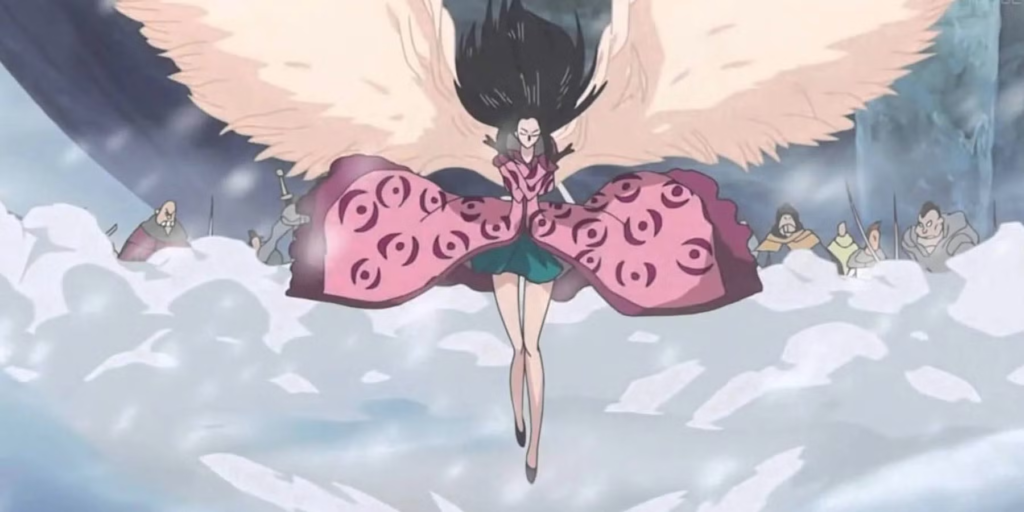
The Hana Hana no Mi (Flower-Flower Fruit) is a Paramecia-type Devil Fruit that allows Robin to sprout replicas of her body parts — arms, legs, eyes, ears, and more — on any surface within a certain range, including on other people’s bodies.
The range expands significantly after the timeskip.
What She Can Actually Do
The most common application is her grab-and-break fighting style. Robin sprouts arms directly on an opponent — from their shoulders, their face, their back — and snaps them into submission. Her signature move, Clutch, crosses her arms through a target’s torso and pulls in opposite directions. It’s as bad as it sounds.
She can also:
- Sprout eyes and ears on distant surfaces to scout ahead or eavesdrop
- Grow wings of hands to slow a fall (used occasionally for mobility)
- Create full duplicate torsos of herself to confuse opponents or operate in multiple directions at once
- Combine with other Straw Hats tactically — holding an enemy in place while Zoro finishes the job, or restraining multiple targets simultaneously
After the timeskip, Robin’s Hana Hana no Mi unlocks a significantly more powerful mode: Gigantesco Mano, which produces enormous duplicate limbs at giant scale. Her Mil Fleur: Gigantesco Mano creates massive hands that can slam, grab, and crush at a scale that changes the battlefield. This version of Robin can handle enemies that her pre-timeskip self couldn’t touch directly.
Haki: Robin has confirmed Armament Haki (Busoshoku), developed during the two-year timeskip when she trained with the Revolutionary Army. She doesn’t use it as flashily as Luffy or Zoro — her fighting style is about precision and control, not raw force — but it’s there.
Why Her Fighting Style Is Different
Most Straw Hats fight at close range, head-to-head. Robin doesn’t. She fights by surrounding her opponent. Her range lets her attack from angles that make no physical sense to the person being attacked — arms appearing behind them, on their own back, from the floor beneath their feet.
It’s also worth noting what the Devil Fruit costs her: any damage to the body parts she sprouts is reflected back to her real body. If someone grabs one of her sprouted arms and twists it, Robin feels it. That limitation adds genuine risk to her fighting style that’s easy to overlook.
Nico Robin’s Key Story Moments
Alabasta: The Introduction
Robin’s first major arc as an apparent villain is Alabasta. She’s elegant, controlled, and working directly against the Straw Hats for most of it — and yet even here, Oda seeds enough ambiguity that it’s clear something more complicated is happening. She rescues Luffy from drowning in a moment that serves no obvious self-interest. She’s not simply evil. She’s surviving.
Water 7 and the Apparent Betrayal
This is where Robin’s character becomes unmistakable. She tells the crew she wants to part ways, seemingly of her own will — and the Straw Hats, for a moment, let her go. What’s actually happening is more painful: she’s been offered a deal that would protect the crew by sacrificing herself, and she’s taken it because she can’t bear to be the reason they die.
She’s been doing this her whole life. Every organisation she joined, she eventually left or was forced out before they were destroyed. She’s learned to pre-emptively abandon things before they abandon her. The tragedy of the Water 7 sequence is Robin reverting to the survival mode she’s lived in for twenty years.
Enies Lobby: “I Want to Live”
The moment. If you’ve heard One Piece fans talk about Robin, this is what they’re remembering.
The Straw Hats track Robin to Enies Lobby, a World Government fortress. They declare war on the World Government directly — literally burning the island’s flag — to make clear they’re not there to negotiate. They’re there to bring Robin back.
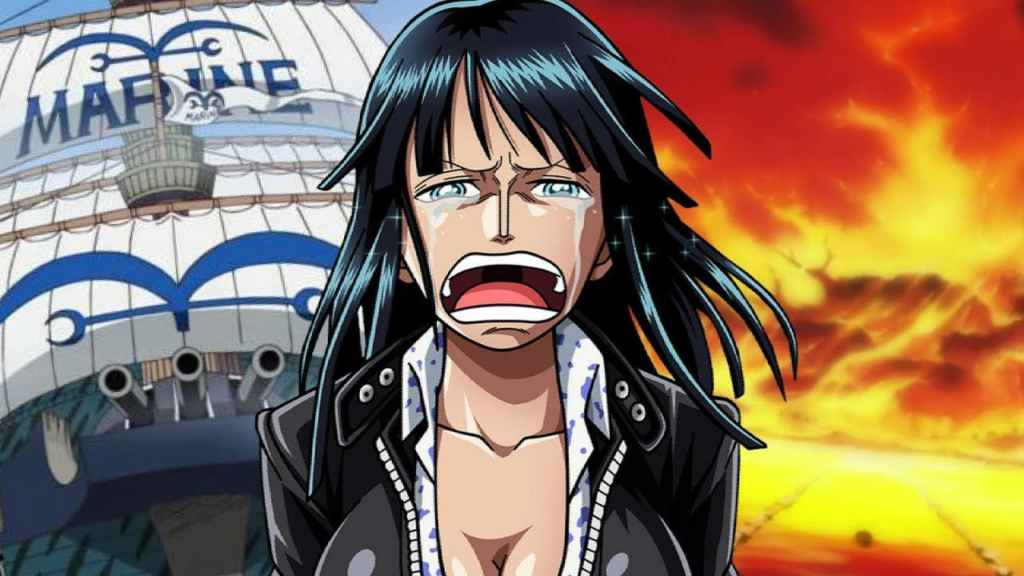
When Luffy tells her to say what she actually wants, Robin breaks. She screams that she wants to live. That she wants to sail with the crew.
It’s the first time in the series — perhaps in Robin’s entire adult life — that she’s said what she actually wants without calculating whether she deserves it. It’s one of the best character moments in the whole series, not because of the action around it, but because of twenty years of context that makes it land.
After Enies Lobby, Robin is a different person. Still quiet, still dry, still unnerving to opponents — but no longer performing survival. She belongs somewhere now, and she knows it.
Post-Timeskip and the Endgame
Robin spent the two-year timeskip training with the Revolutionary Army — Dragon’s network of rebels actively working against the World Government. She didn’t just get stronger physically. She deepened her understanding of the political forces she’s been running from her entire life.
In the later arcs, Robin’s role becomes increasingly central to the series’ endgame. Every Road Poneglyph the Straw Hats encounter has to pass through her. She’s not just crew support — she’s the mechanism that makes their entire mission possible. Without Robin, the Straw Hats can find every Poneglyph in the world and still have nothing.
Nico Robin in One Piece Season 2: Live Action
Robin’s Netflix debut is one of the most anticipated character introductions in Season 2.
Lera Abova has been cast as Nico Robin. Season 2 covers the Alabasta arc, which means we get Robin in her Miss All Sunday phase — the villain-adjacent, Baroque Works Vice President version, not the Straw Hat we know she’ll become. That’s actually the right way to introduce her. The gap between who she appears to be and who she is should be felt before it’s resolved.
What to watch for: the adaptation needs to do a lot of work in silence. Robin’s character is communicated as much through what she doesn’t say as what she does — the half-second glances, the moments she could hurt someone and chooses not to, the fact that she rescues Luffy from drowning when there’s no tactical reason to. If the performance leans too much on exposition, it’ll flatten her.
The Alabasta arc doesn’t give Robin her big moment — that’s still seasons away at Enies Lobby. But it plants every seed that makes that moment possible. Pay attention to how she watches Luffy, and specifically to the moment she makes the decision to ask to join the crew. That’s the hinge the whole character turns on.
The Kuma Theory: Did We Almost Get Robin’s Father Right?
In 2016, we published a theory that Bartholomew Kuma might be Nico Robin’s secret father — arguing that his protection of the Straw Hats at Sabaody, his Revolutionary Army connections, and his seemingly deliberate choice to send Robin to the Revolutionaries’ headquarters all pointed to paternal motivation.
Oda answered that question in the Egghead arc. We got it half right.
Kuma is a father — to Jewelry Bonney, his adoptive daughter, who sacrificed everything to save. The paternal instinct was real. The target was wrong. Robin’s father remains unconfirmed canon.
Robin’s Relationships in the Crew
With Luffy: Simple and unshakeable. Luffy never asks Robin to justify her past or prove her usefulness. He treats her as crew from the moment she joins, and that unconditional acceptance is, for Robin, one of the rarest things she’s ever experienced. Her loyalty to him is absolute partly because of what Enies Lobby proved: this crew will burn down a World Government fortress rather than leave without her.
With Zoro: The two communicate in a register most of the crew doesn’t — direct, minimal, no performance. Fans have shipped them for years, and it’s easy to see why: they’re the two crew members who feel like adults. In canon, it stays as mutual respect and a shared tendency to be the ones who notice when something is wrong before anyone else does. Whether Oda intends anything more is genuinely unclear.
With Nami: Something close to sisterhood. Nami is one of the few people Robin is openly warm with. They coordinate well under pressure, share a dry read on their crewmates’ chaos, and there’s a comfort between them that Robin doesn’t extend to everyone.
With Chopper: Robin finds Chopper genuinely endearing, which she expresses through her habit of making him describe monstrous things in graphic detail and watching his reaction. It’s the closest she gets to being mischievous.
With Franky and Usopp: The three of them form an unlikely intellectual trio — Robin brings historical context, Franky brings engineering logic, Usopp brings creative problem-solving (and panic). Their interactions are some of the funniest in the series precisely because Robin plays it completely straight.
Frequently Asked Questions
What is Nico Robin’s Devil Fruit?
Robin ate the Hana Hana no Mi (Flower-Flower Fruit), a Paramecia-type Devil Fruit that lets her sprout replicas of her body parts on any surface within range. She uses it primarily to grab and break opponents by sprouting arms directly on their bodies. After the timeskip, she can produce giant-scale limbs through Gigantesco Mano.
Who is Nico Robin’s father in One Piece?
As of 2026, Robin’s father has not been confirmed in the manga. Her mother, Nico Olvia, is canon — but her father remains an open mystery. Some fans have theorised connections to specific characters, but Oda hasn’t addressed it. We wrote a full theory on the Kuma connection here →
Why does Nico Robin have such a high bounty as a child?
Robin received a 79 million berry bounty at age eight — not for piracy, but for surviving the Ohara Buster Call and being the only person left alive who can read Poneglyphs. The World Government classified her as a threat to world order because the knowledge she carries could expose the lies the current power structure is built on.
Is Nico Robin a villain in One Piece?
She’s introduced as one. In the Alabasta arc she works for Crocodile’s Baroque Works and operates against the Straw Hats. But the series quickly makes clear she’s a survivor making calculated decisions in dangerous situations — not someone driven by cruelty. Her villain phase is short. Her Straw Hat phase is permanent.
Who plays Nico Robin in the Netflix One Piece live action?
Lera Abova plays Nico Robin in Netflix’s live action adaptation. She appears in Season 2, which covers the Alabasta arc, where Robin is introduced as Miss All Sunday — Vice President of Baroque Works and Crocodile’s right hand.
What does Nico Robin want in One Piece?
To read the Rio Poneglyph and uncover the True History of the Void Century. She wants to understand what the World Government erased, and why the scholars of Ohara — her people — had to die for pursuing that question. It’s not treasure. It’s not power. It’s understanding. And in a series full of characters chasing grand dreams, that one hits differently.
Want more on the characters heading into Season 3? Read our complete Alabasta arc guide → and the Crocodile character breakdown →.