

Can voice of all things can hear poneglyphs be treated as canon? Not yet—not if “hear” means receiving the stone’s full written message.
The story gives us a real connection between the Voice of All Things, ancient mysteries, and Roger’s journey. It does not show a Voice user reading a Poneglyph line by line without help. That distinction matters. Sensing a presence, hearing an emotional message, and translating an ancient script are three different feats.
The best current answer is this: the Voice of All Things may help someone notice or respond to something connected to a Poneglyph, but it has not been confirmed as a replacement for Poneglyph literacy.
Start with the key distinction: hearing is not reading
Poneglyphs are stone records written in an ancient script. Reading one means decoding that script. Translation then turns the meaning into language a modern reader can use.
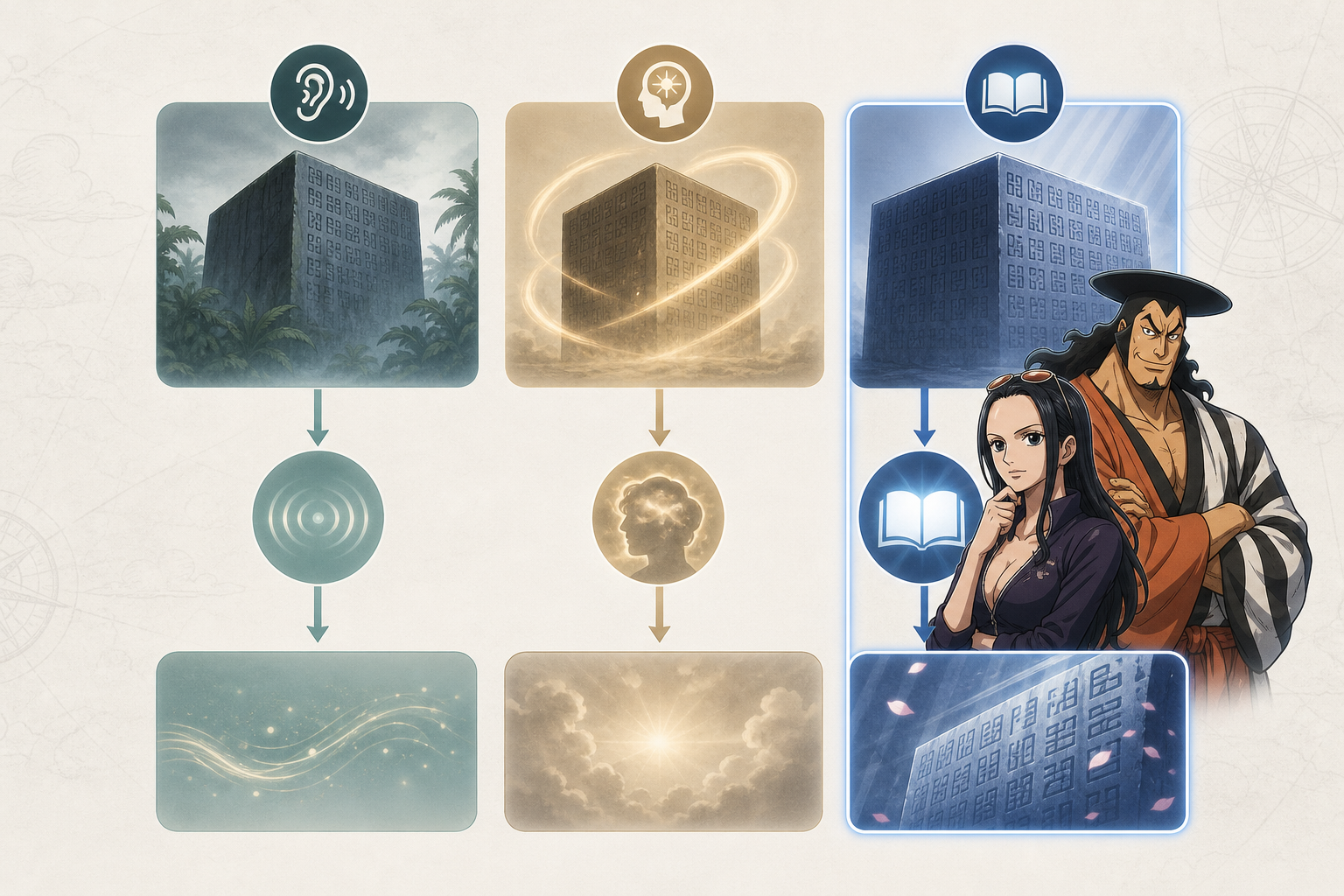
The Voice of All Things is presented differently. It lets rare characters perceive voices that most people cannot. Those voices can come from beings such as Sea Kings and Zunesha. The ability may convey urgency, emotion, or intent, but its limits are still unclear.
That gives us three separate claims:
| Claim | What it would mean | Current support |
|---|---|---|
| A character senses a Poneglyph | They notice an unusual presence or call near the stone | Possible, but not directly established as a rule |
| A character understands a Poneglyph’s general message | They identify a warning, request, or topic without reading symbols | Unconfirmed |
| A character reads a Poneglyph through the Voice | They state precise names, places, or instructions without a translator | Not shown |
This is where many theories go too far. A character can hear Zunesha and still be unable to translate a carved inscription.
For a related theory-led look at the connection, see our Voice of All Things and Poneglyphs guide. The more careful version of the theory is stronger: the Voice may guide a traveler toward truth, while a reader is still needed to unlock the text.
What canon actually links to Poneglyphs
Roger is the strongest link—and also the strongest limit
Gol D. Roger is central to this debate. He had the Voice of All Things, reached Laugh Tale, and encountered Poneglyphs on his final voyage. That makes him the most plausible example of a person who could sense something unusual around the stones.
But Roger’s voyage also supplies the main counterpoint. Kozuki Oden traveled with the Roger Pirates and could read the ancient script. If the Voice gave Roger full, reliable translations, Oden’s skill would be far less important to the journey.
So Roger supports a narrow conclusion: the Voice may have helped him find, recognize, or respond to key clues. It does not prove that he could read every Poneglyph by hearing it.
A supplied character overview also treats Roger’s Voice as a possible aid to his journey rather than settled proof of automatic translation: Every Voice Of All Things User In One Piece. That is useful context, but the manga and anime scenes remain the best standard for any firm conclusion.
Luffy can hear voices, but he has not read a Poneglyph
Can Luffy hear the Voice of All Things? He has clearly perceived voices that ordinary people miss, especially in major lore scenes. That puts him in the conversation.
Can Luffy read Poneglyphs? No confirmed scene shows that. He does not look at a stone, repeat its wording, or provide details later verified by Robin. When the Straw Hats need an inscription explained, Robin remains the crew member who does that work.
Luffy is therefore a plausible sensing candidate, not a confirmed reader.
Momonosuke has an even clearer communication feat
Momonosuke can hear Zunesha and, unlike Luffy in that moment, can communicate with and command Zunesha. That is a remarkable use of the Voice of All Things.
Still, it does not establish Poneglyph literacy. Zunesha is a living being speaking with intent. A Poneglyph is a written record on stone. The two could be related in the wider mystery, but the story has not said that they function the same way.
Robin and Oden show why literacy remains its own skill
Robin’s role is not simply that she knows secrets. She can read the ancient writing. Oden could do the same. Their knowledge lets a crew turn a stone’s symbols into usable history, warnings, or directions.
That separation is probably deliberate. One Piece often divides major tasks across a crew: someone finds the clue, someone survives the obstacle, and someone understands the message. If every Voice user could translate Poneglyphs at will, Robin’s hard-won expertise would lose much of its story weight.
For the larger idea of inherited roles and hidden history, our Inherited Will, Void Century, and All Blue theory is a useful companion read.
The evidence test: what would prove a Poneglyph was “heard”?
A good theory needs a standard that can be proven wrong. Here is a simple rubric for new chapters, episodes, or fan claims.
Score 0: no direct connection
A character stands near a Poneglyph, reacts dramatically, or happens to be important to the Void Century plot. That can create a fun theory, but it is not evidence that they received information from the stone.
Score 1: a character senses a presence
A Voice user says they hear something or feel drawn somewhere near a Poneglyph. This would support a possible link, but not comprehension.
Score 2: the character identifies a general message
A character describes the stone as an apology, a warning, or a location clue before anyone translates it. This would be meaningful evidence that the Voice can convey more than presence.
Score 3: the character gives specific, verified content
This is the proof threshold. A Voice user would need to state a name, event, coordinate, or instruction from a Poneglyph without Robin, Oden, prior notes, or another translator. A later translation would need to match.
Until a scene reaches score 3, saying voice of all things can hear poneglyphs should mean “may perceive something connected to them,” not “can read their script.”
Counterexamples that keep the theory in check
The strongest theories take awkward evidence seriously. Several points argue against treating the Voice as an all-purpose Poneglyph decoder.
Voice users still need readers
Roger had Oden on the final voyage. The Straw Hats rely on Robin. This repeated pattern suggests that locating truth and decoding truth are separate jobs.
The Voice does not produce clear text on demand
When Luffy and Momonosuke hear extraordinary voices, their experiences are not presented as a convenient language lesson. The communication is selective and tied to specific beings or moments.
Poneglyphs are designed as writing
The Kozuki created inscriptions meant to endure censorship. Their form matters: they preserve knowledge through text. If anyone with the right sensitivity could bypass that text, the elaborate system would serve a much smaller purpose.
None of this proves that a Poneglyph can never “speak.” It simply means the story has not shown that it does in a way that replaces reading.
Who could plausibly hear a Poneglyph?
Gol D. Roger: the best historical candidate
Roger has the clearest overlap between the Voice, Poneglyphs, and the journey to Laugh Tale. He is the best candidate for sensing a Poneglyph or receiving some form of guidance from one.
His limit is just as important: Oden’s presence strongly suggests Roger did not depend on the Voice for every translation.
Monkey D. Luffy: likely to sense, unproven to understand
Luffy has the right kind of rare perception and sits at the center of the endgame mystery. He could plausibly hear a Poneglyph if the stones have a voice to hear.
But there is no confirmed basis to say he can extract written facts from one. Any claim beyond sensing remains theory.
Kozuki Momonosuke: a strong communicator, not a confirmed reader
Momonosuke’s link with Zunesha makes him a serious candidate for future Voice-related revelations. His Kozuki heritage also ties him to the people who made the Poneglyphs.
Even so, heritage is not proof of literacy. He has not been shown translating a Poneglyph.
The Kozuki line: important to the stones, but not automatically fluent
The Kozuki connection is vital because their ancestors made the Poneglyphs. That supports deep knowledge of their purpose and construction. It does not tell us which living Kozuki can read every inscription.
Pudding and the Three-Eye Tribe: a separate possibility
Pudding’s potential third-eye awakening is often brought into this debate. The theory is interesting because it offers a possible path to reading ancient text. But it should not be folded into the Voice of All Things without evidence. A future ability to read Poneglyphs would still be different from hearing them.
Poneglyph basics that matter to this theory
What did the Alabasta Poneglyph say?
The Poneglyph in Alabasta contained information about Pluton, the Ancient Weapon. Robin did not reveal its full wording to Crocodile, but the stone’s connection to Pluton was later established.
This scene shows why translation matters. The stone held information with world-changing value, yet most people in the room could not access it. A vague supernatural feeling would not be enough to replace a precise reading.
Is Robin the only person who can read Poneglyphs?
Robin is the only active, reliable Poneglyph reader clearly established in the present-day story. Oden could read them in the past. The Kozuki family’s historical link to their creation adds important context, but it is not proof that every descendant has the skill.
The safest answer to “Who can read Poneglyphs other than Robin?” is Oden, historically. Beyond that, treat claims with care unless the story shows a character translating the script directly.
Which Road Poneglyphs does Luffy have?
By the end of Wano, the Straw Hats had obtained rubbings from the Road Poneglyphs at Zou, Whole Cake Island, and Wano. Those copies matter because the four Road Poneglyphs together provide the route to Laugh Tale.
A rubbing is not the same as instantly understanding the route. The crew still needs Robin to read the inscriptions and make sense of the information. That is another practical reason the Voice-versus-reading distinction matters.
One Piece arcs in order for Poneglyph and Voice clues
If you are revisiting one piece arcs in order for this mystery, focus on these stops rather than trying to scan every arc for a hidden answer:
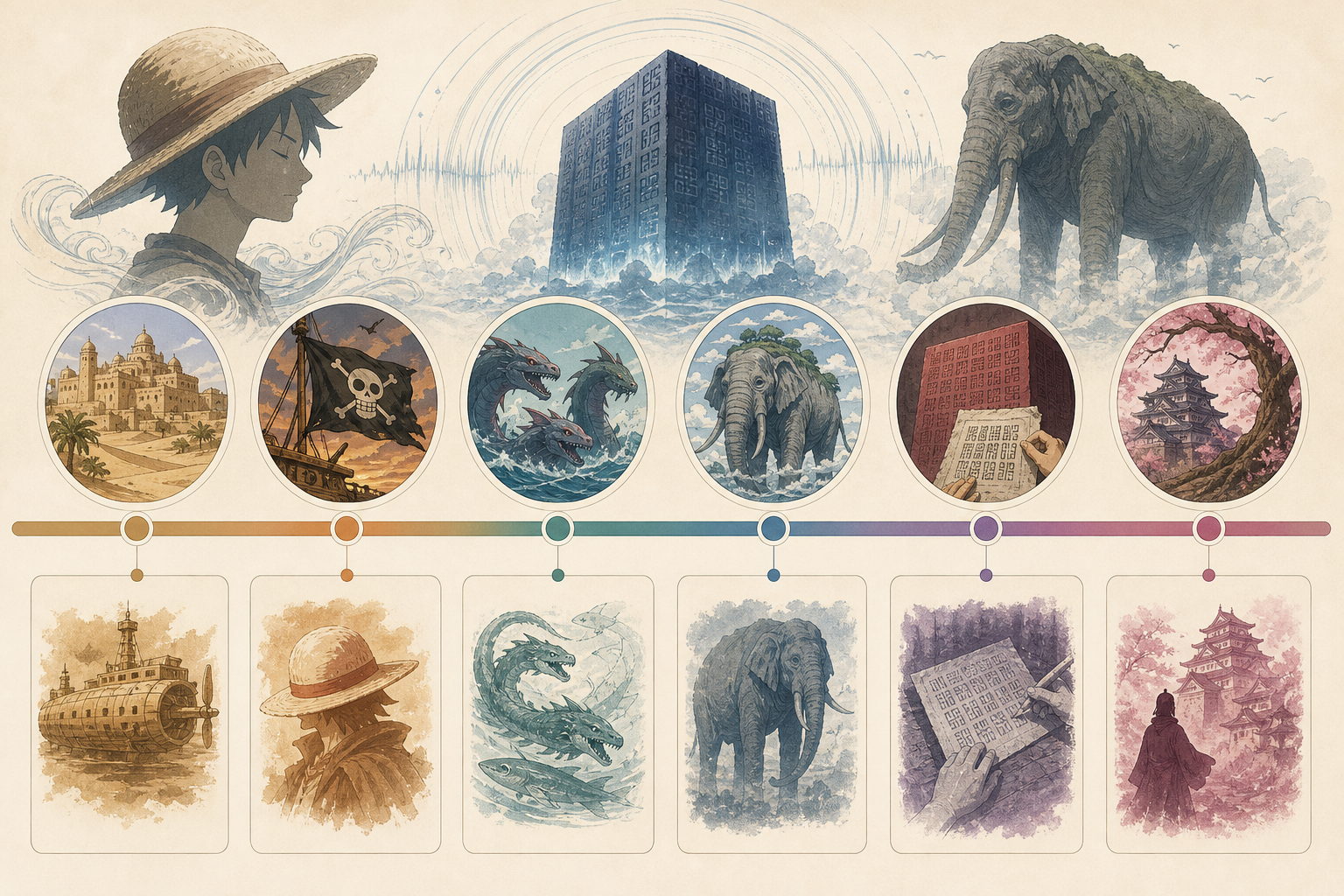
- Alabasta: Robin reads the Poneglyph tied to Pluton.
- Skypiea: Ancient writing and Roger’s connection to the past deepen the mystery.
- Fish-Man Island: Joy Boy, Sea Kings, and the scale of the old promise come into view.
- Zou: The Road Poneglyph race becomes clear, while Zunesha makes the Voice impossible to ignore.
- Whole Cake Island: The crew secures a Road Poneglyph rubbing.
- Wano: Kozuki history, Oden’s journey, and the Road Poneglyph plot converge.
For a close look at Wano-era story discussion, revisit our One Piece Chapter 927 review and reactions. If you want to check wording and scenes for yourself, our guide to reading the One Piece manga can help you choose a format.
A quick checklist for judging future reveals
When a new scene seems to prove that someone heard a Poneglyph, ask:
- Did the character receive information from the stone itself, or did they infer it from context?
- Did they provide specific details, not just a feeling or direction?
- Was Robin, a Kozuki reader, a record, or another translator involved?
- Did a later translation verify the information?
- Does the scene show sensing, communication, or actual reading?
That checklist keeps the debate fun without turning every mysterious reaction into proof.
Final verdict
The Voice of All Things and Poneglyphs are clearly adjacent mysteries. Roger’s voyage, Luffy’s sensitivity, Momonosuke’s communication with Zunesha, and the Kozuki legacy all make a future connection believable.
But the canon line is still clear: hearing a voice is not the same as reading a language. Roger is the best case for a Poneglyph connection, while Robin and Oden remain the clearest proof that ancient-script literacy is a distinct skill.
If Oda eventually shows a Voice user giving a Poneglyph’s exact message without help, the theory moves from plausible to confirmed. Until then, the best answer is: they may be able to sense a Poneglyph, but they have not been shown to read one by hearing it.