
Alabasta feels like a political thriller because Crocodile’s real weapon is not his Devil Fruit. It is a country-wide crisis built on drought, fear, false evidence, and collapsing trust.
So, what makes Alabasta feel like a political thriller rather than a standard One Piece adventure? The Straw Hats can win fights, but defeating Crocodile alone cannot stop the royal army and rebel army from killing each other. To save the kingdom, the truth has to reach people before the crisis becomes irreversible.
That gives the arc a different kind of tension. Fights matter, but so do rumors, public image, deadlines, and who controls the facts. For a full event-by-event guide, see Alabasta Arc One Piece Explained: Story, Battles & Why It Matters.
Why Alabasta Turns One Piece Political
Alabasta is political because it shows a whole society under pressure. The drought affects daily life. People need water, answers, and someone to blame. King Cobra has authority, but authority means little when the public no longer trusts him.
Crocodile understands that weakness. He does not take over as an obvious invader. Instead, he lets the kingdom blame itself while Baroque Works pushes each side toward violence.
The arc makes one crucial distinction:
- Winning a fight removes a threat in front of you.
- Ending a political crisis means changing what frightened people believe and do.
Crocodile can lose a fight while the civil war continues. That is why the climax has so much pressure. Alabasta will not wait for Luffy to finish a duel.
The story is not a realistic political drama with no room for pirates, comedy, or superpowers. It uses those elements to make a political conflict easy to feel. A drought becomes personal when people cannot get water. A rumor becomes dangerous when it sends an army marching. A trusted hero becomes frightening when viewers know that trust was part of the trap.
The Political-Thriller Checklist
Political thrillers create suspense through systems as well as villains. Someone must work out who is shaping events, what ordinary people have been told, and whether the truth can arrive before violence does.
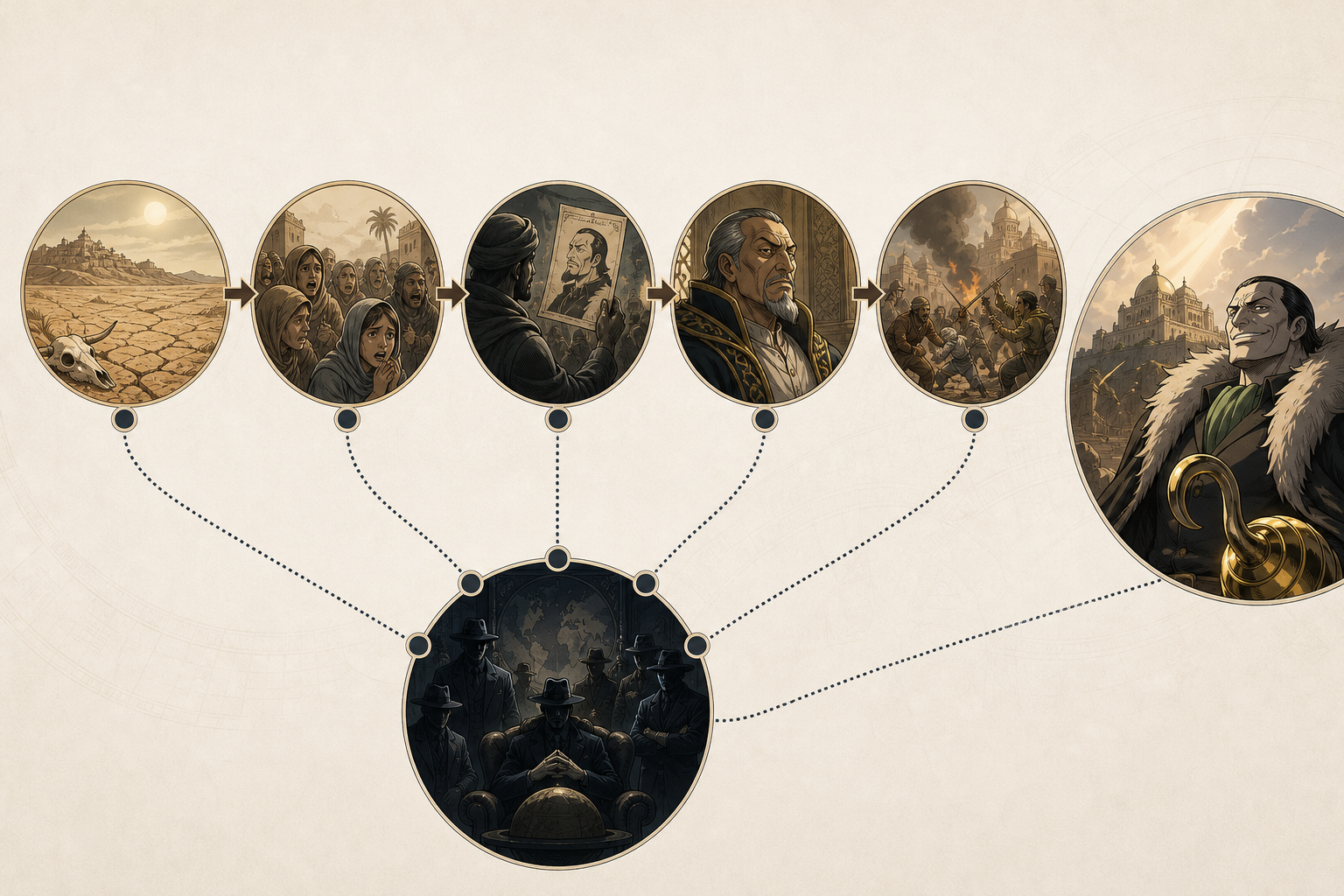
Alabasta checks nearly every box:
| Plot device | How it works in Alabasta | Why it matters |
|---|---|---|
| Scarcity | The drought turns water into a source of fear and blame. | People in crisis need answers quickly. |
| Propaganda | Rumors and staged events make the royal family look guilty. | Citizens act on a false story. |
| Public legitimacy | Crocodile has a trusted public image. | The person behind the crisis can appear to be its savior. |
| Covert operations | Baroque Works uses code names and separate agents. | It is hard to see the full plan at first. |
| Competing groups | The crown, rebels, Marines, and civilians know different things. | No single group can fix the crisis alone. |
| Ticking clock | Civil war and the bomb plot create urgent deadlines. | Even a late victory may cost lives. |
| Civilian stakes | The people of Alabasta bear the cost of escalation. | The conflict matters beyond the main cast. |
This is the arc’s real engine. Viewers are not only asking, “Who will win?” They are asking, “Can the truth reach people before they act on a lie?”
That framework also works beyond Alabasta. When another One Piece story introduces a public crisis, look for the same ingredients: a real grievance, incomplete information, a figure with official cover, and someone who benefits from a rushed response.
Drought, Distrust, and Partial Information
The desert setting is more than atmosphere. The drought makes ordinary life harder, which makes the kingdom easier to destabilize.
When people are thirsty and scared, they do not need to be foolish to believe the worst about their leaders. They have real reasons to be angry. Their pain is genuine. Crocodile’s trick is to give that pain a false cause.
That makes the rebellion tragic. The rebels are not mindless crowds. They believe the government has failed them. Their conclusion is wrong, but it grows from suffering that cannot be ignored.
Why scarcity works so well
Scarcity creates urgency before the final battlefield. A resource crisis changes how every rumor lands. If life feels stable, a claim about government failure may invite skepticism. If people are already struggling, the same claim can feel like proof of what they see every day.
Crocodile does not need every citizen to be gullible. He only needs the lie to feel believable enough that anger can do the rest. The scheme succeeds because it attaches itself to a real problem.
Everyone sees only part of the truth
Most major groups in Alabasta have limited information:
- The royal government is trying to hold the kingdom together.
- The rebels believe peaceful options have failed.
- Civilians react to the stories around them.
- The Marines have their own duties and incomplete knowledge.
- Baroque Works benefits whenever confusion grows.
A sincere character can make a terrible choice when they have been given bad information. On a rewatch, ask two questions: Who benefits if people panic? And who benefits if people wait? In Alabasta, both questions lead back to Crocodile’s plan.
Crocodile Manufactures Trust
Crocodile is dangerous because he understands reputation as well as power.
He is not an enemy hiding in a distant fortress from the start. His public identity gives him trust. That lets him work in the open while Baroque Works works in secret.
A hated villain has to overpower resistance. A respected villain can make resistance look unreasonable. Warnings about Crocodile sound less convincing when he already looks like a hero.
For a closer look at his role and Operation Utopia, read Crocodile One Piece Explained: Powers, Role & Season 2.
Power needs legitimacy
Crocodile does not merely seek power; he seeks legitimacy first. He builds a public identity that makes people ready to see him as a protector. Then he uses that trust as cover for a scheme that harms the country.
The audience knows his image is false, while many people in Alabasta have no reason to doubt it. This creates dramatic irony: viewers can see the danger before the people affected by it can.
His plan attacks two things at once. It weakens confidence in King Cobra and makes Crocodile look dependable by comparison. The problem is not only that the truth is hidden. A more convenient story has already taken its place.
Official status is not accountability
Crocodile’s Warlord status adds another layer. His title gives him public and institutional credibility, even though it does not prove that he serves the public interest.
Alabasta uses this to ask a simple question: what is the gap between power and the appearance of power? A title, uniform, or official role can shape public opinion long before people know the truth. That idea becomes more important as One Piece explores law and authority in later stories. For a wider look at that theme, see What Is Absolute Justice In One Piece? – In Depth!.
Baroque Works Turns Conflict Into a Network
Baroque Works is more than a lineup of opponents for the Straw Hats. It is a covert network designed to worsen a national crisis.
Its agents use code names and separate assignments. That keeps the full plan hidden. One person can carry out an order without knowing every detail, while Crocodile stays distant from the damage.
This is why raw strength is not enough. Defeating one agent does not reveal who controls the next move.
The Straw Hats enter Alabasta as outsiders. They have to learn the country’s conflict while moving through it. At first, separate incidents can seem random. Then the arc shows how carefully they fit together. That is a thriller structure: the heroes are solving a case while trying to survive it.
Infiltration makes the kingdom feel unsafe
A straightforward invasion would make the enemy easy to identify. Baroque Works makes danger harder to locate because its work is spread across the country. The network can influence events without looking like a single occupying force.
The organization also turns information into a weapon. Code names hide responsibility, and separate jobs make it hard for any one character to see the whole picture. The protagonists are always catching up to a plan already in motion.
Vivi Makes the Crisis Personal
Vivi gives Alabasta its emotional center. Her goal is not simply to defeat Crocodile. She wants to stop her country from destroying itself.
That puts her in a different role from a typical action hero. She has to persuade people, reach the right people at the right time, and prevent violence from becoming impossible to stop.
The rebels are suffering people, not disposable obstacles. The royal forces want to protect the kingdom, but they can still make the crisis worse. Vivi needs both sides to pause long enough to hear the truth.
Negotiation is not a side quest
In a simpler battle arc, defeating the boss could be the whole solution. Alabasta refuses that shortcut. Vivi’s attempts to communicate and de-escalate are not interruptions between action scenes. They are the actions needed to save the country.
Luffy’s determination matters, and the crew’s battles against Baroque Works matter. But Vivi’s desperate effort to stop people from treating each other as enemies is just as central. The story needs fighters, messengers, witnesses, and people willing to listen.
Truth moves slower than fear
Alabasta makes a hard point: having the truth does not mean people will accept it.
The source has to seem credible. The message has to arrive in time. People must also be willing to change their minds after choosing a side. Fear moves faster. Once violence starts, every loss becomes another reason to keep fighting.
That is why Vivi’s role is the arc’s genre engine. Every minute spent chasing Crocodile’s scheme is also a minute in which people may make choices they cannot easily undo.
Why Beating Crocodile Does Not End the Civil War
The arc’s best structural choice is its separation of tactical success from political success.
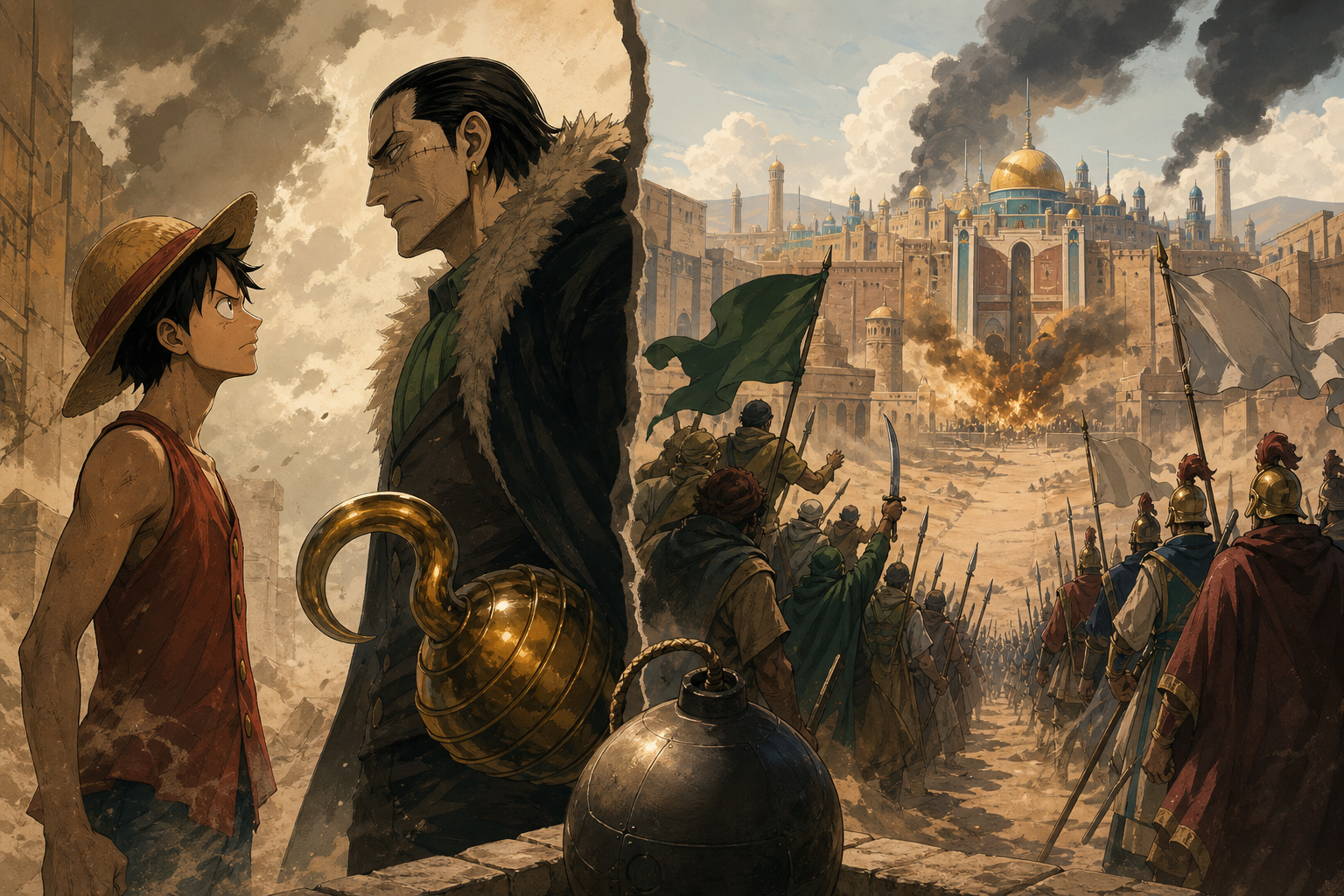
The Straw Hats can defeat Baroque Works officers. They can expose Crocodile’s role. Luffy can beat Crocodile. None of that automatically stops two armies already moving toward each other.
The conflict has momentum of its own. People have suffered losses. Leaders have made promises. Backing down can feel dangerous, shameful, or impossible.
The bomb plot makes this even clearer. It is not just one more obstacle before the ending. It is a mass-casualty threat that could make the crisis irreversible, no matter who wins the major fights.
Several deadlines run at once:
- The rebel army is moving toward battle.
- The royal forces are preparing to respond.
- Baroque Works is pushing every side toward escalation.
- The bomb threatens everyone in the city.
That is why the finale feels frantic. Some characters fight, some search, and some try to communicate. They are all trying to save Alabasta in different ways.
A real victory changes conditions
Removing the architect of a crisis is necessary, but it is not always enough. The people inside the crisis still have to learn what happened, survive the immediate danger, and stop treating each other as enemies.
This makes the resolution more mature than “the strongest person wins.” It does not lessen Luffy’s final fight. It shows why that fight matters only alongside everything else happening in the capital.
What Alabasta Says About One Piece Politics
Alabasta is one early reason people call One Piece political. The series does not only ask whether heroes can beat villains. It also asks how power affects ordinary people.
The politics are shown through consequences rather than long speeches. Alabasta shows how a government can lose trust, how an official title can shield a bad actor, and how civilians can be trapped between groups that do not know the whole truth.
It also teaches a useful habit for theory-minded fans. Separate these three things:
- What happened.
- What characters think happened.
- Who benefits from the gap between those versions.
That lens fits many later mysteries without requiring a major spoiler dump. When a character makes a frustrating choice, it is worth asking what they could reasonably know at that moment.
Was Alabasta inspired by real events?
It is best to be careful here. Without a direct statement from Eiichiro Oda, fan readings should not be treated as confirmed author intent.
Alabasta clearly uses ideas common in stories about political instability: a desert kingdom under stress, a basic resource in short supply, a ruler losing public trust, and a hidden figure who profits from conflict.
Fans have connected the arc to themes such as propaganda, anti-imperialism, and manufactured reasons for war. For example, this fan discussion of Arabasta, Skypiea, and anti-imperialism offers one interpretation. It is a fan source, not proof of Oda’s intent.
The clearest reading is in the text itself: Crocodile uses scarcity, fear, and misinformation to make a country turn against itself.
Later Arcs That Echo Alabasta’s Politics
Later One Piece arcs return to parts of Alabasta’s playbook, even when their settings and villains differ. This is a pattern-based comparison, not a claim that every later story repeats the same plot.
Manufactured crises
A recurring pattern is the engineered emergency. A public threat appears, anger is pushed toward a convenient target, and the person who gains most from the chaos stays hidden or acts helpful.
When a crisis seems unusually useful to someone powerful, Alabasta is a good reference point. It trains viewers to look past the loudest explanation and ask who shaped the conditions around it.
Official-looking power and information warfare
Alabasta also teaches viewers not to treat titles as proof of good intent. Later stories often explore people and groups that claim to represent law, safety, or order while causing harm.
The strongest echo is often the fight over public narratives: rumors, hidden history, selective evidence, and characters struggling to make the truth heard. If you enjoy sorting a popular claim from the story around it, One Piece Sabo kills Burgess – What really happened? takes a similar theory-focused approach.
The key question is not whether someone is official. It is what their status allows them to do, and who can challenge them.
Manga vs. Anime: Does Alabasta Feel Different?
The core political plot is the same in both versions, but the experience can differ.
In the manga
The manga can make the chain of cause and effect easier to track. Readers can move quickly from a rumor to its result, or from a Baroque Works move to the response it triggers. It is also easy to pause and reread a scene to check who knows what.
For readers who value momentum, that can sharpen the thriller feeling. The page-to-page pace makes the arc’s several problems feel tightly connected.
In the anime
The anime adds voice acting, music, and extended reaction shots. At its best, those elements make the kingdom-wide stakes feel immediate and emotional.
Some viewers may find the added runtime slows the urgency, especially during travel or repeated context scenes. If that happens, switching to the manga for part of the arc is a reasonable option. The manga can clarify the plot, while the anime adds performances and music to major moments.
Choose the manga if you want to follow the political machinery as directly as possible. Choose the anime if atmosphere, performances, and big emotional beats are your priority. Either version preserves the answer to what makes Alabasta feel like a political thriller: the outcome depends on more than who wins a fight.
Should You Skip Alabasta?
If you care about the larger One Piece story, it is better not to skip Alabasta.
The arc develops Vivi, introduces Robin in a major role, explores the Warlord system, and gives the series one of its first full nation-level crises. It also establishes patterns that matter later: public distrust, hidden networks, and the gap between official stories and reality.
A recap can give you the basic facts, but it cannot replace the build-up. The point is not only what Crocodile planned. It is watching distrust grow and seeing why a final fight cannot solve everything by itself.
If anime pacing is the problem, try one of these paths:
- Read the manga for the most direct version of the plot.
- Watch the anime, then use the manga when the pace feels slow.
- Use a detailed recap as support, not as a replacement for key scenes.
There is also no single One Piece arc that every fan agrees is the most disliked. Opinions change by platform and format. Anime-only viewers may dislike slower pacing, while manga readers may feel differently. If an arc sounds divisive, sample a few chapters or episodes rather than relying on one ranking.
How to Rewatch Alabasta as a Political Thriller
Try these questions during a rewatch:
- What do civilians believe right now?
- What evidence led them there?
- Who gains if the rebels and royal army fight?
- What information does each group lack?
- Is a character’s public image earned, made up, or both?
- Which problems can a fight solve, and which require communication?
- What must happen after the villain loses for the country to recover?
These questions make Alabasta’s construction easier to see. The arc is not only about uncovering Crocodile’s plan. It is about how that plan works because it uses fear, pain, and broken trust.
On a first watch, it is easy to focus on the final confrontation with Crocodile. On a revisit, the setup becomes more visible. Watch how often the story returns to what people think is happening, not only to what is actually happening. That distance between belief and reality is where the thriller tension lives.
Alabasta remains a key One Piece arc because it keeps the action, comedy, and emotion fans expect while adding a harder problem underneath: how do you save people when the truth alone may not be enough?
For another theory-focused look at secrets and wider conflicts in the One Piece world, continue with Baltigo One Piece – What really happened there?.