
Is Zoro Rematch With Mihawk Inevitable? What Must Happen

Is zoro rematch with mihawk inevitable? In a story sense, it’s close to inevitable because One Piece framed Mihawk as the clearest finish line for Zoro’s dre…

Is Zoro rematch with Mihawk inevitable? Probably—but it is not confirmed. A final duel is the most likely payoff for Zoro’s dream of becoming the World’s Strongest Swordsman, yet One Piece has not named a date, place, or format for a title fight.

The useful question is not just when they might meet again. It is what Zoro still needs to show, what Mihawk has at stake, and whether the story has room to give their duel the weight it deserves.

Is Zoro rematch with Mihawk inevitable? Likely, not guaranteed

Narratively, a Zoro vs. Mihawk rematch looks very likely. Their fight at Baratie gave Zoro’s goal a clear face, and Zoro’s vow to surpass Mihawk has remained central to his character. Mihawk later training Zoro during the time skip made that rivalry even more personal.

Still, likely is not the same as guaranteed. The story has not promised an on-panel rematch or a formal title match. It could delay the duel until after a larger conflict, place it within a wider clash, or resolve the title in a less direct way.

It helps to separate the evidence into three levels:

  • Canon setup: Zoro wants to become the World’s Strongest Swordsman, and Mihawk holds that title.
  • Strong story inference: Zoro will need a clear answer to whether he has surpassed Mihawk.
  • Pure theory: the arc, location, winner’s method, and exact timing of the final duel.

Fans have argued over this payoff for years. One Reddit discussion on Mihawk as Zoro’s final goal captures the core concern: if the story avoids a direct duel, it needs a major alternative that still honors Zoro’s promise. That discussion reflects fan opinion, not confirmation from the series.

For a closer look at possible timing, read our guide to when Zoro and Mihawk might rematch.

Why this duel still matters

Mihawk is Zoro’s benchmark, not just an early obstacle

Mihawk’s Baratie victory did more than establish a huge power gap. It made Zoro confront the distance between ambition and mastery. Zoro did not abandon his dream after losing; he renewed it.

That is why a final meeting should be more than a bigger attack or a single dramatic slash. If Zoro wins, the fight should show that he has gained the judgment, precision, and calm that the title demands.

A direct duel also gives the story a clean contrast. Early Zoro had resolve but could not touch Mihawk. A later Zoro needs to show that his resolve is now matched by complete swordsmanship.

Training changed the rivalry

Mihawk’s time skip training added an unusual layer to their relationship. He is not only Zoro’s distant goal; he has also watched Zoro work, struggle, and improve.

Does Mihawk want Zoro to beat him? We cannot say for sure. The story gives room for more than one reading:

  • Mihawk may see Zoro as the rare challenger who could make his title worth defending.
  • He may have trained Zoro because he respected his resolve, while still intending to remain the strongest.
  • He may simply be waiting to see whether Zoro can reach the level required to challenge him properly.

None of those ideas proves Mihawk’s final intention. What is clear is that their next serious meeting would carry more history than a simple student-versus-teacher fight.

The rematch must resolve a character arc

Zoro’s dream is personal, yet it has always been tied to his promise to Kuina and his place beside Luffy. A satisfying rematch should show that he can pursue the title without losing sight of the people he protects.

That is what keeps the duel from feeling like fan service. The result needs to answer a character question: has Zoro become the kind of swordsman who can bear the title, not merely defeat its current holder?

Zoro’s rematch readiness checklist

There is no official set of requirements for challenging Mihawk. This is a story-based checklist, not a claim about rules in the manga. These are the milestones that would make a final duel feel earned.
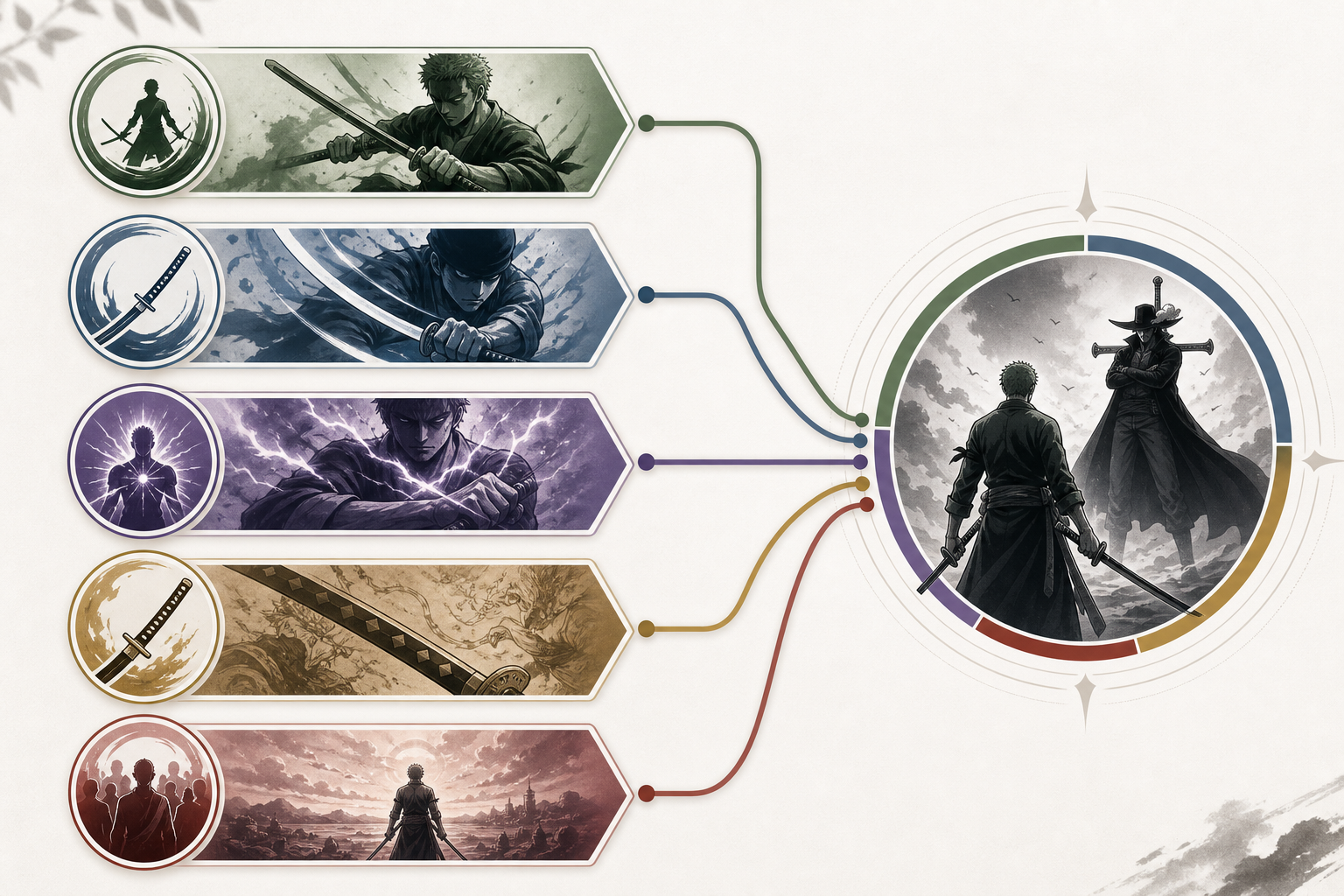
Five narrative milestones that would make Zoro ready to challenge Mihawk.
These are story-based signs to track, not official requirements stated by the series.
Milestone What it would show Why it matters against Mihawk
Reliable control under pressure Zoro can maintain his best form through a full battle Mihawk’s style is associated with precision and composure
Cleaner technique Better timing, defense, distance, and counters A title win should look like mastery, not a lucky trade
Mature Haki use Zoro can apply power with restraint and purpose Elite fights test stamina and decisions as well as force
Blade knowledge Zoro understands his swords and their demands more deeply His blades are central to his style and identity
Wider recognition The world treats Zoro as a genuine top swordsman The title should mean more than Zoro’s private belief

Technique: can Zoro solve a fighter’s style?

Zoro’s toughness is one of his greatest strengths. He has often taken damage to create one decisive opening. That can win a brutal fight, but Mihawk is not a matchup that should be solved by endurance alone.

A major sign of readiness would be efficiency. Watch for Zoro winning difficult exchanges through footwork, timing, feints, blade placement, and control of range. He does not need to become a different fighter. He needs to show that his explosive strength rests on a complete duelist’s foundation.

After a major Zoro fight, ask a simple question: did he only survive long enough to land his strongest move, or did he understand and overcome the opponent’s style? The second result is the stronger Mihawk signal.

Haki: control matters more than labels

Calling Zoro “Yonko level” does not settle this debate. Yonko status is not a neat one-on-one power rank; it also involves reputation, crews, territory, and influence. It cannot tell us whether Zoro can beat Mihawk in a full sword duel.

There is also no direct canon proof that current Zoro has surpassed Mihawk. Zoro has grown enormously, but Mihawk remains the benchmark attached to Zoro’s dream.

More useful signs of growth would include Zoro being able to:

  • read an opponent before he is forced into defense;
  • keep his strongest offense sharp over a long fight;
  • choose when to press and when to conserve energy;
  • adjust when a favored tactic stops working.

Those are not separate power-ups. They are signs of a swordsman who can control a battle rather than only endure it.

Blades, black blades, and unanswered details

Fans often treat forging a black blade as Zoro’s final required milestone, especially because Mihawk carries Yoru. It would be a fitting visual marker, but it remains theory. The story has not said Zoro must forge one before he can challenge Mihawk.

His blade journey could matter in other ways: deeper knowledge of his swords, greater control over their power, or a choice that shows what he values as a swordsman.

The same caution applies to the mystery of Zoro’s closed eye. It is a fun detail to discuss, but it is not evidence that a hidden ability will decide the rematch.

What stakes would justify Zoro vs. Mihawk?

A title challenge is a strong starting point, but the title alone is not enough. The story needs a reason for the duel to happen now, amid the final stage of a much larger adventure.

Personal stakes: keeping a promise

Zoro’s ambition has never existed in a vacuum. He wants the title for himself and for the promise he made to Kuina, but his strength also serves the Straw Hats.

A powerful setup would make him choose responsibility before glory: protect the crew, finish an urgent task, or prove that pursuing Mihawk will not leave his friends exposed. That choice would make the fight feel like the result of Zoro’s growth, not a side quest.

Crew stakes: one dream within the Straw Hats’ endgame

The rematch should not pause the main story. It should feel like part of the Straw Hats reaching the dreams that brought them together.

Zoro becoming the strongest swordsman would validate his role beside Luffy and give the wider world another reason to fear the crew. That larger context matters because the search for the final treasure is also about each Straw Hat reaching a personal destination. Our overview of what the One Piece is and why it matters explores that wider endgame idea.

Mihawk needs a reason to fight, too

Mihawk should not become a trophy waiting at the finish line. His title, pride, and place in a changing pirate world give him reasons to care about a worthy challenger.

His connection to Cross Guild offers one possible route for the two swordsmen to cross paths during a larger conflict. That is a plausible setup, not a prediction. If it happens, the story still needs to give their duel enough space. One quick clash in a crowded battlefield would not fully pay off what Baratie started.

Four ways the rivalry could end

1. A formal title match

This is the clearest and most satisfying option. Zoro challenges Mihawk directly, the conditions are clear, and the World’s Strongest Swordsman question receives an unmistakable answer.

It works best once Zoro has shown the control and consistency needed for a full duel. The title itself provides enough drama; the fight does not need an extra gimmick.

2. A wider Cross Guild conflict creates the opening

A larger conflict could place Zoro and Mihawk on the same battlefield while keeping the duel connected to the final era of piracy.

The advantage is plot logic. The risk is scale. Too many simultaneous fights could reduce a deeply personal challenge to background action.

3. An interrupted fight delays the answer

A first clash could show that Zoro has closed much of the gap without settling the title. Done well, this would raise anticipation and reveal why the final meeting must wait.

Done badly, it would feel like stalling. An interruption only earns its place if it changes what Zoro or Mihawk understands about the other.

4. An indirect or off-panel resolution

This is possible, but it offers the lowest emotional payoff. For it to work, the story would need a direct and credible confirmation of Zoro’s achievement, such as a stated result, public recognition, or a clear concession from Mihawk.

Anything vaguer would leave the central promise incomplete. That is why an on-panel duel remains the strongest expectation, even though it is not guaranteed.

What to watch for in future chapters and episodes

Do not treat every strong Zoro moment as proof that the rematch is next. Look for signals that move the rivalry from a background promise into an active plot point:

  • Direct title language: Zoro, Mihawk, or other characters openly discuss the World’s Strongest Swordsman.
  • A deliberate challenge: either man names the other and makes his intent clear.
  • Mihawk’s full attention: he treats Zoro as a rival, not only as a former student or distant prospect.
  • A complete Zoro duel: Zoro beats a high-level sword fighter through control and adaptation, not only one final burst.
  • Time for closure: the wider plot gives the fight room to breathe rather than cutting away from it.

The claim that Zoro was defeated “2,000 times” is not established in the material reviewed here, so it should not be treated as canon data for power scaling.

So, is Zoro rematch with Mihawk inevitable? It is one of One Piece’s strongest unfinished promises and a highly likely outcome, but its timing and form remain unconfirmed. Until the key signals line up, theory is most fun when it explains not only when they will meet, but why that meeting will matter to both swordsmen.
Is Kuzan Spying on Blackbeard or Loyal? The Evidence

If you’re asking is kuzan spying on blackbeard or loyal, you’re really weighing two clean possibilities: Kuzan as a covert infiltrator with a hidden agenda, …

Is Kuzan spying on Blackbeard or loyal? Canon has not given a final answer. What it has shown is that Kuzan works alongside the Blackbeard Pirates and has taken actions that benefit them. Whether that is deep cover, a temporary alliance, or a real change of sides remains the key question.

The best answer right now is: Kuzan looks genuinely aligned with Teach in public, but his ultimate goal is still unconfirmed. Calling him a confirmed spy goes too far. Calling him unquestioningly loyal does too.

> Spoiler note: This discussion includes manga developments involving Kuzan, Blackbeard’s crew, Pudding, and Garp.

Start with the canon: what Kuzan has actually done

Before picking a side, separate story facts from conclusions.

Kuzan left the Marines after losing his battle with Sakazuki for the Fleet Admiral position. He is no longer an active Marine officer. Later, he was shown traveling with the Blackbeard Pirates and was identified as one of Teach’s Titanic Captains.

His connection to the crew is not just a rumor. Kuzan and Van Augur were involved in the capture of Charlotte Pudding, an act that directly serves Blackbeard’s interests. Kuzan also fought Garp at Hachinosu while Garp tried to rescue Koby. Those are meaningful choices, not harmless background appearances.

Still, none of those scenes reveal Kuzan’s private objective. A character can help a crew while hiding a separate plan. The story has not shown Kuzan reporting to the Marines, SWORD, the Revolutionaries, or any other outside group.

For a fuller look at how the Kuzan–Teach connection developed, see our Kuzan and Blackbeard theory breakdown.

Facts versus interpretation

Canon fact What it can support What it does not prove
Kuzan left the Marines He acts outside the Marine chain of command He secretly still follows Marine orders
Kuzan is associated with Blackbeard’s crew Teach sees him as useful enough to keep close Teach fully trusts him, or Kuzan shares every goal
Kuzan helped capture Pudding He has acted in a way that benefits Blackbeard His long-term allegiance is settled
Kuzan fought Garp at Hachinosu He was willing to oppose a former mentor in a major conflict He has abandoned every part of his old moral code

That distinction matters. “Kuzan is working with Blackbeard” is canon. “Kuzan is a Marine spy” is still theory.

Is Kuzan spying on Blackbeard or loyal? The two cases

The strongest reading depends on whether you give more weight to Kuzan’s current actions or to the unanswered question of why he joined Teach at all.

The case for Kuzan as a spy or double agent

The spy theory is appealing because Kuzan has always been hard to place. As Aokiji, he followed his own version of justice rather than blindly obeying the World Government. His history with Nico Robin also shows that he can reject brutal orders when he believes they cross a line.

That makes a secret mission plausible in a broad sense. Kuzan has the patience, strength, and credibility to enter Teach’s orbit. Blackbeard is also one of the most dangerous people to watch from the inside. If anyone wanted information on Teach’s plans, Devil Fruit hunting, or coming targets, Kuzan would be a powerful asset.

Motives that could support infiltration

A hidden agenda could take several forms:

  • Gathering intelligence: Kuzan may want to learn who Teach plans to target and what the crew knows.
  • Limiting the damage: Staying close could let him delay, redirect, or expose a disaster before it grows.
  • Serving personal justice: Kuzan may not trust the Marines, yet still believe Blackbeard is too dangerous to leave unchecked.
  • Preparing for a later betrayal: He could be waiting for the one moment when turning on Teach would matter most.

The strongest version of this theory does not need Kuzan to be a loyal Marine. He could be acting alone, guided by his own idea of justice. That fits his character better than a simple return to the old system.

Why Blackbeard would still accept the risk

Teach does not need blind trust to recruit Kuzan. He needs value.

Kuzan gives Blackbeard enormous combat power, knowledge of Marine methods, and an intimidating public symbol. Even if Teach suspects that Kuzan has another motive, keeping him nearby may be safer than leaving him free to oppose the crew.

That is especially true for a captain who builds his crew around dangerous, ambitious people. Teach can benefit from a powerful ally while watching for betrayal at the same time.

Blackbeard’s interest in rare abilities also makes Kuzan’s place in the crew worth watching. Our guide to how the Blackbeard Pirates may steal Devil Fruits offers useful context for the kind of secrets someone inside the crew might seek.

The big weakness in the spy theory

There is one major problem: the story has not shown a handler, mission, or secret report.

Until Kuzan contacts an outside ally, sabotages Teach with clear intent, or reveals a prior agreement, “spy” remains an interpretation built on character history. It may be a strong interpretation, but it is not proof.

The case for Kuzan as a real Blackbeard ally

The loyalty case begins with what Kuzan has already risked. He did not merely share a drink with Teach or trade information. He is publicly tied to the Blackbeard Pirates, participated in the Pudding operation, and fought against Garp during the Hachinosu conflict.

Those actions carry real costs. They damage Kuzan’s standing with former allies and make it harder for readers to treat him as a detached observer.

Alignment is not the same as friendship

Kuzan does not need to admire Blackbeard to work with him sincerely. In One Piece, alliances often form around power, freedom, survival, or a shared enemy rather than trust.

Kuzan may believe the Marines and World Government cannot be fixed from within. If so, joining Teach could be a cold, cynical decision: gain room to move, gain access to the coming conflict, and stop pretending that the lawful side is morally clean.

That would make him aligned with Blackbeard’s crew without making him emotionally devoted to Teach.

Why the Garp conflict matters

Garp is one of Kuzan’s most important links to his Marine past. Fighting him is therefore stronger evidence than a vague line of dialogue or an ominous reaction shot.

It does not automatically prove that Kuzan wants Garp dead. The scene still leaves room for restraint, divided feelings, or a deeper plan. But it proves Kuzan was prepared to stand on the Blackbeard side when the stakes became personal.

That is why the “he is only pretending” argument needs more than Kuzan looking conflicted. A double agent can fake loyalty, but the story has already made that cover expensive.

Kuzan’s break from Marine authority is central to this debate. For more background on the role and image of the Admirals, read who the Admirals in One Piece are based on.

The big weakness in the loyalty theory

The main gap is motive. Kuzan has not clearly explained why Teach is the person he chose to stand beside.

If future chapters show Kuzan helping Blackbeard pursue a goal that violates Kuzan’s old moral limits, the loyalty case becomes much stronger. Until then, his actions show cooperation, but not the full reason behind it.

Spy vs. ally: which reading explains more?

Here is the cleanest way to compare the two theories without treating either as settled fact.

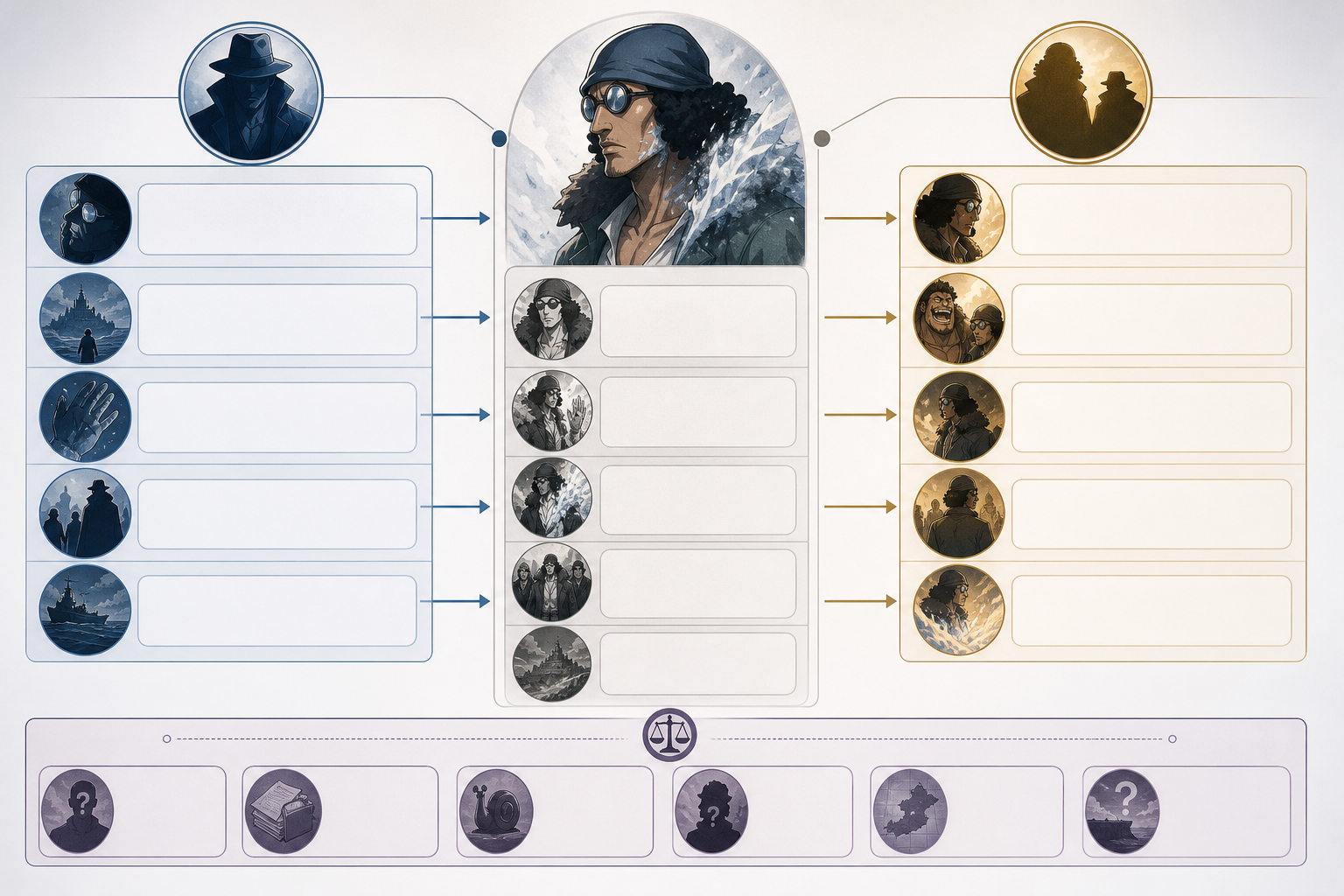
Evidence map comparing the spy and genuine ally theories for Kuzan.
Kuzan’s actions are confirmed; the intent behind them is not.
Question Spy or double-agent reading Genuine ally reading
Does it fit Kuzan’s independent sense of justice? Yes. He could oppose Teach without returning to Marine control. Yes. He may have rejected the whole system, not just its orders.
Does it explain his access to Blackbeard’s crew? Yes. Access is the point of infiltration. Yes. Teach gains a powerful captain and insider knowledge.
Does it explain the Pudding operation and Hachinosu? Only if those acts serve a later objective or protect his cover. Directly. He is helping the crew achieve its goals.
What evidence is missing? A revealed mission, contact, or deliberate sabotage. A clear statement or choice that shows he shares Teach’s endgame.

At the moment, the ally reading has the stronger on-page evidence because Kuzan’s actions have helped Blackbeard. The spy reading has the stronger character-based argument because Kuzan’s past makes a hidden purpose easy to imagine.

That is not a final verdict. It is a reminder to weight actions more heavily than fan expectations.

What would confirm Kuzan’s true allegiance?

Future scenes can move this debate quickly. The most useful clues will be direct and costly, not vague.

Signs that would confirm Kuzan is infiltrating Blackbeard

Look for evidence that is hard to explain away:

  • A private message or meeting with the Marines, SWORD, Revolutionaries, or another confirmed partner.
  • A flashback showing Kuzan accepted a specific mission before meeting Teach.
  • Deliberate sabotage of a Blackbeard operation, with Kuzan’s intent made clear to the reader.
  • Kuzan leaking vital information or rescuing a target that Teach needs, even though it blows his cover.
  • A direct betrayal at a decisive moment, especially if Kuzan gains nothing for himself.

Signs that would confirm Kuzan is truly loyal or fully aligned

The loyal reading needs a similarly clear commitment:

  • Kuzan explains his own reason for choosing Teach when there is no one around to deceive.
  • He protects Teach or a crewmate at serious personal cost when escape would be easier.
  • He takes part in a major Blackbeard plan that cannot be undone with a later “I was undercover” reveal.
  • Teach shares a core endgame goal with Kuzan, and Kuzan helps carry it out willingly.
  • Kuzan rejects a real chance to return to his former allies because he has chosen Blackbeard’s side.

Clues fans should treat carefully

Some common arguments are fun, but weak on their own:

  • A serious expression does not prove secret guilt.
  • Refusing to kill someone does not prove Kuzan is a hero or a spy.
  • Teach keeping Kuzan close does not prove trust; it may only prove usefulness.
  • A character’s old morality does not guarantee that they have not changed.

The best habit is simple: ask who benefited, what Kuzan risked, and whether the scene reveals his private intent.

Verdict: Kuzan is aligned with Teach, but his endgame is open

Kuzan is currently acting as part of Blackbeard’s world. That is the firmest conclusion canon supports. He has helped the crew and opposed people from his own past, so the idea that he is merely hanging around with no commitment no longer fits the evidence.

But the story has not confirmed that he is loyal to Teach personally, nor has it confirmed that he is spying for anyone. The most defensible position is that Kuzan is a real, active Blackbeard ally whose final agenda remains unknown.

That uncertainty is what makes the theory worth following. If a new chapter gives Kuzan a private conversation, a clear sacrifice, or a decisive betrayal, revisit the evidence—not just the hype. Which action do you think tells us the most about where Kuzan truly stands?