

If you want the crocodile timeline anime manga live action comparison, start with one useful distinction: the manga and anime have a complete Alabasta story to compare, while the supplied material does not verify a released live-action version of Crocodile’s Alabasta arc.
That means the manga and anime columns below cover what happens on the page and screen. The live-action section is a spoiler-aware watchlist, not a list of claimed scenes, casting details, or plot changes. It is the safest way to spot real adaptation choices when you watch.
For Crocodile’s powers, role, and larger story purpose, see Crocodile One Piece Explained: Powers, Role & Season 2.
The core timeline: manga and anime
Crocodile’s Alabasta story has a clear shape in both versions:
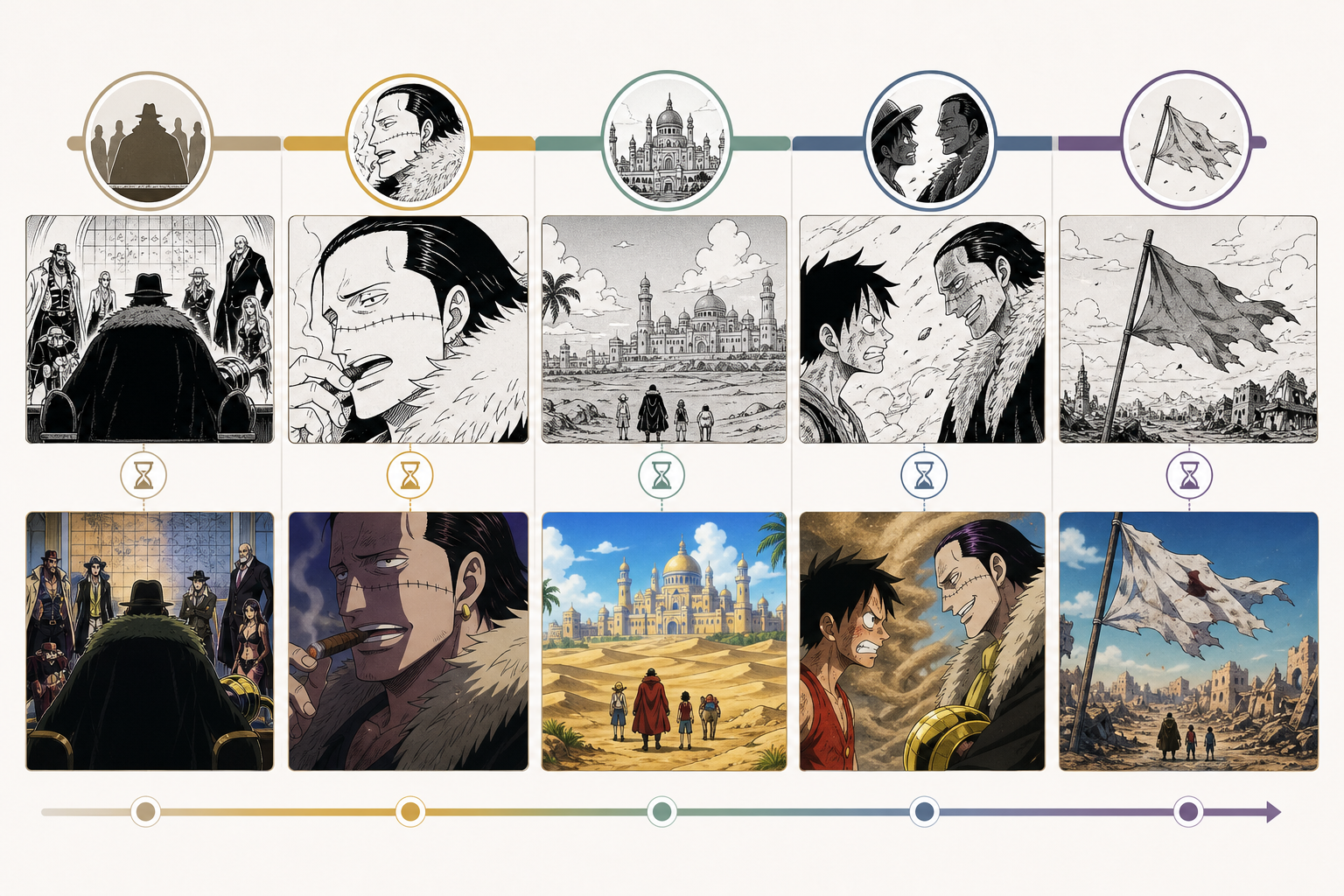
- Baroque Works appears before its boss does. The group is introduced through agents, code names, and its connection to Vivi.
- Mr. 0 becomes a real threat. The unseen leader is revealed to be Crocodile, a public hero with a private agenda.
- Alabasta moves toward disaster. Crocodile uses Baroque Works to deepen conflict and push the country toward civil war.
- The Straw Hats split their efforts. Some confront agents while Luffy goes after Crocodile.
- The plan breaks down. The final conflict exposes the gap between Crocodile’s public image and his real work.
- The fallout reaches beyond Alabasta. Crocodile’s defeat resolves the arc, but it also shows how far one powerful pirate can shape a nation.
| Phase | Manga | Anime | What it says about Crocodile |
|---|---|---|---|
| Setup | Baroque Works and Mr. 0 are introduced as a mystery | Preserves the same core setup, with more time between story beats | His influence arrives before he does |
| Reveal | Crocodile becomes the face behind the system | Follows the same reveal path | His public status makes the scheme more dangerous |
| Escalation | The plot drives steadily toward civil war | Travel, reactions, and fights often take longer | Extra time can make his network feel larger, or make the heroes seem to have more room to respond |
| Payoff | Luffy’s conflict with Crocodile anchors the climax | Major confrontations are more extended | His threat rests on planning as much as raw power |
| Fallout | The arc closes the immediate conspiracy | The same core resolution, with a longer screen rhythm | Defeat does not erase the scale of the damage he caused |
The key point is simple: the anime does not turn Alabasta into a different Crocodile story. It mainly changes the feel of the route there through pacing and added breathing room.
First appearance, setup, and the order of reveals
How the manga seeds Crocodile
The manga makes Crocodile’s first stretch of the story feel like a puzzle. Readers meet Baroque Works as an organization before they fully understand who runs it. Agent numbers, secret orders, and Vivi’s connection to the group create pressure before Crocodile becomes the center of the page.
That structure matters. Crocodile does not need to appear in every early scene to feel present. His system is already making choices, moving people, and creating danger.
In standard anime numbering, Crocodile first appears in episode 76, during the run-up to Alabasta. The manga introduction is in chapter 126. If your streaming service groups episodes into seasons, search for “Crocodile” or “Alabasta” rather than relying only on a season label.
What the anime changes
The anime keeps the broad order intact: Baroque Works first, Crocodile’s identity and plan next, then the Alabasta crisis. Its main difference is duration.
Longer transitions, reaction shots, travel scenes, and expanded fights can change a viewer’s memory of the arc. A threat that lands sharply in a few manga pages may sit on screen for several scenes. That can help the country feel vast and stressed. It can also make the plot seem less direct than it is in the manga.
This is why “the anime reordered everything” is usually too strong. A more accurate reading is that the anime often stretches the distance between important turns.
For a practical way to read or revisit the source material, use Read One Piece Manga – All the Choices.
Which events shift order across adaptations?
Between the manga and anime, the major cause-and-effect chain remains recognisable. The changes viewers notice most are usually changes in emphasis rather than a wholesale rewrite:
- Baroque Works agents may get more screen time, making the organization feel more visible before Crocodile takes focus.
- Travel and regrouping last longer, which puts more space between discoveries and confrontations.
- Side fights receive more attention, so the central race to stop Crocodile can feel less immediate.
- Reaction scenes linger, giving the consequences of a reveal more weight but slowing the next move.
For live action, it is better not to guess at exact swaps without an official episode source. A future adaptation may move a reveal, merge characters, or combine locations, but those are adaptation options—not confirmed facts.
Competence check: why Crocodile can feel smarter in one version
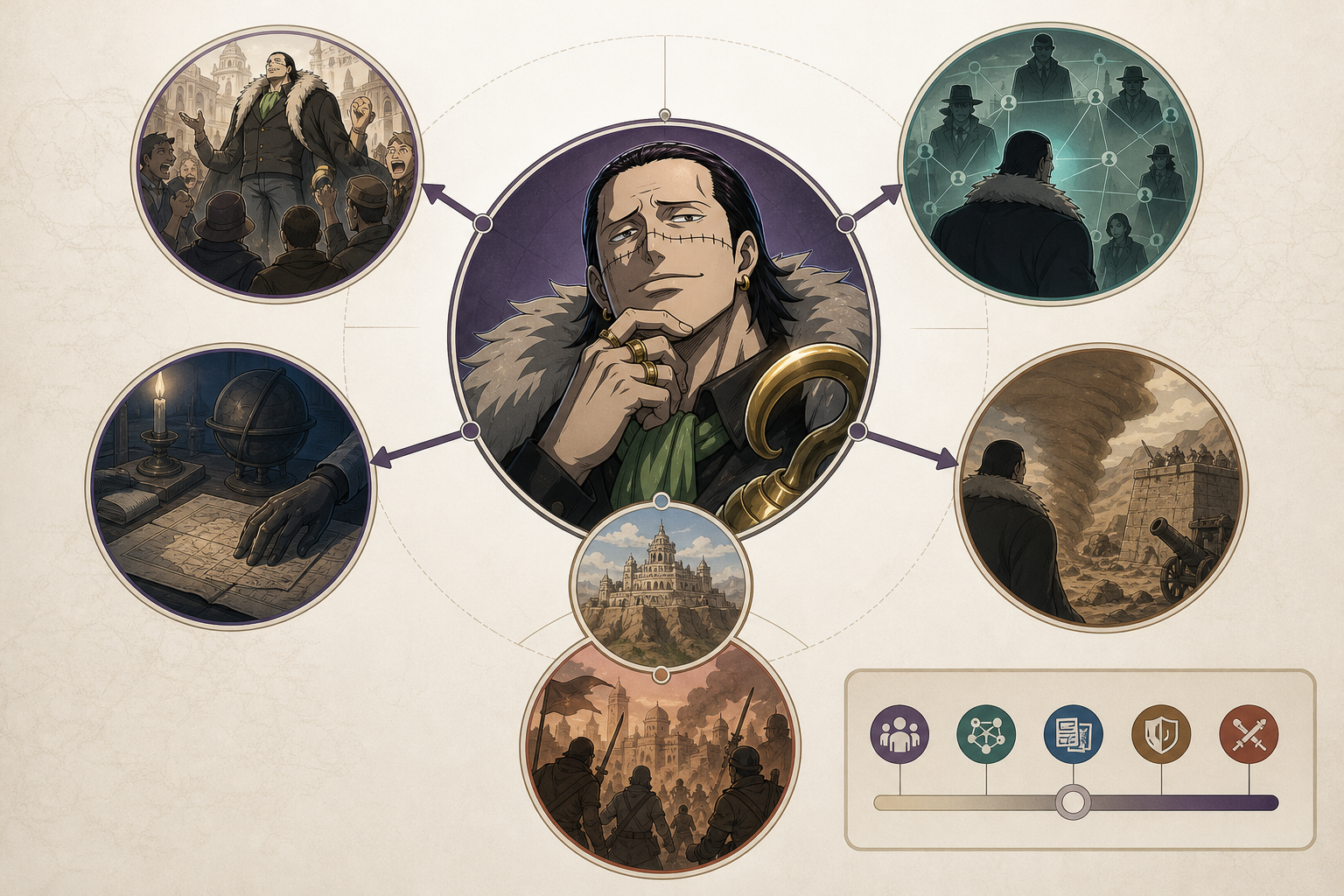
Crocodile’s reputation is built on more than his Devil Fruit. He works because he has reach: a hidden organization, a public reputation, useful information, and a plan that exploits conflict already brewing in Alabasta.
When comparing versions, ask whether the adaptation preserves those signals.
Signals that make him look competent
- The plan has layers. Baroque Works can still act when one agent fails.
- The public story helps him. His image gives him cover that a plainly villainous pirate would not have.
- He controls information. Other characters do not see the full plan at the same time.
- His setbacks cost something. A counter to his advantage should feel discovered or earned, not convenient.
- He adapts without panic. A villain can adjust to a problem and still look prepared.
The manga benefits from tight placement of setup and payoff. A clue appears, a consequence follows, and Crocodile’s wider plan becomes clearer. This rhythm makes him feel like the person steering the plot.
How anime pacing affects that impression
The anime’s longer run time can work in two directions. Extra scenes with Baroque Works agents can make Crocodile’s network feel disciplined and far-reaching. On the other hand, if the heroes get several extended escapes or detours, a viewer may feel that Crocodile has too many chances to stop them.
That is not necessarily a contradiction in the plot. It is a difference in what the audience spends time watching.
A useful viewing question is: does this added scene show Crocodile’s control, or does it simply delay the next canon turning point? The first deepens his threat. The second may soften it.
For more context on how the anime’s format shapes pacing, see One Piece Anime Review – Welcome Aboard!.
What changes alter Crocodile’s perceived competence?
The biggest levers are these:
- Reveal timing: An earlier explanation can make Crocodile’s scheme easier to follow. A later explanation keeps mystery but may hide how much planning is involved.
- Information flow: He looks stronger when his opponents act with incomplete information and weaker when they learn key answers too easily.
- Escape count: Repeated escapes can read as poor containment, even when the final plot outcome is unchanged.
- The cost of counters: If a weakness looks rare and difficult to use, Crocodile feels prepared. If it seems obvious, he can look careless.
- Focus on the country: Alabasta’s political crisis is part of his competence. Removing too much of that context reduces the sense that he built a system rather than just picked fights.
Live-action watchlist: what to compare without relying on rumors
The crocodile timeline anime manga live action question often invites rumors about casting, identity, and unannounced scenes. Those claims are not evidence. In particular, fan posts and social clips are not a reliable basis for saying that Crocodile has received a confirmed live-action change.
Instead, use this checklist when an officially released adaptation reaches this part of the story.
1. First mention versus first appearance
Does the show name Baroque Works or Mr. 0 before showing Crocodile? An earlier appearance can give the season a clear villain anchor. Holding him back protects the mystery that works so well in the manga.
Neither choice is automatically better. The meaningful question is whether the show still makes his organization feel active before he enters the room.
2. Vivi’s role in explaining the stakes
Alabasta is not just a location for a boss battle. Vivi gives the arc its human and political stakes. If an adaptation shortens her investigation, it needs another clear way to show why the country is vulnerable and why Crocodile’s plan can work.
Without that context, he risks looking like a powerful pirate causing random trouble. With it, he looks like a strategist exploiting a crisis.
3. Merged agent fights and locations
Live-action seasons have less room than a long-running weekly anime. It would be normal for an adaptation to combine encounters, reduce travel, or use one location for several plot jobs.
Watch what each merged scene accomplishes. A strong compression should still deliver the clue, the character choice, and the consequence. If it only removes steps, Crocodile’s plan may feel simpler than it should.
4. The timing of the main confrontation
A season may hold Crocodile’s full role for a late reveal, or introduce him earlier and build tension through his actions. Either structure can work if the show preserves the central idea: the heroes are not facing one man in isolation; they are trying to break a network and stop a country from collapsing.
For a broader look at what the first live-action season changed in tone and structure, read One Piece Live Action Review – Masterpiece or Disaster?.
Fast routes for manga readers, anime watchers, and live-action viewers
Fastest route through the manga
Start with the Baroque Works buildup, then read straight through Alabasta. Do not skip the early organization material if your goal is to understand Crocodile. Those scenes explain why the later conflict feels larger than one duel.
Fastest route through the anime
Begin with the episodes that introduce Baroque Works and continue into Alabasta. If the pace feels slow, keep an eye on the milestones in the first table: setup, reveal, escalation, payoff, and fallout. That makes it easier to separate expanded material from the story’s essential chain.
Best route for live-action-only viewers
Watch the official episodes first, then use the manga-and-anime sequence here as a reference point. Compare the order of mentions, introductions, discoveries, and confrontations—not isolated shots or rumor posts.
FAQ
In which episode does Crocodile appear in One Piece?
Crocodile first appears in standard anime episode 76. He is introduced in manga chapter 126. Platform season labels can differ, so searching by character or the Alabasta arc is often faster than browsing season numbers.
Was Crocodile originally a woman?
No official canon confirmation establishes that Crocodile was originally a woman. It is a long-running fan theory based on unanswered details about his past, not a settled fact. Treat posts that present it as confirmed as speculation unless they cite an official manga source or author statement.
What anime has a man with a crocodile head?
That is probably not One Piece. One Piece’s Crocodile is a human pirate with a crocodile-themed name. If you are trying to identify another show, search with details such as “crocodile head mask,” the animation style, a setting, a scene, or the service where you watched it.
Is there a kids’ TV show about a crocodile?
There are many unrelated children’s shows and films with crocodile characters, so this search often gets mixed into One Piece results. One unrelated example is A Crocodile Who Lived for 100 Days, described in this film synopsis. Add details such as a song, puppet style, country, or year to narrow your search.
Where should I start for the Crocodile story quickly?
Start with the Baroque Works setup and continue through Alabasta. That is the shortest route that still explains Crocodile’s network, Vivi’s stakes, and the logic behind the final conflict. Skipping straight to the fights gives you the spectacle, but not the reason Crocodile feels like such a major threat.