
The short answer to why the crew helps in Alabasta is that Vivi becomes their friend before Alabasta becomes their problem. The Straw Hats do not set out to fix a kingdom for glory. They see Vivi carry an impossible burden, learn that Crocodile is driving her country toward war, and decide that walking away is not an option.
Alabasta matters because it turns a familiar One Piece instinct—protecting a friend—into a crisis involving an entire nation. The crew can fight beside Vivi, but they cannot make her choices for her. That balance is the heart of the arc.
How Vivi turns a detour into a personal mission
Vivi first meets the Straw Hats while working undercover as Miss Wednesday. Her identity as Alabasta’s princess changes the scale of the story, but it is not her title that wins the crew over. It is her conduct.
She has already put herself in danger to investigate Baroque Works from within. Once her mission is exposed, she is not asking Luffy to win a throne for her. She is trying to stop people in her country from killing one another. That distinction matters: Vivi’s goal is protection, not power.
The crew also sees that she is willing to act. She travels with them, faces enemies herself, and keeps trying to reach Alabasta even when the odds are bad. For more on her role before, during, and after the arc, see Princess Vivi One Piece Explained.
The commitment happens in stages
There is no single contract that makes the Straw Hats responsible for Alabasta. Their commitment builds through a series of choices:
- Vivi reveals what is at stake. Baroque Works is not merely chasing her; its plan threatens Alabasta’s people.
- The crew agrees to take her home. Escorting her is dangerous, but it gives Vivi a chance to act before the conflict worsens.
- They keep going when the trip becomes costly. Pursuit, hostile terrain, and injuries do not make them abandon her.
- Luffy treats Vivi’s crisis as a friend’s crisis. Once he accepts that bond, the mission is no longer a favor with an easy exit.
This is why the arc feels more personal than a standard “save the kingdom” plot. The country matters because Vivi matters to them.
Crocodile’s plan makes neutrality impossible
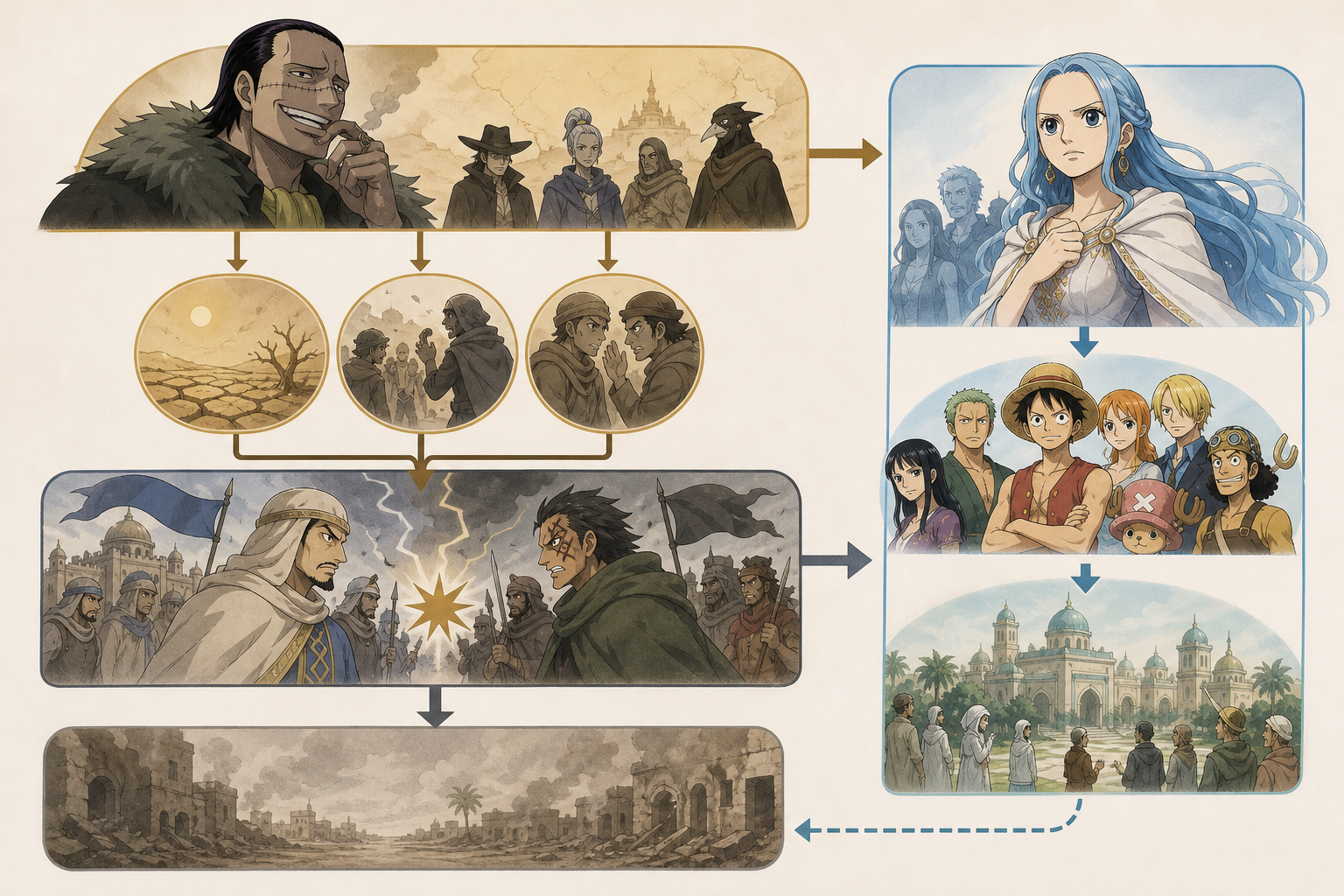
Crocodile, secretly Mr. 0 of Baroque Works, aims to seize control of Alabasta through Operation Utopia. He fuels distrust between the royal army and the rebels, exploits the kingdom’s drought, and lets both sides believe the other is responsible. His end goal is power, including access to the ancient weapon Pluton said to be connected to Alabasta.
For a fuller event and battle guide, read Alabasta Arc One Piece Explained.
It is not simply a war between two sides
The conflict can look like a simple clash between a monarchy and a rebellion. The tragedy is that Crocodile engineers the conditions that make the clash possible. People who believe they are defending their homes or seeking justice are being used as pieces in his scheme.
That is exactly the kind of cruelty the Straw Hats cannot ignore. Crocodile does not only threaten Vivi or challenge Luffy. He treats ordinary people as tools and turns fear into a weapon.
The crew is not interested in ruling Alabasta or choosing its politics. Their role is more direct: expose the person manufacturing the disaster, protect their friend, and help prevent the catastrophe from becoming irreversible.
Why defeating Crocodile is not enough on its own
Even after Crocodile is confronted, Alabasta still faces a ticking clock. Rumors, anger, and armed conflict have a momentum of their own. The crew therefore cannot solve the problem with one fight alone.
That pressure gives the arc its moral weight. Luffy’s battle with Crocodile matters, but so do Vivi’s efforts to make herself heard and stop the fighting. The Straw Hats create an opening; Vivi remains the person trying to reach her people.
An official recap of the story also highlights the crew’s willingness to keep moving through danger, including their escape from the Marine blockade with Bon Clay’s help (Bandai Namco Entertainment).
What Alabasta reveals about Straw Hat ethics
Alabasta is an early, clear statement of the Straw Hats’ moral code. They are pirates, not formal heroes, and they do not take on every injustice they hear about. But several triggers reliably move them from concern to action.
A chosen friend is worth the risk
The crew does not protect Vivi because she is a princess. In fact, her rank means little to them. They protect her because she has shared danger with them and earned their trust.
That is the key answer to why the crew helps in Alabasta: friendship is not a light promise in this crew. Once someone is accepted as one of their own, inconvenience and danger stop being reasons to leave.
They reject power built on manipulation
Crocodile’s strength is not just his Devil Fruit. It is his ability to hide behind a public image while he creates misery in private. The Straw Hats have little patience for that kind of power.
They do not need a political theory to recognize the problem. They see a powerful person trapping civilians in a conflict they did not choose, and they push back. For a closer look at Mr. 0’s place in the story, see Crocodile One Piece Explained.
Helping is not the same as taking over
The Straw Hats help Vivi, but they do not replace her. She has knowledge of her country, ties to its people, and a responsibility she chooses to carry. Luffy cannot speak to the citizens of Alabasta in her place, and he does not try.
That division of roles is one reason the ending works. The crew fights the forces blocking Vivi’s path. Vivi faces her people and works for peace herself. It is support without possession.
The scenes that make Vivi a non-negotiable friend
The arc has many fights, but its most important turns are emotional decisions. These are the moments to watch when revisiting the story.
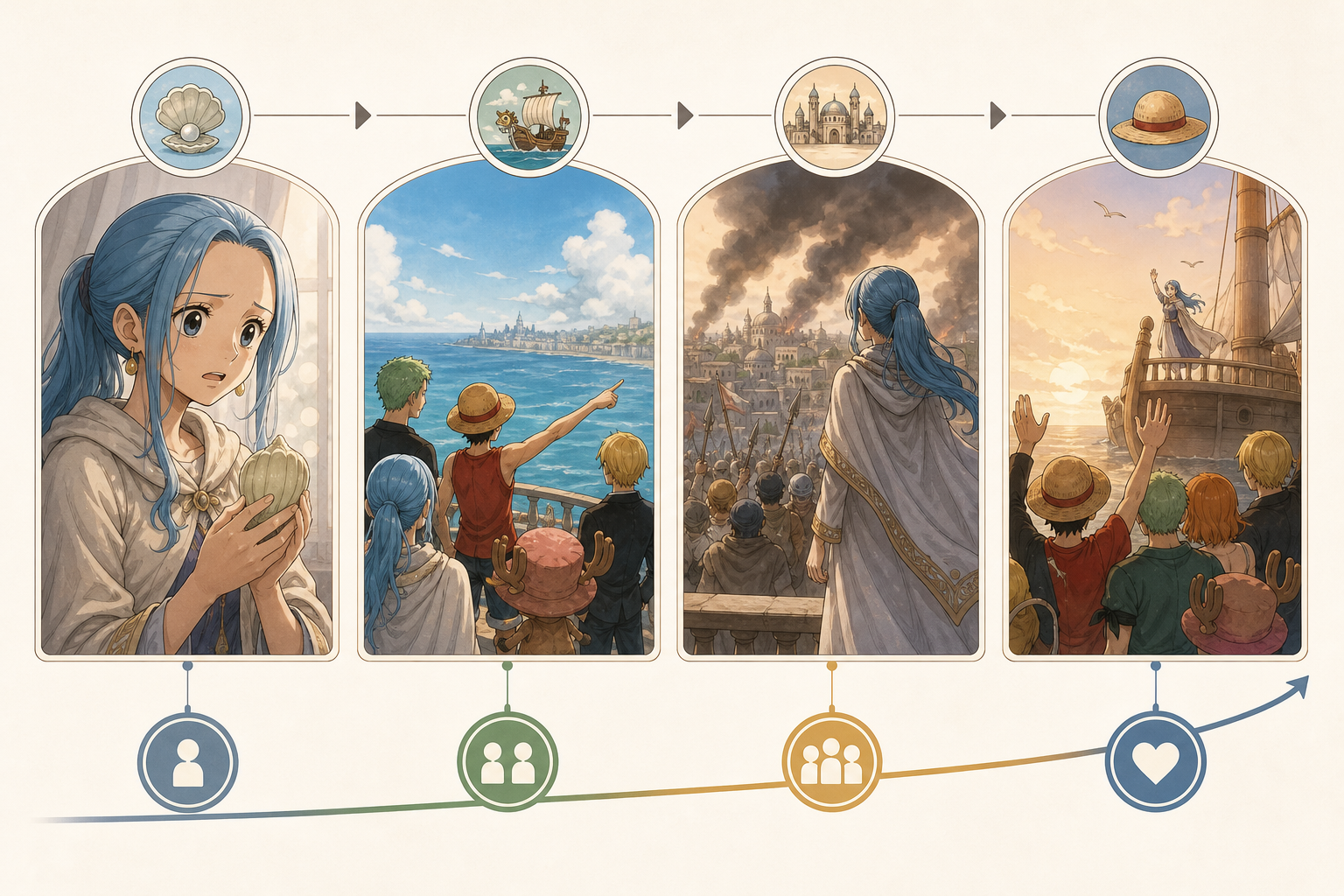
Vivi drops the disguise and shows the cost of her mission
Once the Straw Hats understand that Miss Wednesday is Vivi, they also understand how much she has risked alone. Her royal status does not erase her fear or make the task easy. It makes the stakes more painful: she is watching her own country slide toward violence.
The crew responds to that sincerity, not to royal authority.
Luffy refuses to let her carry everything alone
Vivi often tries to bear the full responsibility for Alabasta. Luffy pushes against that instinct. His response is not a detailed plan for governing a country. It is a blunt refusal to let a friend suffer alone while he can act.
That is a recurring Straw Hat pattern: when someone insists they must handle a crisis by themselves, the crew challenges the isolation before it challenges the enemy.
The crew accepts the cost of staying
Traveling to Alabasta brings heat from Baroque Works and the Marines, as well as the hazards of the Grand Line. The crew has chances to treat Vivi as a temporary passenger and move on. Instead, they keep choosing the harder route.
Their loyalty is practical, not ceremonial. They show it by continuing the journey, sharing the danger, and fighting for the chance that Vivi can reach her people.
The farewell proves the friendship is not conditional
The farewell is powerful because Alabasta has already established the rule: friendship does not require ownership. Vivi belongs with her people, while the Straw Hats must continue their voyage. Separation does not undo what they chose together.
That idea becomes especially important when considering other characters whose loyalty is unclear at first.
Nami, Robin, and Bon Clay: three useful contrasts
Questions about betrayal and shifting alliances often get folded into Alabasta discussions. These characters show three different forms of loyalty under pressure.
Nami did not betray Luffy in Alabasta
When fans ask why Nami “betrayed” Luffy, they are usually referring to the Arlong Park story, not Alabasta. Nami works under Arlong because she is trying to protect Cocoyasi Village. Her secrecy is a survival strategy under coercion.
Vivi’s situation is different in scale but similar in one key way: both women try to carry a crushing responsibility alone. The Straw Hats’ response in both stories is to look past the apparent betrayal or distance and see the pressure underneath.
Robin helps Luffy, but her motives stay guarded
Nico Robin, then known as Miss All Sunday, is one of the arc’s deliberate mysteries. She opposes Crocodile at key moments, including helping Luffy survive, but she does not suddenly become an open Straw Hat ally. Her actions are tied to her own goals, especially the poneglyph in Alabasta, and the story keeps her motives partly hidden.
That uncertainty is what makes her later place in the crew meaningful. Alabasta begins the question of whether an enemy can become someone worth trusting. Explore that later journey in Nico Robin One Piece Explained.
Bon Clay shows that honor can cross enemy lines
Mr. 2 Bon Clay begins as an opponent, but he also follows his own code. His actions complicate the simple labels of friend and enemy. In an arc driven by deception, he stands out because a promise can still mean something to him.
Together, Vivi, Robin, and Bon Clay show that One Piece treats loyalty as a choice shaped by pressure, values, and action—not as a fixed team label.
Why Alabasta remains important in One Piece
Alabasta is one of the first arcs to show that the Straw Hats can affect a world much larger than their ship. It expands the story beyond island adventures without losing the personal reason the crew gets involved.
The formula is simple but powerful: a friend is in danger, a corrupt force is hurting ordinary people, and the crew refuses to stand aside. Yet the arc also avoids making the Straw Hats the sole owners of the victory. Vivi’s voice, the citizens’ choices, and the truth behind the conflict all matter.
That is why Alabasta is more than a Crocodile fight or a royal rescue plot. It is the point where the Straw Hats’ chosen-family ethics meet a national crisis—and where their willingness to help becomes impossible to mistake.
Quick reference: chapters, episodes, and common questions
Which chapters and episodes cover Alabasta?
The Alabasta Arc is commonly listed as manga chapters 155–217 and anime episodes 92–130. Lists sometimes differ because fans and platforms may include earlier Baroque Works setup arcs in the wider Alabasta Saga. The One Piece Wiki arc guide is a useful cross-check, though streaming services may group episodes differently.
Is Alabasta one of the most disliked One Piece arcs?
There is no single answer because fan opinion changes by platform, pacing preference, and whether someone watches the anime or reads the manga. Alabasta is often discussed as a major early arc rather than a consensus “most disliked” one. Its long-term importance comes from Vivi, Crocodile, Robin, Baroque Works, and the way it broadens the world’s political stakes.
How should a live-action version handle Alabasta?
Any adaptation would need to preserve the core relationship, not just the desert setting or major fights: Vivi’s agency, Crocodile’s manipulation of public fear, and the crew’s decision to treat her problem as their own. Specific adaptation choices should not be assumed until they are officially announced.