

Learning how to build a theory from unsolved mysteries starts with one rule: separate what the story confirms from what you think it means. Gather the strongest canon clues, keep each clue in context, offer an explanation, and say what later chapters would need to show for you to be right—or wrong.
That keeps a fun One Piece theory from becoming unsupported headcanon. It also gives you a post you can update when new chapters change the picture.
Start by separating facts, guesses, and headcanon
A theory is more than a prediction. It is an explanation that fits the known evidence and gives you ways to test it later.

- Fact: A manga panel, line of dialogue, narrator statement, or other source you can point to.
- Interpretation: What that fact may mean.
- Prediction: A later reveal that should happen if your interpretation is right.
- Headcanon: An idea you enjoy but cannot support with the text yet.
Use a three-column note for every clue:
| Canon fact | Interpretation | Testable prediction |
|---|---|---|
| A character reacts to a name or symbol | They may know its history | A later flashback or conversation explains that link |
This makes weak links easy to spot. If the first column is empty, the claim may still be fun, but it is not evidence.
For practice, start with a mystery that has several clear clues. Our list of Top Mysteries in One Piece – Still Unsolved is a useful place to find one.
Map the mystery before you explain it
Do not start with the answer you want. Start with a narrow question.
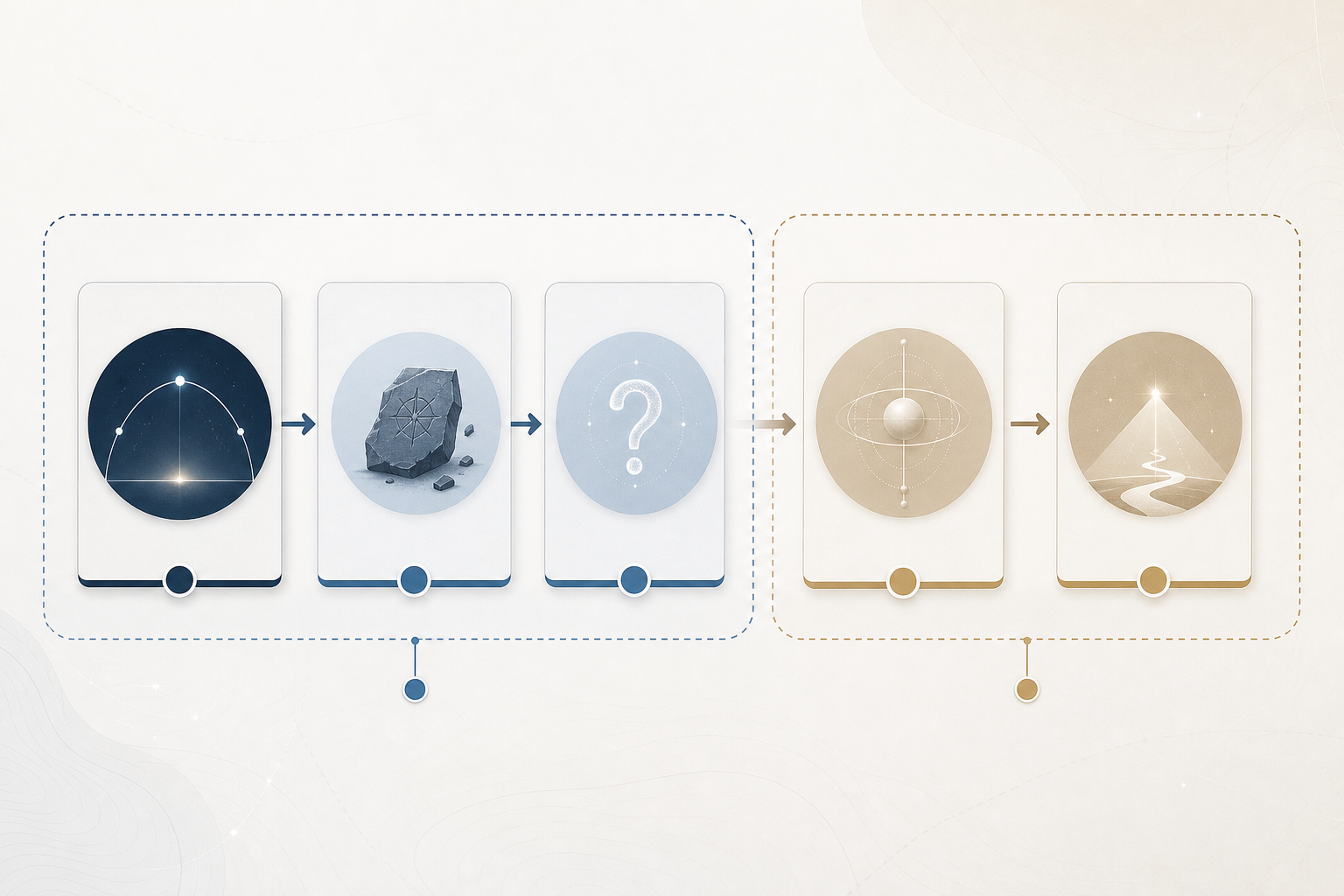
“Who is linked to this shadow?” is manageable. “What is the whole truth behind the Void Century, the One Piece, Joy Boy, and every Ancient Weapon?” is several mysteries at once. Split a large topic into smaller questions first.
Build a canon timeline
Make a short timeline with four fields:
- Arc and chapter or episode anchor
- What the source says or shows
- What remains unknown
- How certain the clue is
The phrase one piece arcs in order matters here because a clue can change meaning when it is pulled out of its story context. Use arc order to file your notes, not as proof that every repeated image is a planned link. Arc names and boundaries can vary between guides, so use chapter numbers when precision matters.
For example, a Void Century note might look like this:
- Alabasta: Robin encounters a Poneglyph; the full historical message remains unknown.
- Skypiea: Another Poneglyph adds to the pattern; its link to the wider history still needs an answer.
- Enies Lobby: The Ohara flashback gives direct context for why historical research is dangerous.
The timeline does not solve the mystery. It stops you from treating scenes from different eras, speakers, or situations as if they say the same thing.
Set canon constraints
A good theory has rails. Write down the facts your explanation cannot break:
- Character motives and known relationships
- The known timeline
- Rules for powers, technology, and the World Government
- Direct statements that have not been contradicted
- The difference between a narrator statement and a character’s belief
For a wider example that connects inherited will, history, and endgame questions, compare your notes with Theory About One Piece – Inherited Will, Void Century and All Blue. Treat any theory page as commentary, then trace its key claims back to canon yourself.
Rank evidence before you build on it
Not every clue has the same weight. A strong theory may have fewer clues than a popular one, but its clues are easier to check.
What sources count as the strongest supporting evidence?
For One Piece, use an evidence ladder:
- Manga chapters and cover stories: The best starting point for story events and dialogue.
- Official author material, such as SBS answers: Useful context, but read the wording closely.
- Official reference material and interviews: Helpful when you can identify the original source and date.
- Anime adaptation: Useful for revisiting scenes, but it can add pacing, dialogue, or filler details not found in the manga.
- Translations, recaps, wikis, videos, and fan posts: Good for finding leads, not for proving a claim on their own.
Save the chapter number with every note. If one translation choice carries your whole argument, check more than one translation. Do not treat a disputed word as a hard fact.
This follows a basic research habit: separate primary material from later commentary. PBS’s Crack the Case: History’s Toughest Mysteries frames mystery research around studying sources before building an explanation. That works well for fandom theorizing too.
Watch for common traps
Some evidence looks strong because it is specific. Be careful with:
- Silhouettes and shadows: They can suggest a link, but rarely prove identity.
- Anime-only details: Check whether the manga supports them.
- Character testimony: A character can lie, be mistaken, or lack key facts.
- Single-panel patterns: One visual parallel may be a callback, not a secret rule.
- Timeline jumps: A clue may appear later but happen earlier in the story world.
A focused character question is good practice. In How Did Kid Lose His Arm In One Piece?, separate what the story establishes about the event from any guess about the full fight or its timing.
Turn clues into a theory that can be wrong
A theory becomes useful when it risks being wrong. You do not need to predict an exact chapter or every twist. You do need to name the kind of evidence that would support or hurt your explanation.
How do you define falsifiable theory predictions?
A falsifiable prediction is a clear result you could observe if your theory is true. Write it in an if/then form:
> If this explanation is correct, then the story should reveal this kind of evidence in this likely context.
Weak prediction: “The reveal will be huge.”
Stronger prediction: “If the mystery is tied to a character’s hidden past, a flashback or direct conversation should link that character to the earlier symbol or event.”
Also write the reverse:
> I will revise or drop this theory if the story confirms __.
That is not a weakness. It shows readers that you can separate evidence from attachment.
Make three to five predictions
Three to five predictions are enough to test a theory without turning it into a wish list. Mix direct and indirect tests:
- A reveal that should happen
- A detail that should return
- A motive that should match earlier behavior
- A limit the theory should explain
- A fact that would disprove the theory
Here is a simple example using the question of why Blackbeard can hold two Devil Fruit powers:
- Theory claim: His ability comes from an unusual biological trait.
- Prediction: Earlier flashbacks or a scientific explanation should point to that trait.
- Prediction: The story should explain why most people cannot repeat the process.
- Disconfirming evidence: A confirmed method that any person can use with the right tool or ritual would weaken a biology-only explanation.
Notice what this does not do: it does not pretend the answer is already known.
This is the heart of how to build a theory from unsolved mysteries: make a claim, show its support, and leave room for canon to prove you wrong.
Stress-test the theory against other answers
Before you publish, give your own idea a fair fight. Write two competing explanations and see which one fits the most evidence with the fewest extra assumptions.
Compare competing hypotheses
Suppose you are studying a character’s power. You might test:
- Hypothesis A: The power comes mainly from a Devil Fruit mechanism.
- Hypothesis B: The effect comes mainly from Haki, fear, or another known ability.
- Hypothesis C: Both matter, but only under a stated condition.
Ask the same questions of each one: Does it fit the timeline? Does it explain the direct dialogue? Does it need invented rules? Does it make useful predictions?
A Big Mom discussion is a good reminder that power-scaling claims need clear terms. If you are exploring that topic, How Strong Is Big Mom In One Piece? – Is She A Former Homie? can help you spot claims worth checking against manga evidence.
Use a simple scorecard
You do not need false precision. A short written scorecard is enough:
| Check | Question to ask |
|---|---|
| Evidence strength | Is the main support a direct source or a loose visual hint? |
| Coverage | Does the theory explain several clues, not just one? |
| Canon fit | Does it break a known rule, motive, or date? |
| Simplicity | Does it need many unproven steps? |
| Predictive power | Could later canon support or weaken it? |
| Alternatives | Does another explanation fit the same clues better? |
If you find a contradiction, do not hide it. Narrow the theory, lower your confidence, or replace it. “Possible” is often more honest—and more interesting—than “confirmed.”
Publish a theory readers can check and revisit
A clear structure lets readers follow your reasoning without agreeing with every conclusion.
Use this theory-post template
- Mystery recap: State the exact unanswered question.
- Canon timeline: List the key scenes in order.
- Evidence table: Separate facts from interpretations.
- Theory statement: Give the explanation in one or two sentences.
- Predictions: Include three to five tests.
- Counterarguments: Present the strongest alternative.
- What would change my mind: Name the evidence that would disprove it.
- Confidence level: Use plain labels such as low, medium, or high.
This also works for older character theories. For example, when reading One Piece Kaido Theory – The King of the Beasts, ask which claims are direct observations and which are interpretations made before later story events.
Update the theory when new canon arrives
Add a dated update at the top when a new chapter or episode affects your argument. For each prediction, mark it:
- Supported: New material fits the prediction.
- Weakened: New material creates doubt but does not settle it.
- Disproven: New material clearly conflicts with it.
- Still open: Nothing relevant has changed.
Keep a brief edit log at the end. Readers can see how the theory changed instead of wondering whether old claims were quietly rewritten.
FAQ
What are some unsolved theories to practice on?
Choose mysteries with several canon clues and one clear unanswered question. In One Piece, readers often practice on the Void Century, Blackbeard’s unusual abilities, hidden identities, the national treasure of Mariejois, or the meaning of repeated symbols. Start with one question, not an entire endgame theory.
What is the 12-step mystery formula?
There is no single 12-step formula for every mystery. A useful version for fandom work is: define the question, gather sources, map the timeline, label facts, rank evidence, list unknowns, set constraints, write alternatives, choose a working explanation, make predictions, name disconfirming evidence, and update after new clues appear.
The goal is not to force every theory into twelve boxes. It is to make your reasoning easy to follow.
What is the greatest unsolved mystery of all time?
There is no objective answer. “Greatest” may mean the mystery with the biggest historical impact, the least surviving evidence, or the most compelling competing answers. For theory practice, ask whether the mystery has reliable sources and a claim you can test.
Has anything been solved from Unsolved Mysteries?
Individual cases can receive new leads, identifications, or resolutions over time, while others remain open. The lesson for theorists is simple: new evidence can change the best explanation. Updating a theory is part of doing it well, not proof that the first effort was pointless.
Why will an embedded source or video not load?
A blank embed may come from an ad blocker, privacy extension, blocked scripts, disabled JavaScript, cached page data, or a network issue. Try reloading the page, temporarily turning off conflicting extensions, allowing scripts for the site, clearing your browser cache, or opening the page in another browser. If the text source is available as a normal link, use that while you troubleshoot.