
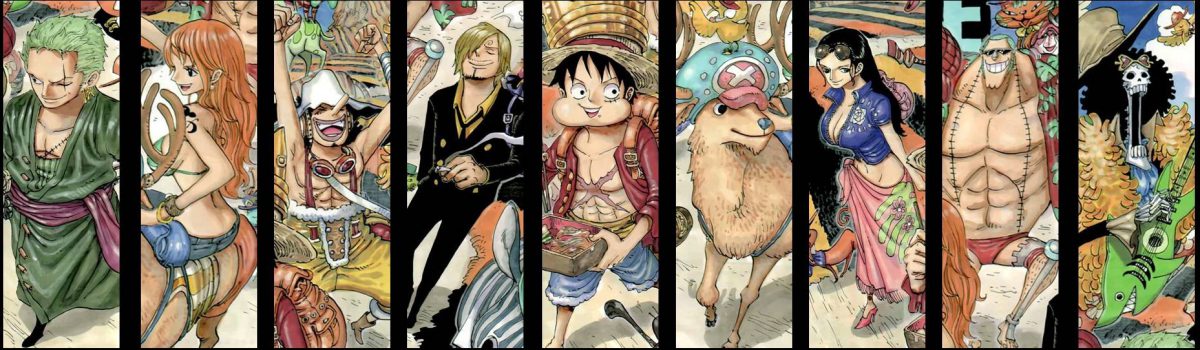

If you are asking what is the peter pan theme in crocodile, the useful answer is not that Crocodile is secretly Captain Hook. It is that he can be read through a Hook-like lens: a powerful man who relies on status, planning, and fear because losing control would destroy the image he built.
This is a fan interpretation, not confirmed One Piece canon. Still, it fits Alabasta surprisingly well. Crocodile creates a crisis with a deadline, turns public fear into a weapon, and tries to make one future feel unavoidable. That gives the arc a strong time-and-control theme.
The short answer: Crocodile as a Hook-like villain
The Peter Pan reading connects Crocodile with Captain Hook, not with Peter Pan himself.
Hook is a pirate captain defined by wounded pride, a theatrical public image, and fear of the ticking crocodile that pursues him. Crocodile shares the parts that matter for a thematic comparison:
- He presents himself as untouchable.
- He hides insecurity behind titles, threats, and careful planning.
- He treats humiliation as dangerous.
- He tries to control the setting before anyone can challenge him.
- His Alabasta scheme runs on mounting pressure and a clear sense that time is running out.
So, what is the peter pan theme in crocodile? It is the idea that Crocodile is trying to outrun vulnerability by becoming the person who controls everyone else’s fate. Like Hook, he needs the performance of power as much as power itself.
For the plot facts behind that reading, see our guide to Crocodile’s powers, Baroque Works role, and Operation Utopia. The theory works best when it stays grounded in what he actually does in Alabasta.
Peter Pan basics: the crocodile, Hook, and the ticking clock
In the familiar Peter Pan story, Captain Hook loses a hand to Peter Pan. A crocodile swallows the hand along with a clock, then pursues Hook. The ticking becomes a warning that the predator is near.
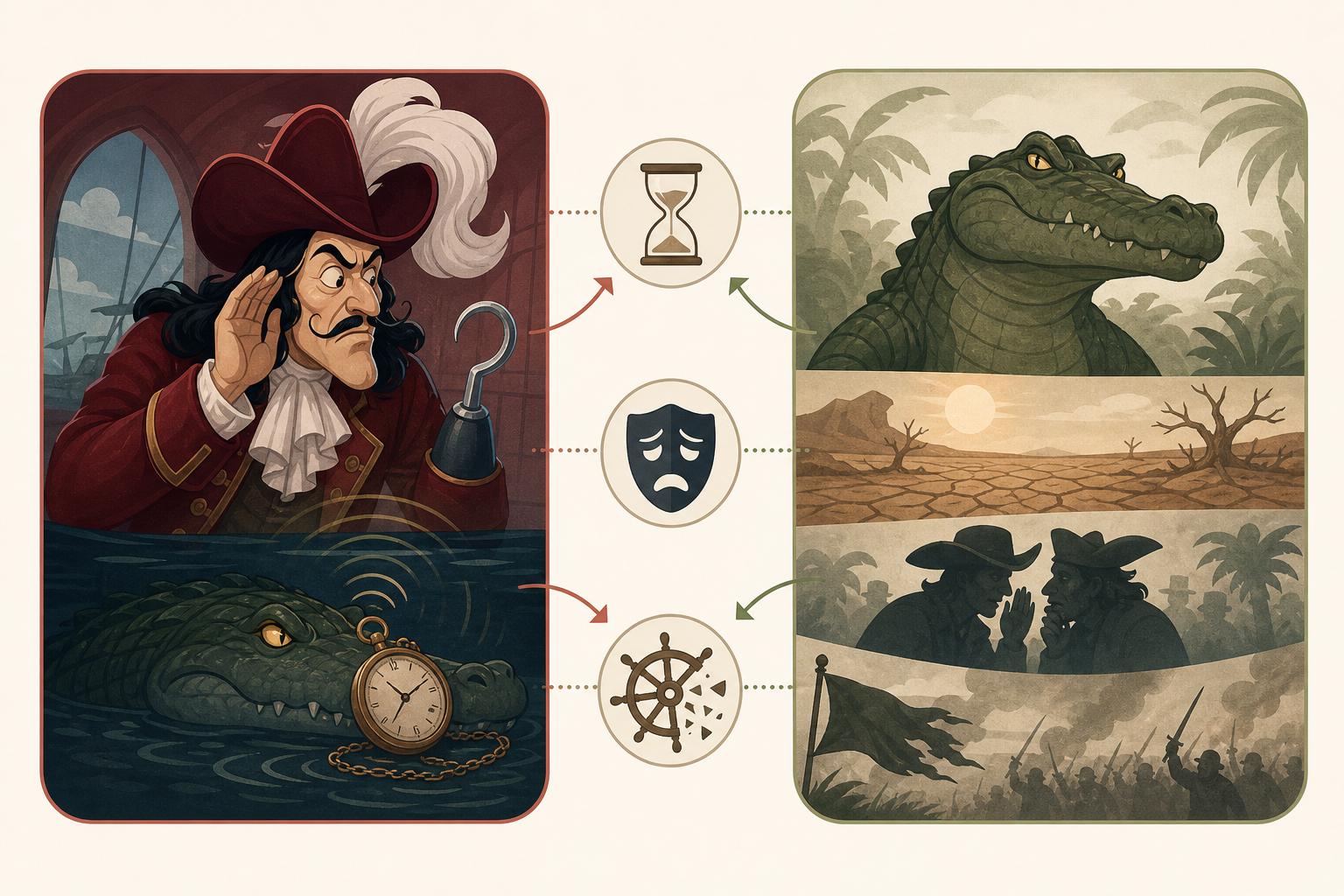
That is why the crocodile is often called Tick-Tock in Disney-related material. The supplied Disney soundtrack listing includes “The Legend of the Croc,” reflecting how central the crocodile is to Hook’s fear in that adaptation (Disney’s Peter Pan soundtrack sequence). Names and details can vary between adaptations, but the symbolic role stays clear: the crocodile makes time feel like a hunter.
What does Captain Hook represent?
A single symbol never has one fixed meaning, but Hook often reads as a character afraid of decline. He values rank, ceremony, revenge, and being taken seriously. The ticking crocodile threatens all of that. It reminds him that his control has limits.
That makes Hook useful for reading Crocodile. Crocodile is not literally chased by a clock or a monster. Instead, the “tick” appears in the pressure of his own operation. His plan depends on events happening before the truth reaches the right people and before Alabasta can pull itself back from collapse.
Why the clock matters more than the crocodile’s name
The strongest parallel is not “there is a character named Crocodile.” It is the clock.
In Peter Pan, the ticking sound tells Hook that consequences are coming. In Alabasta, drought, unrest, mistrust, and the coming civil war create a similar feeling. Crocodile benefits when everyone believes there is no time left to verify claims or find another path.
That is a useful way to watch the arc: notice every moment when panic makes people act before they have enough information.
Four parallels that support the Peter Pan reading
1. Time pressure is part of the villainy
Crocodile does not simply seek treasure or pick fights. He builds a long plan that relies on timing. Baroque Works operates in secret, the public story is carefully managed, and the conflict in Alabasta is pushed toward a breaking point.
This resembles the ticking-clock idea because the pressure is not background detail. It is a tool. The closer the country gets to disaster, the harder it becomes for anyone to slow down and think clearly.
A good rewatch question is: Who gains when people feel they must choose immediately? In Alabasta, the answer is usually Crocodile.
2. Public image matters as much as raw strength
Hook performs authority. His ship, crew, manners, and title all help him look like the captain he wants to be.
Crocodile does something similar, though in a more political way. His public role gives him credibility while his real operation stays hidden. The gap between his image and his agenda is central to why his scheme works.
That split also helps explain why exposure matters so much. A defeated fighter can recover. A mastermind revealed as a fraud loses the story he was using to control others.
For a more spoiler-heavy discussion of Crocodile’s identity and secrets, read Sir Crocodile’s dark secret.
3. The hook is a persona, not just a weapon
Captain Hook’s name turns an injury into an identity. The hook is part of the threat he performs for the world.
Crocodile’s own hook can be read in a similar way. It is a visual warning, but it also fits a character who makes every part of his appearance serve his authority. His titles, controlled voice, and ruthless confidence all send the same message: he is the person in charge.
This does not mean the two characters have the same backstory or purpose. It means both use a striking public persona to keep others off balance.
4. Control fails when people refuse the script
Crocodile plans around fear, scarcity, and predictable self-interest. His mistake is assuming those forces will always decide what people do.
Alabasta pushes back against that assumption. Characters share information, take risks, and keep moving even when the situation looks hopeless. Crocodile’s system is powerful, but it is not absolute.
That is where the Hook comparison becomes most useful. Both villains want a world that stays arranged around their authority. Both are threatened when other people stop playing their assigned roles.
How this theme changes the meaning of Alabasta
The Peter Pan lens makes Alabasta feel less like a simple battle between a kingdom and a criminal organization. It becomes a story about who gets to define the future.
Crocodile manufactures inevitability
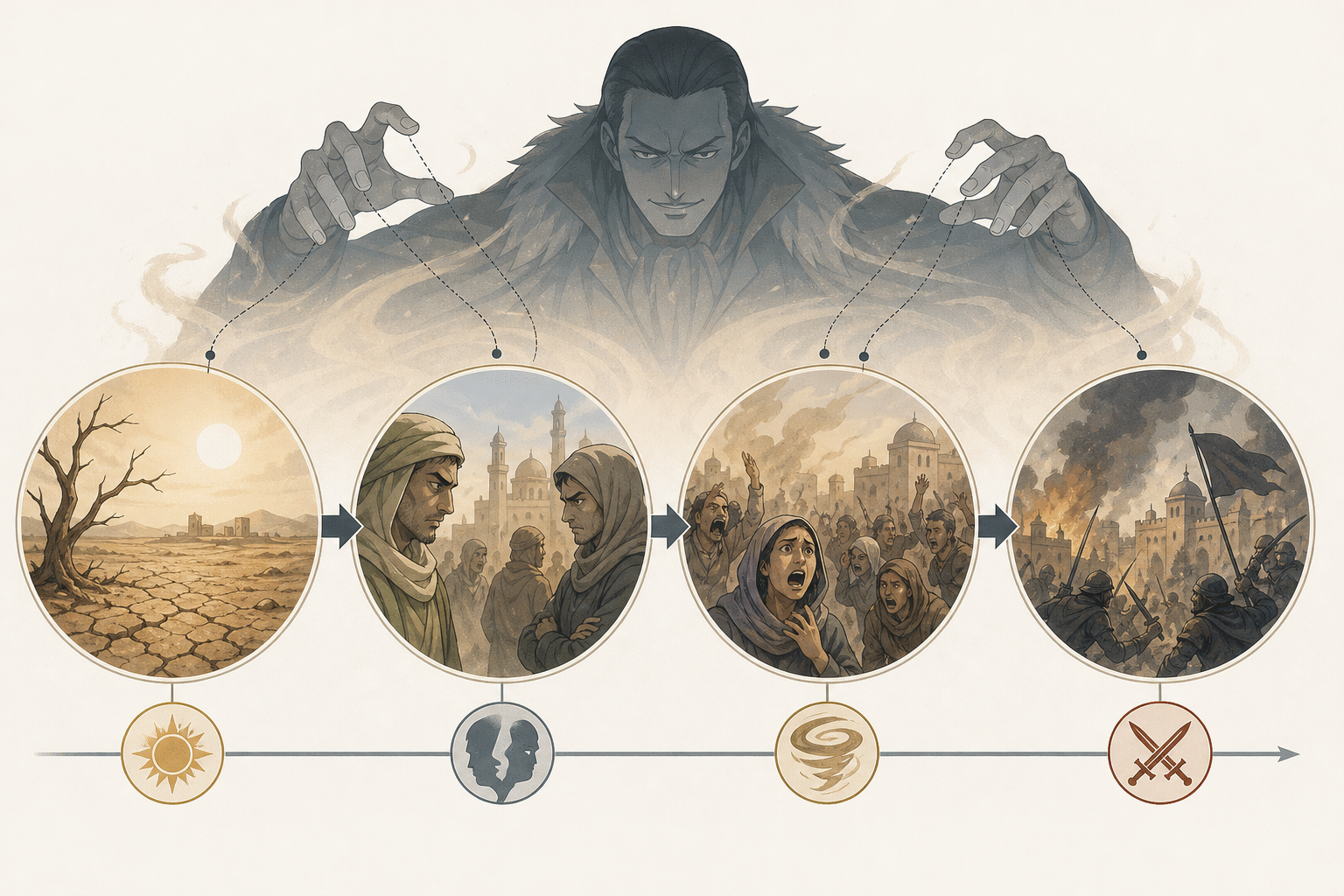
Crocodile’s great weapon is the sense that collapse cannot be stopped. Drought creates desperation. Rumors and violence destroy trust. The civil war becomes easier to trigger because people are already primed to expect the worst.
Under this reading, Crocodile is not merely causing chaos. He is trying to make chaos seem natural and final. If everyone accepts that the country is doomed, he can present his victory as the only possible outcome.
That is the “ticking” element of the arc: not an actual clock, but a crisis designed to make alternatives disappear.
Luffy represents movement, not a one-to-one Peter Pan role
It is tempting to label Luffy as Peter Pan, but that flattens both stories. The comparison is stronger when it stays focused on Crocodile’s behavior.
Luffy does, however, challenge the worldview Crocodile relies on. Crocodile believes people can be managed through fear and incentives. Luffy keeps acting on loyalty and direct conviction, even when that response seems irrational to a strategist.
The clash is therefore control versus freedom, not childhood versus adulthood in any simple sense.
Alabasta also questions official authority
Crocodile’s public standing helps his deception. That makes the arc partly about the danger of trusting a respectable role without examining the person behind it.
This connects with a wider One Piece concern: authority can look stable while causing harm. For another angle on how the series frames power and institutional certainty, see our explanation of Absolute Justice in One Piece.
Where the theory stops: important limits
This interpretation has limits, and those limits make it more useful.
First, there is no supplied evidence that Eiichiro Oda confirmed a direct Peter Pan reference for Crocodile. Treating it as fact would overstate the case.
Second, the Peter Pan crocodile and One Piece’s Crocodile have opposite story roles. The crocodile pursues Hook as an outside force of consequence. Crocodile tries to become the force that controls consequences for everyone else.
Third, Crocodile’s animal name has its own obvious predator imagery. Crocodiles suggest patience, ambush, and danger beneath a calm surface. That imagery already fits his hidden organization and gradual takeover plan without requiring any Peter Pan connection.
The best conclusion is modest: the Hook-and-clock framework adds a convincing layer to Crocodile’s ambition, but it does not replace the text or prove authorial intent.
A practical checklist for spotting this kind of parallel
When a One Piece theory draws on another story, test it before treating it as meaningful:
- Start with the text. What does the character repeatedly do, fear, or control?
- Identify the shared structure. Here, it is time pressure, status anxiety, performance, and control.
- Avoid surface-only matches. A crocodile name alone is not enough.
- Check where the comparison breaks. Differences often reveal more than similarities.
- Separate canon from interpretation. Say “this can be read as” rather than “this proves.”
Using that method keeps theory discussion fun without turning every coincidence into a hidden confirmation.
FAQ
Is the Peter Pan theme in Crocodile confirmed?
No. It is a fan reading, not confirmed canon. The evidence is thematic: Crocodile’s controlled image, his need to manage outcomes, and Alabasta’s constant countdown pressure all resemble aspects of Captain Hook’s relationship with time and fear.
What is the name of the crocodile from Peter Pan?
In Disney-related usage, the crocodile is commonly called Tick-Tock or Tick-Tock Croc because it swallowed a clock. Some versions simply call it the crocodile, so the name can depend on the adaptation.
How did Captain Hook lose his hand?
In the familiar version of the story, Peter Pan cuts off Hook’s hand and a crocodile eats it. The crocodile then keeps pursuing Hook. This is the origin of the clock-and-consequences image used in the Crocodile theory.
What does a crocodile symbolize in this reading?
The crocodile can symbolize a patient threat that waits beneath the surface. In Peter Pan, it also becomes a sign of time catching up with Hook. In One Piece, Crocodile reverses that idea: he wants to be the hidden force that makes everyone else feel trapped by events.
Does this theory change Crocodile’s role in Alabasta?
It does not change the plot, but it changes the emphasis. Crocodile becomes more than a clever schemer. He becomes a villain who tries to control time, public belief, and the future of an entire country because uncertainty is the one thing he cannot tolerate.