
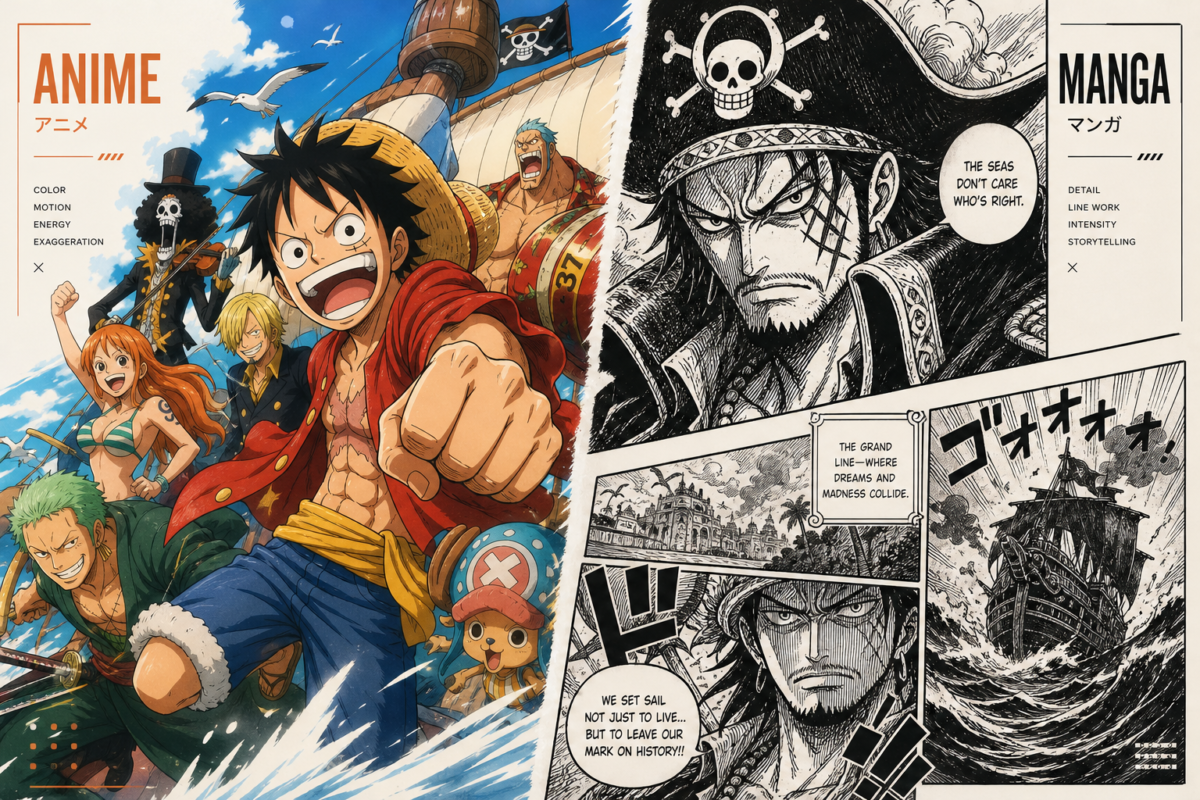
If you want to know how to compare anime and manga character portrayals, start with the same scene in both versions. Do not compare a famous manga panel with a random anime frame. Match the same goal, conflict, action, and outcome first. Then ask what each medium adds or changes.
A character can feel calmer on the page but more emotional in the anime. They may seem more capable in a quick manga fight, or more vulnerable when an episode adds pauses, reaction shots, music, and voice acting. That does not always mean the character changed. It may mean the delivery changed.
This guide gives One Piece fans a simple way to compare those differences. Use it to decide which version fits your taste, not to force a winner.
Plot and portrayal are different things
Plot asks, “What happened?” Portrayal asks, “What impression does this moment give us of the character?”
Two versions can keep the same plot point but create a different feeling.
For example, a character refuses to retreat:
- In manga, one sharp panel may make the choice feel cool and certain.
- In anime, a long pause, a close-up, and a shaky voice may make it feel painful and brave.
- If the episode adds a joke after the scene, the character may seem less severe.
The action is still the same. The emotional weight is not.
When you compare a character, look for these signals:
- Personality: Do they seem patient, reckless, proud, cruel, kind, or awkward?
- Emotional tone: Is the scene tense, funny, sad, triumphant, or light?
- Agency: Does the character drive events or only react to them?
- Competence: Do they seem skilled, prepared, lucky, slow, or overwhelmed?
- Relationships: Who do they trust, protect, fear, tease, or respect?
- Framing: Does the story present them as heroic, threatening, silly, suspicious, or sympathetic?
- Expression: What do posture, faces, movement, color, shadows, and staging tell you before dialogue begins?
After each matched scene, write one sentence. For example: “This version frames Vivi as determined but overwhelmed.” That is more useful than trying to compare every panel with every frame.
Why anime and manga can make the same character feel different
Most differences come from the medium, the adaptation choices, or anime-only material.
Manga lets you set the pace
When you read manga, you control the rhythm. You can stop on a panel, reread a line, or race through a page. Layout, page turns, white space, and panel size still guide your attention, but you decide how long a moment lasts.
Anime sets the rhythm for you. The episode controls each pause, cut, reaction, and close-up. A held shot can make a character look uncertain. A fast cut can make the same character look decisive.
That is why image-only debates are often unfair. A striking manga image and a routine anime screenshot do not show the same thing. One fan discussion makes this point well: picking cool manga images and plain anime images can decide the result before the comparison starts (Reddit discussion). Compare a full story beat instead.
Anime adds performance
Anime adds voice acting, music, color, motion, sound effects, camera work, and editing. These can change how a character lands even when the dialogue and plot stay close to the manga.
A voice can make a character sound tired, smug, gentle, frightened, or commanding. Music can make the same line feel heroic, tragic, comic, or ominous. A long silence can make an emotion clearer than it was on the page.
When a scene feels different, ask this first:
> Did the character change, or did the delivery change?
That question stops many weak comparisons.
Additions and cuts can shift the emphasis
Anime may expand a short scene, add comedy, repeat a flashback, change the order of material, or cut a detail. Some changes only help an episode fill time. Others can change how viewers read a character.
Watch for these common shifts:
- Long reaction shots can make a person seem more shocked, cruel, embarrassed, or unsure.
- Repeated flashbacks can make a motive feel more emotional or more obsessive.
- Added jokes can make a serious character seem warmer or more childish.
- Longer fights can change how skilled, tough, or dangerous someone appears.
- Extra dialogue can explain a motive that manga left unclear.
- Cuts can remove context, soften an action, or reduce an emotional setup.
Do not label every addition “filler” and move on. Some anime-only scenes fit the character well. Others are fun but should not be treated as proof of the manga version’s intent.
If you are moving from the anime to the source material, Read One Piece Manga – All the choices can help you plan that switch.
Start with fair scene alignment
The easiest way to make a bad comparison is to compare non-matching material. Do not put a manga canon scene against an anime-only scene. Do not compare a chapter with an episode full of recap. Do not use your memory of a later reveal to judge an early scene.
Use a small window instead.
Pick one clear story beat
Avoid starting with “this whole arc.” Begin with one moment, such as:
- a choice under pressure;
- a first entrance;
- an argument;
- a battle turning point;
- a reaction after a loss;
- a promise, refusal, or betrayal.
Then find the manga chapters and anime episodes that cover the same core event.
A matched scene should have the same:
- Setting
- Goal
- Conflict
- Outcome
Anything outside that shared core is an adaptation change. Mark it instead of quietly treating it as baseline material.
Use a pacing-correction sheet
A small table keeps your notes honest.
| Scene | Manga location | Anime location | Change | Possible effect |
|---|---|---|---|---|
| S1 | Chapter and pages | Episode and timestamp | Longer reactions | May make the character seem less certain |
| S2 | Chapter and pages | Episode and timestamp | Added joke | May make the character seem more playful |
| S3 | Chapter and pages | Episode and timestamp | Repeated flashback | May make the motive feel heavier |
| S4 | Chapter and pages | Episode and timestamp | Music and acting | May heighten emotion without changing the action |
Use one of these labels for each difference:
- Canon-consistent expansion: The anime adds time or texture but no clear new motive, action, or result.
- Neutral padding: The material mainly extends the runtime.
- Portrayal-altering addition: The anime adds behavior, dialogue, conflict, motive, or relationship detail that changes the impression of the character.
- Compression or omission: The anime shortens or removes manga material, which may reduce context.
This gives you better language than “the anime ruined the character.” You can say, “The longer pause makes this choice read as hesitation, even though the decision itself is the same.”
Control for filler bias
“Filler” is often used for every anime-only moment. It helps to separate three questions:
- Is this scene in the manga?
- If not, does it fit the character we already know?
- Does it change how the audience understands that character?
Score the matched scenes first. Then treat anime-only scenes as a second layer.
For example: “This anime-only scene makes the character seem warmer, and I like it.” That is a fair personal view. It is different from saying, “This proves the manga character is warm in this exact way.”
The 10-part portrayal rubric
Once your scenes match, use the same categories each time. The goal is not fake precision. The goal is to explain what changed.
Score each category from 1 to 5:
- 1 — Meaningfully different: You would describe the character differently after seeing this version.
- 2 — Noticeably different: The core trait is similar, but the framing changes the impression.
- 3 — Mostly aligned: Same character, with a different level of intensity or flavor.
- 4 — Very close: Small presentation changes with little effect on the overall read.
- 5 — Near-identical: The change is mostly cosmetic.
Your note matters more than the number.
1. Dialogue and wording
What does the character say? Are lines shorter, softer, harsher, clearer, or more direct? A small wording change can affect how smart, warm, confident, or threatening a person seems.
2. Emotional intensity
How strong do fear, anger, joy, grief, or resolve feel? Check panel composition, close-ups, pauses, facial focus, and vocal delivery.
3. Comedic framing
Does the adaptation make the moment funnier through reaction cuts, sound effects, timing, or exaggerated faces? Comedy can change whether a character feels cool, scary, immature, or easy to approach.
4. Competence and agency
Does the character make choices and carry them out? Look for added struggle, delayed action, extra rescues, or changed fight choreography. A longer fight can make someone look tougher, but it can also make them look less efficient.
5. Moral framing
How does the scene guide your judgment? Notice who gets the final line, whose pain is shown, and whether the story stresses harm, remorse, courage, or cruelty. This matters a lot with antagonists.
6. Relationships and chemistry
Track warmth, rivalry, fear, trust, and respect. An added conversation can make a bond feel richer. A removed reaction can make that bond feel colder.
7. Visual design and expression
Compare linework, shadows, faces, posture, motion, color, and staging. Manga may use hard ink contrast. Anime may use color, movement, and smoother designs to create a different effect.
8. Voice, music, and acting
This is anime-only, but it often explains why viewers love an anime version. Is the voice calm, playful, harsh, worn down, or commanding? Does the music make a scene feel hopeful, ominous, tragic, or comic?
9. Localization, censorship, and release version
Use this only when you know there is a specific change. Subs, dubs, broadcast edits, and other releases may handle dialogue or violence differently. Check which version you watched before making a broad claim.
10. Narrative focus
How much time does the story give the character? More screen time can add weight. It can also slow a scene so much that a character seems indecisive. Keep this category separate from competence.
Use this template for your own notes:
Character:
Arc / chapter range / episode range:
Matched scene(s):

Scoring key: 1 = meaningfully different | 3 = mostly aligned | 5 = near-identical

1) Dialogue / wording:
2) Emotional intensity:
3) Comedic framing:
4) Competence / agency:
5) Moral framing:
6) Relationships / chemistry:
7) Visual design and expression:
8) Voice / music / acting:
9) Localization / censorship, if relevant:
10) Narrative focus:

Anime-only additions worth noting:
Manga-only details worth noting:
One-sentence takeaway:
Which version fits my preferences, and why:
Weight the categories that matter to you
There is no formula that can prove one portrayal is best for every fan. Your priorities matter.
If you care most about source material and fast story flow, give more weight to matched manga scenes, dialogue, and narrative focus.
If you care most about emotion and atmosphere, give more weight to acting, music, animation, and emotional intensity.
If you care most about power and credibility, focus on competence, agency, action staging, and consequences.
If you care most about relationships, focus on chemistry, emotional intensity, and small interaction beats.
Two fans can watch the same scene and reach different preferences without either one being dishonest. One may prefer the manga’s speed and room for interpretation. Another may prefer an anime performance that makes the feeling hit harder.
The useful question is: What is each version doing well for me?
Compare design as a signal, not a beauty contest
“Which version looks better?” is a fair fan question, but it is not enough for character analysis. Ask what the art is telling you.
A sharper jawline, deep shadows, a low camera angle, or stiff posture can make a character feel older, colder, or more dangerous. Rounder features, brighter colors, loose movement, and broad reactions can make the same character feel younger, friendlier, or more comic.
Anime and manga also use stylized features. Big eyes, unusual hair, simple noses, and varied colors are not reliable real-world ethnicity markers. When people ask why anime characters look “Caucasian,” the better question is usually what the style is trying to communicate: clear expressions, glamour, youth, genre tone, or instant visual recognition.
For a useful comparison, ask:
- Does anime color and lighting soften the character compared with manga ink and shadow?
- Does movement make them seem athletic, clumsy, graceful, or aggressive?
- Does an anime close-up show vulnerability that manga leaves quiet?
- Does limited movement weaken an expression that was strong on the page?
Manga and anime are related but distinct forms, even when they adapt the same story (Sequential Tart). A different visual effect is not automatically a bad adaptation.
Production context explains a change, but does not settle the debate
Anime has episode lengths, recaps, previews, schedules, and a large production team. Manga has its own limits, but it can use page turns and panel rhythm in ways animation cannot copy exactly.
That context can explain longer pauses, repeated information, added comedy, or clearer emotion. It does not mean every change is harmless. Your rubric still asks the key question: what did the choice do to the character?
Try to name the likely purpose:
- Clarity: The anime makes an implied reaction easier to see.
- Pacing: The episode needs to stretch, combine, or rearrange material.
- Tone: The adaptation adds humor, tension, spectacle, or sentiment.
- Compliance: A release changes violence, language, or imagery.
- Character expansion: The anime gives the character new material that may enrich or alter the impression.
This approach leaves room to enjoy what anime brings. One Piece’s animation, performances, music, and shared viewing culture are part of its appeal; Why Is One Piece Anime So Famous? looks at that larger question.
One Piece walkthrough: Vivi and Crocodile
You do not need to compare a whole saga. Pick a few scenes from one contained stretch, and avoid using later spoilers to explain an early moment.
Vivi: leadership, fear, and resolve
For Vivi, choose matched scenes from a pre-Alabasta or early Alabasta stretch where she must persuade someone, make a choice, or endure pressure.
For each scene, note:
- What does Vivi do?
- What does she say?
- How does the manga frame the action?
- What does the anime add through timing, music, close-ups, or reactions?
- Does that addition change your sense of her leadership, fear, or resolve?
An extended pause may make Vivi’s fear easier to see. That can be powerful. It may also make some viewers read more hesitation into the scene than they did in manga.
A fair conclusion could be: “Both versions show resolve. The manga feels brisk and purposeful, while the anime makes the emotional cost clearer.”
That is a comparison. It is not a disguised claim that one version is universally better.
Crocodile: menace, charisma, and control
Crocodile is useful because villain portrayal often depends on aura. In an early Alabasta window, track three things:
- Threat: Does he feel dangerous before action proves it?
- Charisma: Do other characters and the framing make him seem powerful or commanding?
- Intent: Do his words and actions show what he values, or only what he wants?
Anime can build villain presence with music, silence, close-ups, smirks, and shots of other characters reacting. These choices can make Crocodile feel larger than life. They can also feel too heavy if the added emphasis lasts longer than the scene needs.
| Matched moment | Signal | Manga read | Anime read | What may cause the difference? |
|---|---|---|---|---|
| Entrance or reveal | Threat | Controlled and direct | More theatrical | Music and held shots |
| Exchange with another character | Charisma | Cool confidence | More open dominance | Reaction cuts and vocal delivery |
| Statement of intent | Intent | Concise or unclear | More emotionally pointed | Pacing, acting, or added dialogue |
Do not jump to later material to prove your reading of an early scene. Ask what each version has shown at that point.
For help organizing version-by-version Crocodile notes, see the Crocodile Timeline Anime Manga Live Action Guide. For a character-focused look at a major shift in the series, see How Usopp Changed After the One Piece Time Skip.
Which version should you choose?
After you score a few scenes, do not overstate the result. A character can be closer to the manga in dialogue but more affecting in anime because of the performance. An anime-only scene can work well even if it is outside the manga baseline.
Use your notes to make a preference choice:
- Choose manga first if you want faster pacing, control over reading speed, original page composition, and a source-first experience.
- Choose anime first if you value voices, music, movement, color, and a shared viewing experience.
- Use both if you enjoy seeing how different tools shape the same character.
A strong approach is to keep one medium as your default and use the other for a second view. Read the manga for story flow, then watch favorite scenes for acting and music. Or watch the anime first, then read a favorite arc to see what moved faster and what details stood out.
FAQ
How do I compare anime and manga character portrayals without mixing non-equivalent scenes?
Match the same setting, goal, conflict, and outcome. Keep anime-only scenes in a separate note. Do not compare a recap-heavy episode with a short manga sequence as if every second has equal value.
Is the manga always more canon than the anime?
When a manga is the original work, it is usually the clearest baseline for comparing the main story. The anime can still be an official adaptation with valuable performances and additions. Treat manga material and anime-only material as separate categories.
How do I avoid filler bias?
Score matching scenes first. Then describe additions clearly: “This anime-only scene makes the character feel warmer,” or “This extended fight makes them seem less efficient.” You can enjoy an addition without confusing it with the original baseline.
What portrayal differences matter most when switching mediums?
Start with motivation, emotional tone, competence, moral framing, and relationships. These are the areas most likely to change how you describe the character afterward. Fan discussions also often point to tone and action intensity as major differences between formats (Facebook discussion).
Why can anime make a character feel more emotional?
Anime adds acting, music, held shots, motion, and editing. These tools can make feelings more direct without changing the character’s basic motive.
What if I love an anime-only scene?
It still matters to your experience. Call it anime-only characterization and explain why it works for you. That lets you praise the scene without making a claim about the manga version that the manga does not support.
Why are some anime girls drawn as curvy?
Character designs vary by creator, genre, audience, and visual style. A curvy design can be used for glamour, comedy, exaggeration, or simple variety. It is better to judge the specific character and story role than to treat one design trend as a rule for anime as a whole.
What are the “Big 3” of manga?
The phrase usually refers to One Piece, Naruto, and Bleach. It is a fan and media label tied to a period of major shonen popularity, not an official award.
Why is anime popular with Gen Z and younger viewers?
There is no single reason. Streaming, clips, memes, fan communities, cosplay, and a wide range of genres make anime easy to find and discuss. That culture also makes adaptation debates more common, since fans can quickly share manga panels, anime clips, subs, and dubs.
What anime took seven years to make?
That question needs a specific title and source. Production timelines vary, and “seven years” can refer to planning, animation, delays, or the time between announcements and release. Do not use a production claim in a portrayal comparison unless you can verify what the timeline refers to.
Final checklist
Before posting your take, check these points:
- Did I match equivalent scenes?
- Did I separate manga material, anime expansion, neutral padding, and clear portrayal changes?
- Did I name the cause of the difference: dialogue, pacing, framing, music, design, or acting?
- Did I avoid using later spoilers to judge an earlier scene?
- Did I state my preference as a preference, not as a universal fact?
That is the practical core of how to compare anime and manga character portrayals. Match the scene, control for pacing and filler, and identify what truly changed. You will be able to explain why a character feels different across mediums—and choose the One Piece experience you enjoy most.