
The Shichibukai system has already been abolished in One Piece. So the real question is: what would abolishing Shichibukai change in the balance of the seas?
It takes away the World Government’s right to work with selected pirates. The Marines must now hunt former Warlords. Pirates gain new chances to seize territory. And the Government needs a replacement it can control.
That does not make the world safer overnight. It makes the map less stable.
> Spoiler note: This article covers the Reverie decision and later manga and anime developments.
The short answer: power becomes harder to manage
The Shichibukai were pirates with government approval. Their goals were never the same, but the title gave the World Government a useful shortcut. It could tolerate powerful criminals, call on them in war, and point them toward larger threats.
After abolition, three things happen at once:
- Former Warlords become targets. The Marines can no longer leave them alone for political reasons.
- The Marines take on more work. They must deal with threats the Warlords once discouraged or contained.
- Pirate power becomes more fluid. Crews can seek new allies, grab land, and build new networks.
The system had always been full of risks. Crocodile used his title to hide his plan for Alabasta. Doflamingo used his status to protect a criminal network. Abolition ends that official cover, but it also removes a deterrent before the Government can prove its replacement works.
For more on the Marine mindset behind strict enforcement, read What Is Absolute Justice in One Piece?.
Was the Warlord system abolished in canon?
Yes. At the Reverie, the member nations voted to end the Seven Warlords of the Sea program. The choice came after years of proof that the system gave dangerous pirates political protection.
The direct result is clear: former Warlords lose their protected status and become targets for capture. One overview of the decision also describes the program as ending after repeated abuses by its members (VCGamers’ overview of the disbandment).
But ending a title does not make Mihawk, Hancock, Buggy, or the other former Warlords weaker. It changes their legal position. They now have to choose between escape, open conflict, independence, or a new alliance.
Who were the Seven Warlords?
The roster changed over time. When fans ask “who are the 7 warlords,” they often mean this early lineup:
| Warlord | Why the title mattered |
|---|---|
| Dracule Mihawk | His strength alone made him a major deterrent. |
| Crocodile | He used government trust to hide a plan against Alabasta. |
| Donquixote Doflamingo | He mixed royal status, underworld power, and Warlord protection. |
| Bartholomew Kuma | He became closely linked to Government science and military work. |
| Gecko Moria | He built power through an army of zombies. |
| Boa Hancock | She accepted the title in part to protect Amazon Lily. |
| Jinbe | He brought political weight through Fish-Man Island. |
Other holders included Marshall D. Teach, Trafalgar Law, Buggy, and Edward Weevil. This shifting roster was part of the flaw. The Government was not managing one united force. It was making deals with people who had very different aims.
Who benefits most from the power vacuum?
The biggest winners are not always the best fighters. They are the people who can move fast, recruit talent, and turn fear into influence.
Large pirate groups
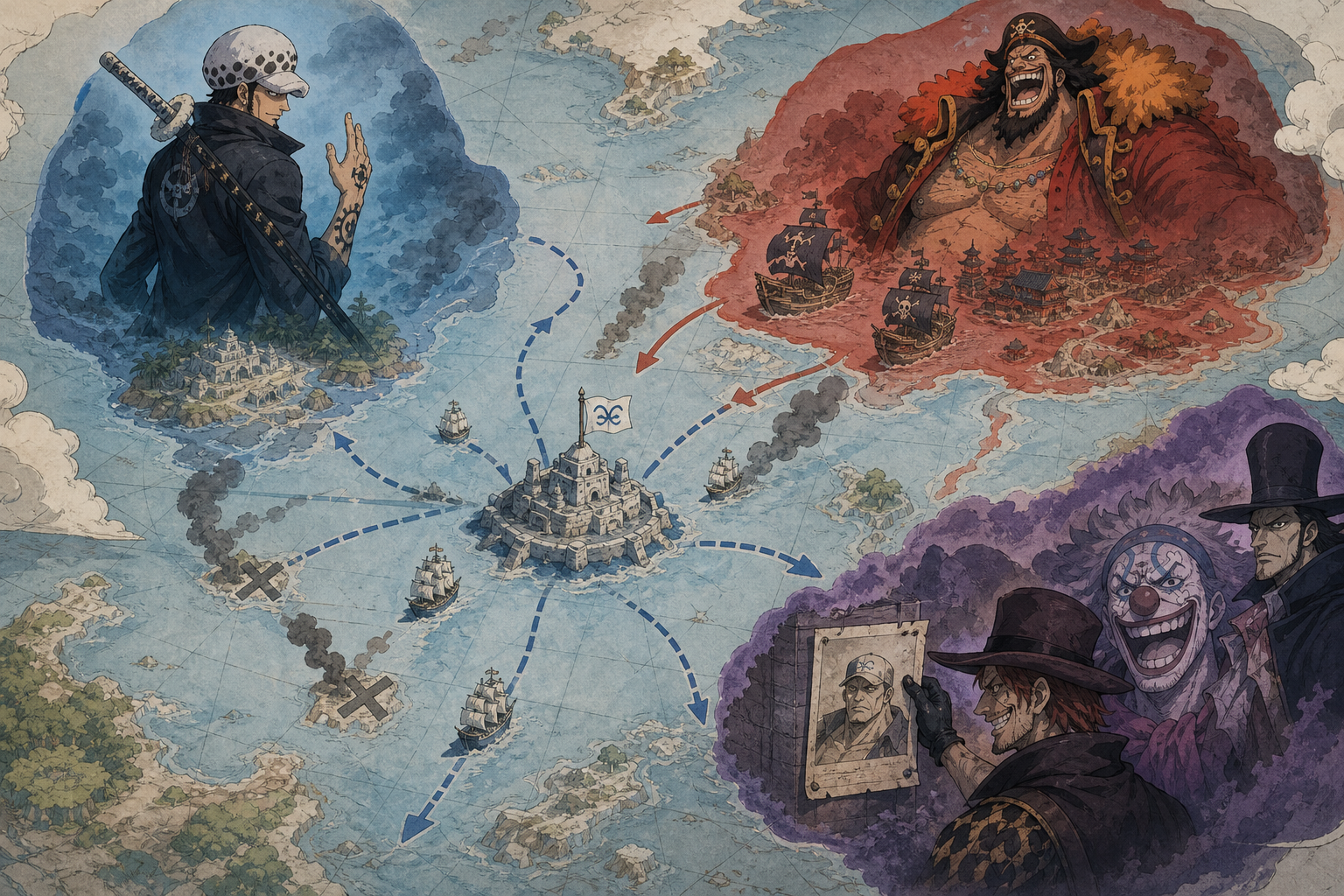
In the Yonko era, power rests on territory, supply routes, crews, and reputation. When a former Warlord loses legal cover, a large pirate group can offer another option: join us, work with us, or become our enemy.
Former Warlords become valuable free agents. Their names can draw recruits, scare rivals, and change the safety of an entire route. Yet these alliances can be weak. A deal made to avoid the Marines may end when a better offer appears.
Cross Guild and reputation-based power
The post-abolition era shows that the Warlord title was not the only way to organize fear. Cross Guild, formed by Buggy, Mihawk, and Crocodile, puts bounties on Marines.
That flips an old incentive. The Marines used bounties to encourage people to hunt pirates. Cross Guild uses the same idea against them. It does not erase Marine power, but it makes enforcement more dangerous.
Crocodile is a good example of why combat strength is only one kind of power. He also has ambition, planning skill, and connections. Doflamingo filled a similar role through the underworld before his defeat in Dressrosa. For Dressrosa context, see One Piece Sabo Kills Burgess – What Really Happened?.
Independent crews and underworld brokers
Small crews can find openings when larger forces are distracted. A local pirate may raid a route, take an island, or sell protection before a Marine force arrives.
Brokers also gain from uncertainty. When official deals collapse, people need information, weapons, safe passage, and introductions to stronger crews. Still, this is risky. The same chaos that helps a small crew can bring a Yonko crew, a Marine fleet, or a former Warlord to its door.
The Marines, but at a price
The Marines gain a clearer legal position. They no longer have to defend a program that protected pirates who abused their status.
But this is an expensive win. They need ships, soldiers, intelligence, and powerful officers to pursue targets that once sat outside normal enforcement. Remote bases and poorly defended islands may feel that pressure most.
Civilians may benefit the least in the short term. A contested sea can mean broken trade routes, more raids, and fewer reliable protectors.
What replaces the Shichibukai system?
The World Government did not end the Warlords without another plan. Its answer is the Special Science Group, or SSG, based on Dr. Vegapunk’s science.
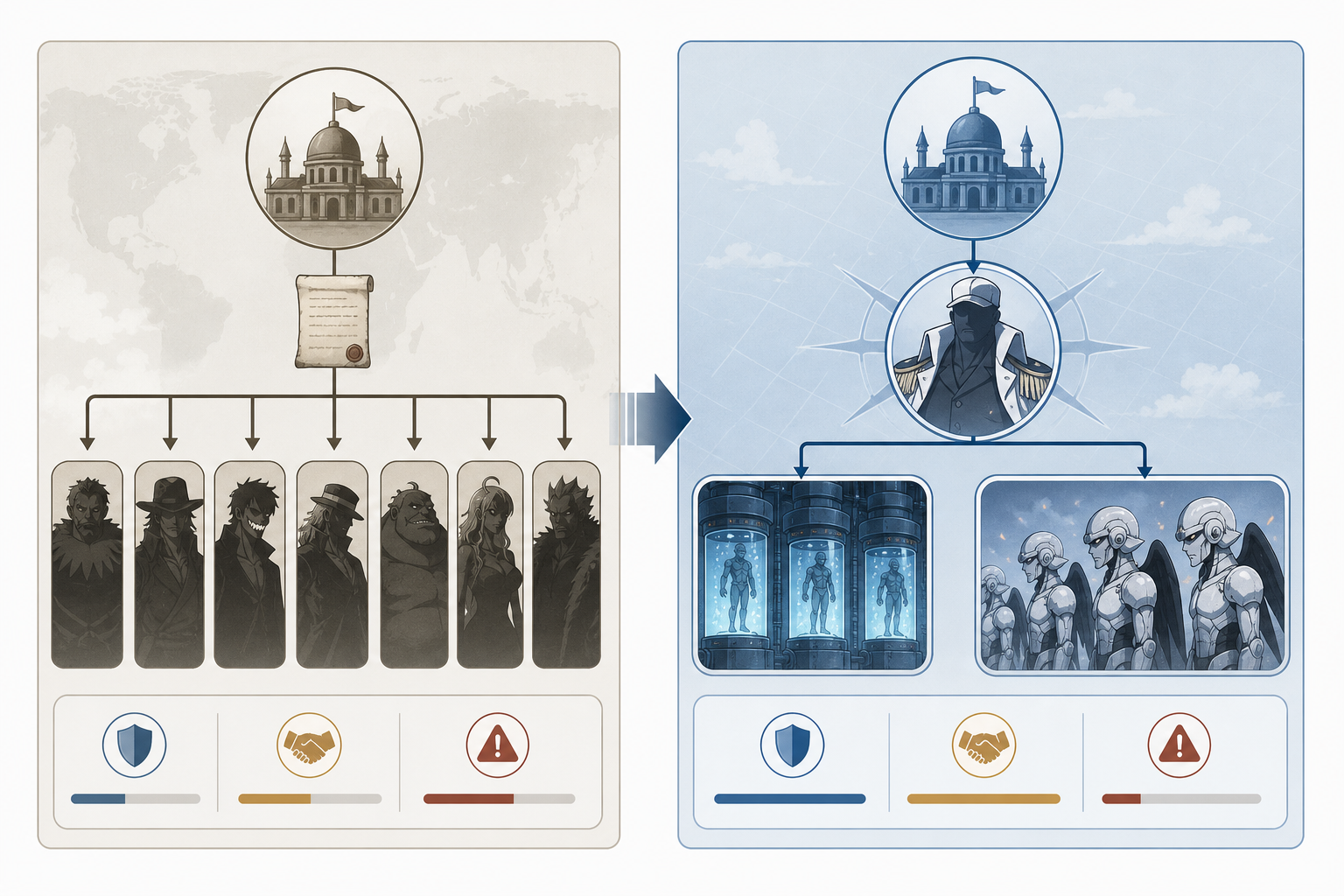
The basic goal is simple: replace pirate allies with forces the Government can command.
SSG and the Seraphim: control instead of contracts
The Seraphim are the clearest new enforcement tool. They are powerful Government weapons with traits tied to former Warlords. They are meant to give the Marines force without having to bargain with pirates.
| Old system: Shichibukai | New direction: SSG and Seraphim |
|---|---|
| The Government makes deals with pirates | The Government relies on science and its own chain of command |
| Loyalty is personal and conditional | Obedience is built into the force |
| Warlords follow private goals | The Government seeks more direct control |
| Political cover can shield crimes | State power can be used more directly |
The new system has its own danger. A Warlord could ignore orders or betray the Government. A controlled weapon raises another question: who gives the orders, and what happens if that power is misused?
More strain on Marine resources
Technology can add firepower, but it cannot be everywhere at once. The Marines still need ships, supplies, intelligence, and officers across a huge world.
That creates an enforcement gap. Some islands may be safer without a predatory Warlord acting as their “protector.” Others may face more raids until the Marines can establish a real presence.
This is the practical answer to what would abolishing Shichibukai change: the Government gives up a morally compromised shortcut for a more direct and costly kind of control.
How former Warlords change the map
Each former Warlord creates a different problem. What matters is not only personal strength, but also the kind of disruption each one can cause.
Mihawk: a target the Marines cannot take lightly
Mihawk does not need a huge crew or a large territory to force a response. Hunting him takes planning and enough force to avoid a costly defeat. That makes him an expensive target.
His independence matters too. He does not fit neatly under a Yonko flag or in a normal pirate crew. In a world built on crews and alliances, that makes him hard to predict.
Boa Hancock: Amazon Lily faces new risks
Hancock’s title helped protect Amazon Lily. When it was revoked, the island became more open to a Government attack and to outside pirates drawn by its location and reputation.
Her case shows that the system was not only about combat. The title could act as a shield for a community. Removing it may fit the Government’s policy, but the people behind the title face the first danger.
Buggy and Crocodile: organization can matter more than rank
Buggy’s public image draws followers. Crocodile brings strategy and ambition. Their partnership shows that ending the Warlords does not reduce pirate influence. It can push powerful pirates to build groups that are more flexible than the old, state-approved system.
That is why the post-Warlord era feels less stable. Power no longer fits neatly into Marines, Yonko, and Warlords. New groups can mix fame, money, and force in unexpected ways.
One Piece arcs in order: the route to abolition
For one piece arcs in order, these are the key stops for the Warlord story:
- Baratie introduces Mihawk and shows the gap between a Warlord and most pirates.
- Alabasta reveals how Crocodile used his title to hide a plot against a kingdom.
- Thriller Bark shows Moria acting with broad freedom despite the harm he causes.
- Sabaody Archipelago highlights the Celestial Dragons and the World Government’s unequal justice.
- Marineford shows the Warlords as part of the Government’s wartime balance.
- Dressrosa exposes Doflamingo’s mix of Warlord status, royalty, and criminal power.
- Reverie brings the vote to abolish the system.
In this order, abolition is not a sudden change of heart. It is the result of a long-running question: can the World Government claim justice while protecting pirates who serve its interests?
For the broader stakes around freedom, Government secrets, and the Pirate King’s dream, see What Is The One Piece? – Plus Theory!.
FAQ
Is Law still Luffy’s ally?
Law and Luffy formed an alliance to take down Kaido. They share history and have worked together when their goals match. But they are not one permanent crew, and neither commands the other. They are best seen as allies when the situation calls for it.
Who is the Shichibukai that Ace defeated?
Ace did not defeat Jinbe in a clear victory. They fought for five days, and the battle ended with no decisive winner. Their later respect for each other matters more than a simple power-ranking answer.
Did abolition make the world safer?
Not right away. It removes official protection for dangerous pirates and ends a deeply flawed system. But it also starts a fight over territory, resources, and allies. In the short term, that can make the seas more dangerous, especially for small islands and weak crews.
What changes most after the Shichibukai are abolished?
Control changes hands. The Government shifts from negotiated pirate power to direct force through the SSG. Former Warlords must defend themselves or form new alliances. That pressure changes Marine goals, pirate behavior, and the safety of the seas.